Strengthening Anti-Harassment Policies and Institutional Protection at UIN Jakarta
Syarif Hidayatullah State Islamic University Jakarta is committed to maintaining a safe, respectful, inclusive, and supportive academic environment by establishing institutional policies and mechanisms to prevent and respond to harassment, particularly sexual harassment and sexual violence.
The University recognises that harassment can undermine personal dignity, equal educational opportunities, academic achievement, psychological well-being, and professional participation. To address these risks, UIN Jakarta has established formal regulations, reporting mechanisms, institutional protection arrangements, and educational programmes aimed at preventing sexual harassment and violence within its academic community.
These measures apply to students, lecturers, and administrative personnel in relevant University activities and contribute to Sustainable Development Goal 10: Reduced Inequalities, particularly Indicator 10.6.11 concerning institutional anti-harassment policies.
1. Establishing a Formal Institutional Anti-Harassment Framework
On 30 June 2022, UIN Jakarta established Rector's Decree Number 573 of 2022 concerning Guidelines for the Prevention and Handling of Sexual Violence. The regulation provides a formal institutional framework for preventing sexual violence, responding to reported incidents, and protecting members of the academic community.
Its provisions address conduct occurring within educational, research, community-service, and other activities under the University's responsibility. The policy covers students, lecturers, and administrative personnel, recognising that individuals from different institutional groups may experience sexual harassment or violence.
It also incorporates principles of non-discrimination and gender justice in the prevention and handling of such incidents. The policy establishes institutional obligations concerning prevention, reporting, protection, case handling, and victim recovery. Through this regulation, UIN Jakarta has formally recognised sexual harassment and violence as institutional concerns requiring structured prevention and response mechanisms.
2. Protecting Students, Lecturers, and Administrative Personnel
UIN Jakarta's institutional protection framework recognises that harassment can affect both educational participation and professional activities. The University's 2022 Rector's Decree establishes safeguards for members of its academic community who experience sexual violence.
These measures are relevant to students, lecturers, and administrative personnel who may require institutional protection when reporting incidents or participating in case-handling procedures.
The University has also reaffirmed the importance of protecting victims, reporters, and witnesses through confidentiality and safeguards concerning their continued education or employment. In an official publication dated 15 June 2025, UIN Jakarta emphasised that individuals reporting sexual violence should not lose educational or professional opportunities because of their decision to report. This position reflects the University's commitment to treating affected individuals with dignity and protecting their participation in academic and institutional activities.
3. Establishing Institutional Reporting and Response Mechanisms
The implementation of anti-harassment policies requires organisational arrangements capable of receiving reports and coordinating appropriate responses. UIN Jakarta has established mechanisms involving the Centre for Gender and Child Studies (PSGA) and its sexual-violence prevention and response task force, known as Rumah, Ramah, Rahmah (ERTRI).
The University's institutional framework provides for receiving complaints, handling reported incidents, and coordinating support for victims. ERTRI was formally established through a Rector's Decree in October 2023 to strengthen the prevention and handling of sexual violence.
Its structure involves representatives from different faculties and the postgraduate school, reflecting the University's effort to coordinate institutional protection across academic units. These arrangements provide a basis for reporting, institutional follow-up, and protection within the University's educational and administrative environment.
4. Supporting Confidentiality and Victim-Centred Protection
The University's anti-harassment framework places importance on protecting individuals who experience or report sexual violence. Official institutional communications emphasise confidentiality, security, and protection against consequences that could disrupt a person's education or employment.
These safeguards are particularly important because harassment may occur in circumstances involving unequal power relations between members of the academic community. A victim-centred approach recognises that individuals reporting harmful conduct may require appropriate institutional assistance and protection during the handling process. Through its regulatory framework and supporting institutional mechanisms, UIN Jakarta seeks to encourage reporting while safeguarding the dignity and rights of affected individuals.
5. Promoting Awareness through Student Orientation
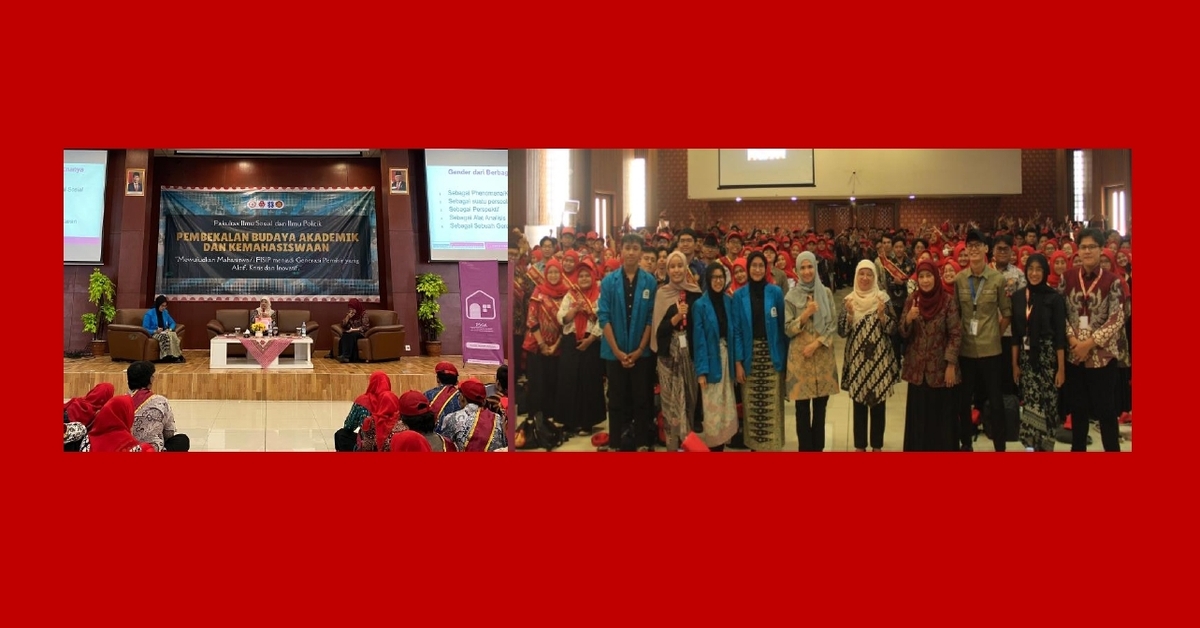
Anti-harassment policies require continued communication and educational outreach to support effective implementation. On 30 August 2024, the Faculty of Social and Political Sciences organised a student-orientation discussion addressing gender equality and the prevention and handling of sexual violence in higher education.
The programme was attended by approximately 500 new students and featured a speaker from Indonesia's National Commission on Violence Against Women. The discussion examined the importance of inclusive academic environments, gender equality, and prevention of harmful conduct within university communities.
Participants were encouraged to recognise violence and discrimination and to contribute to a safer campus culture. By introducing these subjects during new-student orientation, the University demonstrated a practical effort to increase awareness of harassment prevention at the beginning of students' academic experience.
6. Strengthening Coordination through PSGA and ERTRI
UIN Jakarta continued developing its institutional protection mechanisms during 2025. On 23 April 2025, PSGA organised a Focus Group Discussion concerning the development of guidelines for preventing sexual violence.
The discussion involved University leadership, institutional units, students, and representatives of the ERTRI task force. The activity focused on developing guidance for preventing and responding to sexual violence and creating a safe and inclusive campus environment. It also provided an opportunity to strengthen coordination among the University units responsible for policy implementation. These activities demonstrate that the University's anti-harassment efforts include continued institutional review and policy development.
7. Publishing and Disseminating Updated Protection Guidelines
On 16 October 2025, PSGA organised a Focus Group Discussion and officially launched the University's Guidelines for the Prevention and Handling of Sexual Violence. The launch involved University leadership and members of the academic community.
The updated guidance was presented as part of the University's continued efforts to strengthen institutional protection and improve awareness of gender equality and prevention of sexual violence. Such guidance contributes to policy implementation by supporting understanding of institutional responsibilities, prevention measures, and responses to reported incidents. The 2025 programme also reinforced the University's recognition that protection against harassment requires cooperation between academic leaders, students, lecturers, and administrative personnel.
8. Integrating Anti-Harassment Principles into Student Governance
UIN Jakarta's Student Affairs Governance Guidelines for 2025 further document the University's commitment to preventing violence, discrimination, and bullying. Chapter VIII establishes a zero-tolerance commitment toward sexual violence, discrimination, and bullying.
The document identifies PSGA as the principal institutional unit for the prevention and handling of sexual violence. It also outlines the role of the University's prevention and response mechanisms in awareness activities, educational campaigns, reporting, and case handling. The guidelines emphasise the integration of prevention-related education into new-student orientation and student-organisation activities.
These provisions demonstrate how anti-harassment principles are incorporated into the University's student-governance framework. The student-governance guidelines complement the earlier Rector's Decree on sexual violence by explicitly addressing bullying and discriminatory conduct in student-related activities.
9. Strengthening Ethical Standards across the University
UIN Jakarta also maintains formal codes of ethics relevant to different members of its institutional community. These include Rector's regulations concerning student ethics, lecturer ethics, employee ethics, and institutional ethics.
The existence of these regulations demonstrates that the University maintains documented standards of conduct for academic and administrative activities. They provide an additional governance framework alongside the University's specific prevention and handling guidelines for sexual violence. Further examination of the detailed provisions of each code would help establish how comprehensively they address different forms of harassment beyond sexual misconduct.
10. Contribution to SDG 10: Reduced Inequalities
Syarif Hidayatullah State Islamic University Jakarta demonstrates a documented commitment to preventing and addressing harassment through formal institutional policies, reporting mechanisms, and educational programmes. Rector's Decree Number 573 of 2022 establishes the University's principal framework for preventing and handling sexual violence, including safeguards for students, lecturers, and administrative personnel.
The University has also established institutional reporting and response mechanisms through PSGA and ERTRI. These mechanisms have been reinforced through student-orientation programmes in 2024, policy-development discussions in April 2025, and the publication of updated guidelines in October 2025.
The University's 2025 Student Affairs Governance Guidelines further establish a zero-tolerance commitment toward sexual violence, discrimination, and bullying. Together, these policies and institutional arrangements demonstrate UIN Jakarta's commitment to preventing harassment, protecting affected individuals, and maintaining a safer and more inclusive academic environment. Through these measures, the University contributes to Sustainable Development Goal 10, particularly Indicator 10.6.11, by maintaining institutional policies that address harassment and by implementing mechanisms supporting prevention, reporting, and protection within University operations.
Source :
https://fpsi.uinjkt.ac.id/id/berani-melapor-tanpa-takut-kehilangan-masa-depan-uin-jakarta-perkuat-perlindungan-di-kampus
https://asset.uinjkt.ac.id/uploads/fmXyXwZY/2026/04/pedoman-tata-kelola-kemahasiswaan-2025.pdf
https://uinjkt.ac.id/id/wujudkan-kampus-aman-dan-inklusif-psga-uin-jakarta-gelar-fgd-penyusunan-buku-pedoman-pencegahan-kekerasan-seksual
https://uinjkt.ac.id/id/cegah-kekerasan-seksual-psga-uin-jakarta-gelar-fgd-dan-luncurkan-buku-pedoman-ppks
https://fisip.uinjkt.ac.id/index.php/id/pbak-fisip-2024-membahas-kesetaraan-gender-dan-pencegahan-kekerasan-seksual-di-perguruan-tinggi
https://biroauk.uinjkt.ac.id/id/dokumen