Advancing Maritime Technology and Aquatic Ecosystem Protection at UIN Jakarta
Syarif Hidayatullah State Islamic University Jakarta contributes to the protection of aquatic ecosystems through maritime technology collaboration, environmental research, wastewater-treatment practices, and institutional partnerships supporting sustainable marine development. The University recognises that marine and freshwater ecosystems face increasing pressures from pollution, infrastructure development, resource exploitation, and technological change.
Addressing these challenges requires collaboration between universities, research institutions, maritime specialists, government agencies, and communities whose livelihoods depend on aquatic resources. During 2024, UIN Jakarta strengthened its engagement in maritime technology and aquatic ecosystem-related research through collaboration with Raja Ali Haji Maritime University, the National Research and Innovation Agency (BRIN), and environmental management initiatives within its Green Campus programme.
These activities contribute to Sustainable Development Goal 14: Life Below Water, particularly Indicator 14.3.4 concerning technologies and practices that can help minimise or prevent damage to aquatic ecosystems.
1. Strengthening Collaboration in Maritime Technology
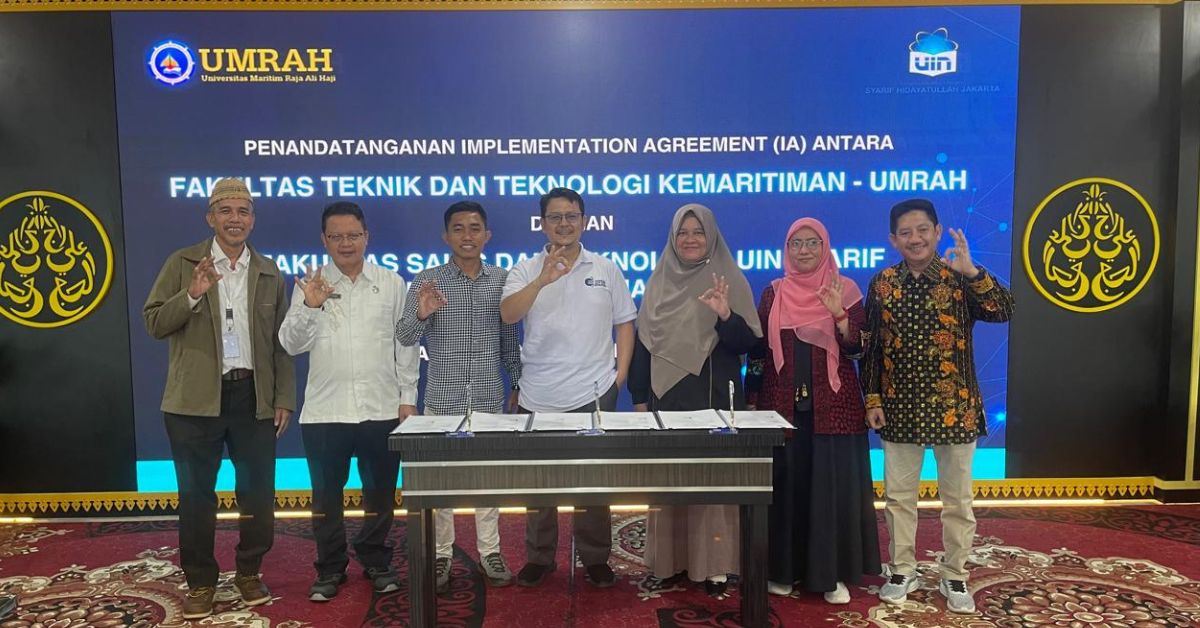
On 11 October 2024, the Faculty of Science and Technology of UIN Jakarta and the Faculty of Maritime Engineering and Technology of Raja Ali Haji Maritime University signed an Implementation Agreement to strengthen collaboration in education, research, and technological innovation. The agreement places particular emphasis on maritime technology and digital transformation.
Through this collaboration, both institutions seek to expand opportunities for joint research, technological innovation, seminars, workshops, and academic cooperation relevant to the maritime sector. The partnership creates an institutional framework through which researchers can explore technologies and practices addressing challenges in maritime environments. The collaboration also highlights the increasing importance of digital technologies, including artificial intelligence, in supporting innovation within maritime activities.
2. Connecting Digital Innovation with Maritime Challenges
The signing of the Implementation Agreement was accompanied by a public lecture on digital transformation and artificial intelligence. The programme discussed the role of AI in improving efficiency, innovation, and competitiveness across different sectors.
In the context of maritime development, digital technologies can support environmental monitoring, decision-making, resource management, and sustainable operational practices. By strengthening cooperation between a science and technology faculty and a specialised maritime engineering faculty, UIN Jakarta contributes to the development of research capacity that can support more environmentally responsible maritime activity.
The published documentation establishes a collaborative framework for maritime technology development, although specific ecosystem-protection technologies resulting from the partnership require further documentation.
3. Researching the Impacts of Development on Coastal Fishing Communities
UIN Jakarta's engagement with aquatic and marine issues also includes collaborative field research. In July 2024, researchers from UIN Jakarta and Indonesia's National Research and Innovation Agency (BRIN) conducted approximately ten days of research in Jenebora, Penajam Paser Utara, East Kalimantan.
The study examined the impacts of Nusantara Capital City development on traditional fishing communities. Researchers interviewed fishermen, community leaders, local government officials, the Penajam Paser Utara Fisheries Department, and representatives of the Nusantara Capital Authority. The study identified concerns relating to fishing access, declining catches, changing livelihoods, and the ability of fishing communities to adapt to large-scale development.
These findings are relevant to sustainable marine management because they demonstrate how infrastructure development can affect coastal livelihoods and the use of aquatic resources.
4. Supporting Better Practices for Fishing Communities
The research also documented government responses intended to support local fishermen. The Penajam Paser Utara Fisheries Department described training, assistance, and infrastructure programmes designed to help fishermen adapt to changing local conditions.
UIN Jakarta researchers emphasised the importance of using research findings as a basis for better government policies affecting coastal communities. Although this research primarily addressed socioeconomic impacts rather than the development of a specific marine technology, it provides important evidence concerning practices that can reduce negative effects on communities dependent on aquatic ecosystems.
The collaboration with BRIN and fisheries authorities strengthens the University's understanding of the relationship between marine development, technology, environmental change, and community welfare.
5. Applying Wastewater Treatment Technology to Prevent Pollution
UIN Jakarta also applies environmental technologies within its own operations.
The University operates wastewater treatment infrastructure designed to process liquid waste generated through campus activities. The treated water can be reused for non-potable purposes, including landscape irrigation and toilet flushing. Wastewater treatment reduces the risk that untreated pollutants will enter surrounding soil and water systems.
By processing wastewater before discharge or reuse, the University contributes to pollution prevention and demonstrates practical application of technology relevant to aquatic ecosystem protection.

6. Integrating Environmental Technology into Green Campus Management
The University's wastewater-treatment activities operate within its wider Green Campus framework.
Water conservation, wastewater management, rainwater harvesting, and responsible water reuse are integrated into institutional environmental-management practices. These technologies support efficient water use while reducing potential environmental pollution.
Such infrastructure demonstrates that technologies capable of reducing aquatic ecosystem damage are relevant not only to marine-sector operations but also to institutional environmental management. The experience provides a practical foundation for further research, innovation, and knowledge exchange concerning pollution-control technologies.
7. Building Capacity for Sustainable Maritime Innovation
The collaboration between UIN Jakarta and Raja Ali Haji Maritime University provides an important platform for future development of environmentally responsible maritime technologies. Potential areas of collaboration include environmental monitoring, digital maritime systems, artificial intelligence, pollution control, sustainable fisheries, and technology supporting coastal-community resilience.
The 2024 agreement establishes institutional cooperation in maritime technology and research.
Further documentation of jointly developed technologies, pilot projects, industry partnerships, or environmental-monitoring systems would strengthen evidence of direct technological application for marine-industry ecosystem protection.
8. Supporting Evidence-Based Marine Management
The University's marine-related research and environmental technology initiatives demonstrate complementary approaches to aquatic ecosystem protection. Technology collaboration supports innovation.
Field research provides evidence concerning development impacts on coastal communities. Wastewater treatment demonstrates practical pollution-control technology. Together, these activities support greater awareness of how technological and development decisions affect aquatic ecosystems and the communities dependent upon them.
Such interdisciplinary approaches are important for strengthening sustainable marine development and reducing environmental risks.
9. Contribution to SDG 14: Life Below Water
Syarif Hidayatullah State Islamic University Jakarta demonstrates increasing engagement in technologies, research, and practices relevant to aquatic ecosystem protection. In October 2024, the Faculty of Science and Technology strengthened collaboration with the Faculty of Maritime Engineering and Technology of Raja Ali Haji Maritime University to advance research and technological innovation in the maritime sector.
In July 2024, UIN Jakarta researchers collaborated with BRIN to investigate the impacts of national development on traditional fishing communities and engage directly with fisheries authorities. The University also applies wastewater-treatment technology to reduce pollution and support water reuse within its Green Campus operations. Together, these initiatives demonstrate an institutional foundation for developing and applying technologies and practices relevant to reducing damage to aquatic ecosystems and supporting more sustainable maritime development.
Further evidence of technologies directly deployed with marine-industry partners would strengthen the University's submission under SDG 14 Indicator 14.3.4.
Source :
https://fst.uinjkt.ac.id/id/penandatanganan-ia-fttk-umrah-dan-fst-uin-jakarta-disertai-kuliah-umum-dekan-fst-uin-jakarta-tentang-digital-transformation-with-ai
https://www.uinjkt.ac.id/index.php/id/fst-uin-jakarta-dan-fttk-universitas-maritim-raja-ali-haji-sepakati-kerja-sama-
https://uinjkt.ac.id/id/peneliti-uin-jakarta-dan-brin-kaji-dampak-pembangunan-ikn-bagi-kehidupan-nelayan-lokal
https://uinjkt.ac.id/en/water