
What Ego Must We Slaughter? Moving from Ritual to Global Solidarity
Ahmad Tholabi
(Professor at UIN Jakarta)
As systemic conflicts and the 'polycrisis' deepen from Gaza to Sudan, the ritual of the season demands a definitive transition from temporary charity to structural global solidarity.
Eid al-Adha 1447 H arrives at a juncture when the international community is bearing the weight of deep, compounding humanitarian wounds. In the Gaza Strip, Sudan, and numerous other conflict zones, millions of civilians are not participating in a celebration; they are navigating the brutal realities of survival amidst ruins, acute food insecurity, and institutional uncertainty.
Children are losing their homes and their access to education before they can fully comprehend the concept of a future. For countless displaced families, the calendar is no longer marked by festive milestones, but by a desperate calculus of tracking the remaining food rations required to survive until the next dawn.
In this grim theater, Eid al-Adha stands as a stark mirror reflecting the conscience of modern civilization. We find ourselves in an era that has achieved unprecedented technological and digital advancements, yet simultaneously demonstrates a catastrophic failure in safeguarding basic human empathy and international humanitarian law.
Social scientists and international observers increasingly classify the current global landscape as a polycrisis; it is a state where distinct, interlocking crises converge to exponentially worsen one another. Armed conflicts trigger structural food scarcity; economic instability accelerates climate degradation; and systemic political paralysis breeds a pervasive crisis of institutional trust. The modern world appears to have lost the moral anchor required to balance power and technology with fundamental human rights.
Paradoxically, while global hunger metrics spike and millions face starvation, global military expenditures continue to hit historic highs year after year. Trillions of dollars are seamlessly funneled into manufacturing advanced weaponry and prolonging protracted conflicts. Modern civilization does not suffer from a scarcity of resources to destroy; it suffers from a scarcity of moral courage to save.
Dismantling the Ego
The historical narrative of the Prophet Ibrahim (Abraham) is frequently oversimplified, reduced merely to the dramatic moment of physical sacrifice. However, the foundational essence of the narrative does not lie in the instrument of sacrifice, but in the ultimate triumph of human conscience over the collective ego.
Ibrahim demonstrated that authentic sacrifice demands the courage to relinquish deep-seated self-interest for a higher, universal moral good. What was surrendered was not merely a beloved son, but the illusions of absolute ownership, human arrogance, and the destructive tendency to place the self at the center of the universe.
It is precisely here that modern governance faces its most acute deficit: an inability to sacrifice narrow ambitions. Wars persist because geopolitical actors refuse to surrender their territorial and strategic ego. Global inequality widens because short-term economic greed is systematically prioritized over social justice and structural equity. Even in daily civilian life, modern culture has trapped itself in a cycle of relentless accumulation—prioritizing hoarding, dominance, and the preservation of privilege at all costs.
In his seminal texts, philosopher Seyyed Hossein Nasr noted that the primary crisis of modernity is neither technological nor economic, but profoundly spiritual. In Man and Nature (1968), Nasr argued that modern humanity has stripped the sacred dimension from life, treating the environment, fellow human beings, and even spiritual traditions purely as instruments for exploitation.
The sacred texts of Islam explicitly reinforce this, stating that it is neither the meat nor the blood of the sacrifice that reaches the Divine; rather, it is the quality of one's consciousness and moral devotion. This serves as a vital reminder that faith cannot be hollowed out into mere symbolism. Sacrifice demands a measurable, physical alignment with the marginalized.
"It is neither their meat nor their blood that reaches Allah, but it is piety from you that reaches Him."
— Qur'an 22:37
This presents the ultimate paradox of contemporary religious and social spaces. While public expressions of piety and digital markers of faith are at an all-time high, structural social justice is visibly fracturing. Grand institutions and places of worship stand monumental, yet localized empathy is thinning. Digital feeds are saturated with narratives of righteousness, yet society has rapidly normalized the catastrophic suffering of distant communities.
The late sociologist Zygmunt Bauman aptly conceptualized this as the advent of "Liquid Modernity": a state where society loses its solid, enduring moral bonds. In a hyper-accelerated, visual culture, human tragedy is instantly commodified into transient information streams. We consume graphic accounts of catastrophe daily, yet we are slowly losing the cognitive capacity to genuinely feel the weight of those wounds.
From Performative Ritual to Sustainable Solidarity
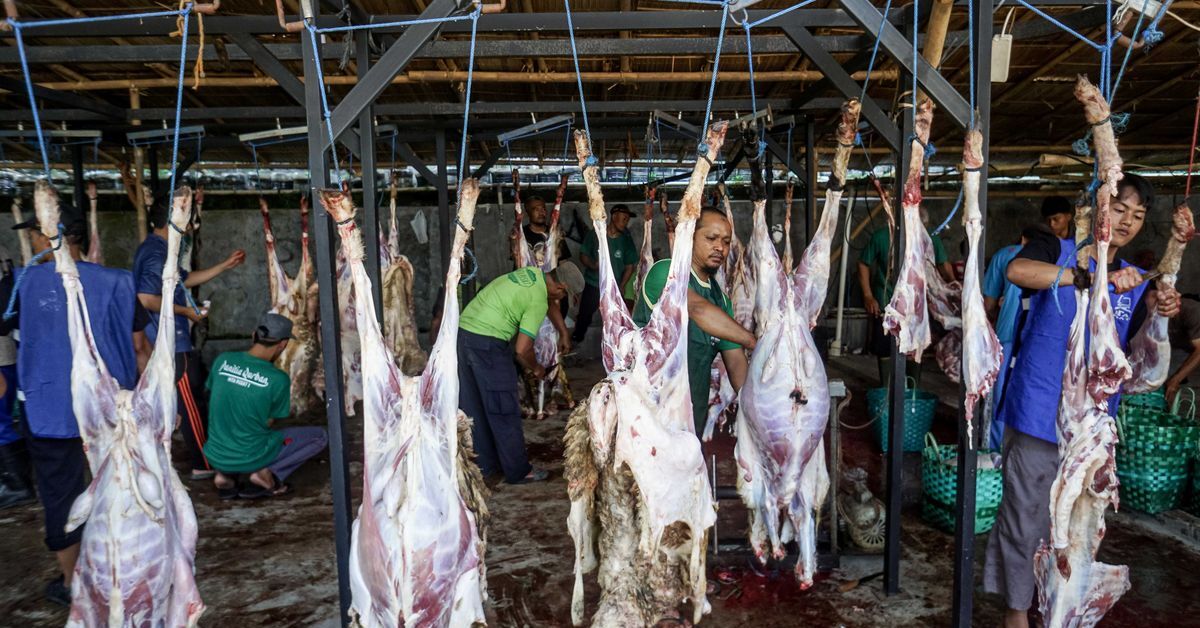
By design, the distribution of the sacrifice carries a radical egalitarian mandate. The resources cannot be hoarded by the affluent; they must be distributed systematically to families, neighbors, and critically, to those facing systemic poverty. It is a mandatory mechanism of wealth redistribution.
Yet, in a hyper-visualized world, this substantive mandate risks being hijacked by performative social status. The size of the sacrifice is displayed; documentation is excessively broadcasted across digital platforms; and quiet piety is displaced by visual currency.
True solidarity, however, cannot survive on transient acts of seasonal charity. International thinkers like Tariq Ramadan have consistently argued that the core ethics of faith demand the courage to establish structural justice in the public sphere. Rituals lose their systemic validity when they serve merely as cultural identifiers while failing to ignite genuine social transformation.
Therefore, as the knives are raised this season, the most fundamental question facing humanity is no longer about the volume of the sacrifice. The critical question is: What collective ego must we dismantle?
-
For Global Leaders: It demands the immediate cessation of geopolitical expansionism that stretches active warfare.
-
For Economic Titans: It requires a definitive halt to the unregulated accumulation of capital that enforces systemic inequality.
-
For Protected Societies: It dictates a conscious awakening from the comfortable apathy that reduces foreign human suffering to mere background noise.
Ultimately, the greatest tragedy of the modern era is not merely the occurrence of war or famine. The absolute tragedy is the psychological adaptation of humanity—the moment we become thoroughly accustomed to witnessing atrocities without experiencing a profound moral disruption.
The calls of the Takbeer echoing across borders this week must serve as a global alarm. They remind us that no geopolitical objective, no economic metric, and no technological ambition is greater than the sanctity of human life. The true legacy of Ibrahim is the absolute subordination of the self to the survival and dignity of humanity. When the world stands to observe this day, our baseline humanity is on trial. We must free ourselves from the ego of indifference, ensuring that our conscience awakens before the window for intervention closes forever.
This article was published on Kompas in May 28, 2026.