
Unpacking Harvard Doctoral Research on Global Pilgrimage, PPIM UIN Jakarta Seminar Dissects the Commercialization, Bureaucracy, and Spiritual Traditions of Hajj
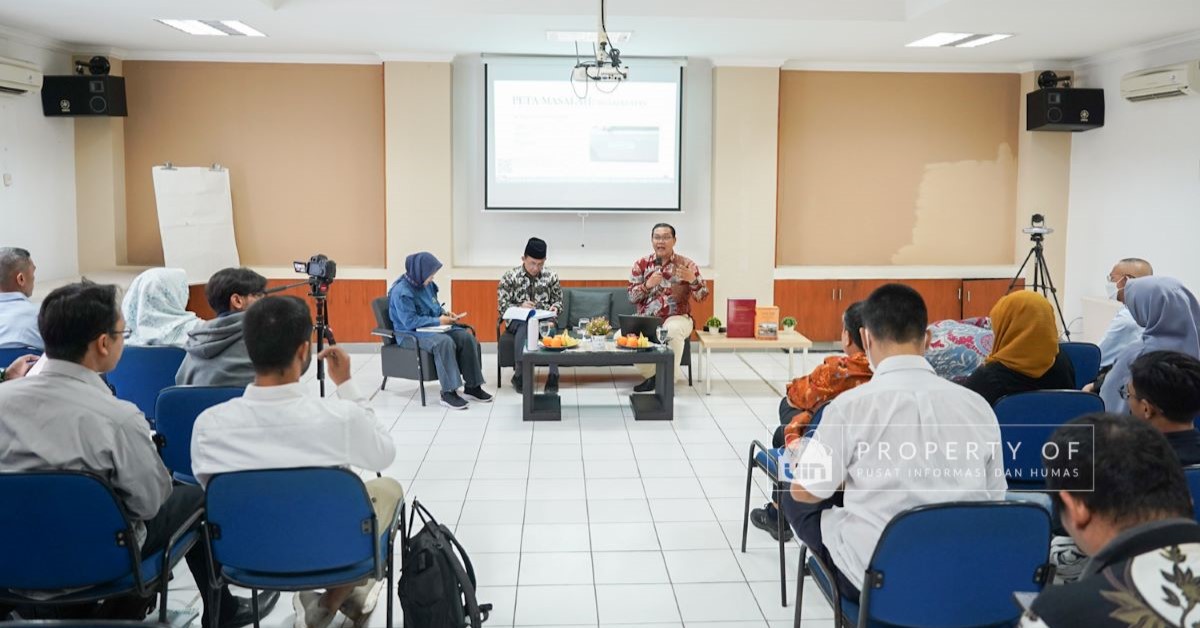
JAKARTA, UIN Online News – Examining the complex intersections of spiritual mobility, market forces, and state regulation, the Center for the Study of Islam and Society (PPIM) at UIN Syarif Hidayatullah Jakarta hosted the 53rd PPIM Seminar Series on Wednesday, July 29, 2026. Titled "The Face of Hajj Today: Between Tradition, Bureaucracy, and Commercialization," the academic forum featured a critical book discussion on The Hajj, Reinvented: Pilgrimage, Mobility and Inter-State Organizations in Saudi Arabia and Indonesia, authored by PPIM researcher Dadi Darmadi, Ph.D.
Derived from Dr. Darmadi's doctoral dissertation at Harvard University, the research applies state anthropology and mobility frameworks to analyze how Indonesian Hajj governance is continuously reshaped through bilateral dynamics with Saudi Arabia.
Presenting his empirical findings before hybrid attendees, Dr. Dadi Darmadi explained that the modern pilgrimage experience cannot be isolated as a purely religious ritual. Instead, it operates at the crossroads of three powerful, competing forces.
"Three major layers interact continuously: grassroots spiritual traditions, state bureaucratic machinery, and market commercialization," Dr. Darmadi highlighted. "These forces negotiate, overlap, and frequently collide. The contemporary face of the Hajj is the direct product of these ongoing structural negotiations."
Dr. Darmadi noted that key public policy decisions such as quota allocations, yield management by the Hajj Financial Management Agency (BPKH), and cost determinations (BPIH) serve as evolving arenas of political and economic negotiation rather than static administrative rules.
Adding deep historical context, Senior UIN Jakarta Philologist Professor Oman Fathurahman examined 19th- and early 20th-century religious manuscripts. His research demonstrates that Archipelago-Makkah pilgrim networks (Sheikh Haji) operated efficiently long before the emergence of modern state bureaucracies, with traditional religious scholars acting as enduring spiritual anchors.
Addressing contemporary policy consequences, Subkhani Kusuma Dewi, Ph.D., from UIN Sunan Kalijaga Yogyakarta, highlighted how bureaucratic quota caps have created extreme waiting periods of 30 to 50 years in various Indonesian regions. Consequently, this bottleneck has driven a massive market shift toward the Umrah (minor pilgrimage) economy as an adaptive social response.
By combining Harvard-backed anthropological research, philological manuscript analysis, and public policy critiques, PPIM UIN Jakarta continues to establish itself as an international authority on global Islamic studies and pilgrimage governance.
(Khoirillah/Zaenal/Arifin/Photo: Tiara Abdhie)