
UIN Jakarta's Halalbihalal, Gus Faiz Highlights the Difference Between the Essence of Religion and Cultural Instruments
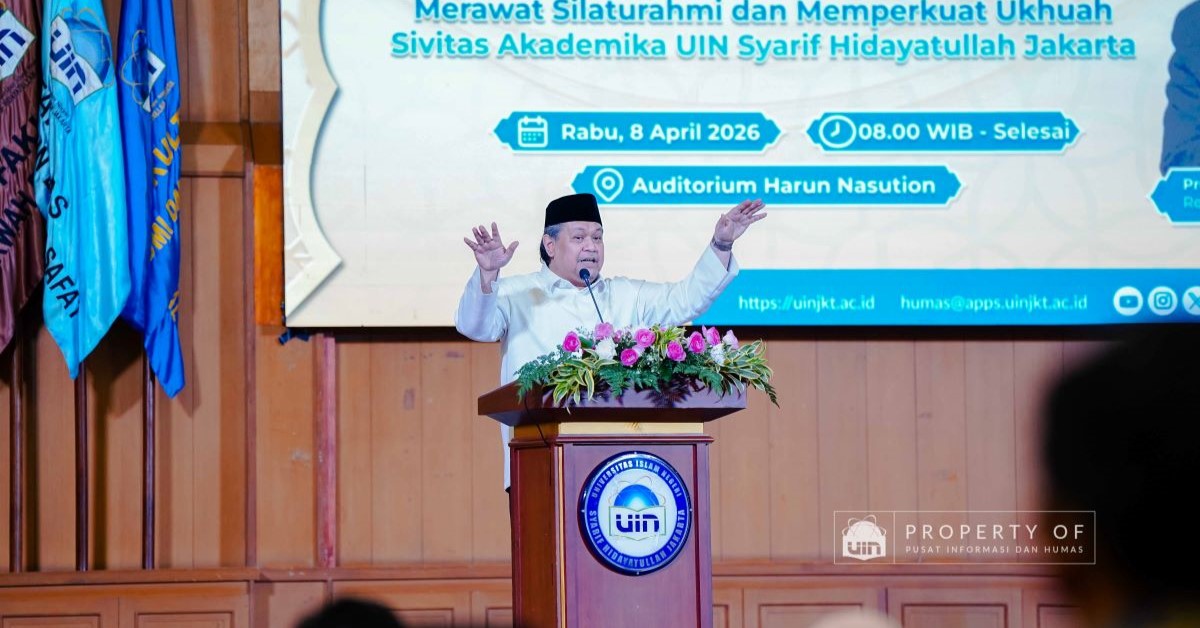
Harun Nasution Auditorium, UIN Online News — Chairman of the Jakarta Chapter of the Indonesian Ulema Council (MUI DKI Jakarta), K.H. Muhammad Faiz Syukron Makmun, Lc., M.A., widely known as Gus Faiz, emphasized the importance of distinguishing between the core principles of Islamic teachings (ushul) and the cultural instruments used to communicate them. He delivered the message during UIN Syarif Hidayatullah Jakarta's Halalbihalal gathering held at the Harun Nasution Auditorium on Wednesday (8 April 2026).
During his lecture, Gus Faiz shared a humorous yet insightful story from his visit to Masjid Gedhe Kauman in Yogyakarta. He recalled being intrigued by a decorative ornament resembling the salak (snake fruit) displayed near the mosque entrance. His curiosity was answered by a mosque caretaker, who referred to it as the "Hadith of the Salak."
"It turned out to be a reminder of the hadith 'Man salaka ṭarīqan yaltamisu fīhi 'ilman'—'Whoever follows a path in pursuit of knowledge.' Four hundred years ago, many Javanese people may have found it difficult to memorize the Arabic text, but whenever they saw the salak symbol, they were reminded of the obligation to seek knowledge," he explained.
According to Gus Faiz, cultural symbols such as low doorways that encourage visitors to bow in humility (tawadhu') or ornaments representing everyday objects serve as educational tools that help people grasp the essence of religious teachings without becoming preoccupied with complex textual debates.
Addressing the challenge of engaging Generation Z, he stressed the importance of adapting educational methods to contemporary audiences. He illustrated this by describing how he once motivated high school students through the dramatic comeback victory of Manchester United in the 1999 UEFA Champions League Final.
"If I had started with Ihya' Ulum al-Din, it might have taken much longer to capture their attention. But through what I jokingly call the 'Book of Manchester,' they immediately understood that just three minutes can change destiny—and that is precisely why Islam teaches us never to lose hope," he said.
He added that he has even used scenes from Tom and Jerry to explain prophetic traditions about the dangers of injustice to elementary school students, demonstrating that effective teaching often depends on relatable examples rather than rigid methods.
Gus Faiz further encouraged the UIN Jakarta academic community to carefully distinguish between the objectives of Islamic teachings and the means used to achieve them. Using the examples of siwak versus a toothbrush and camels versus modern vehicles, he argued that the purpose of religious guidance should always take precedence over its historical instruments.
"The siwak is a tool; the real objective is oral hygiene. If the Prophet were living today, perhaps he would travel in an Alphard instead of a camel, because the camel was the 'Alphard' of its time. We should not become absorbed in debating the tools while forgetting the true purpose of the teachings themselves," he emphasized.
Concluding his address, Gus Faiz expressed his hope that UIN Syarif Hidayatullah Jakarta would continue serving as a center of Islamic scholarship capable of engaging constructively with the challenges of the modern world. He encouraged both lecturers and students to cultivate Islamic scholarship that is thoughtful, compassionate, and able to distinguish between enduring religious principles (ushul) and flexible cultural instruments.
"Let us present Islam in a way that brings ease to people's lives and helps them understand and practice their faith, as long as it remains faithful to the fundamental principles of the Sharia," he concluded.