
UIN Jakarta’s Faculty of Psychology Promotes Paperless Office to Accelerate Digital Transformation
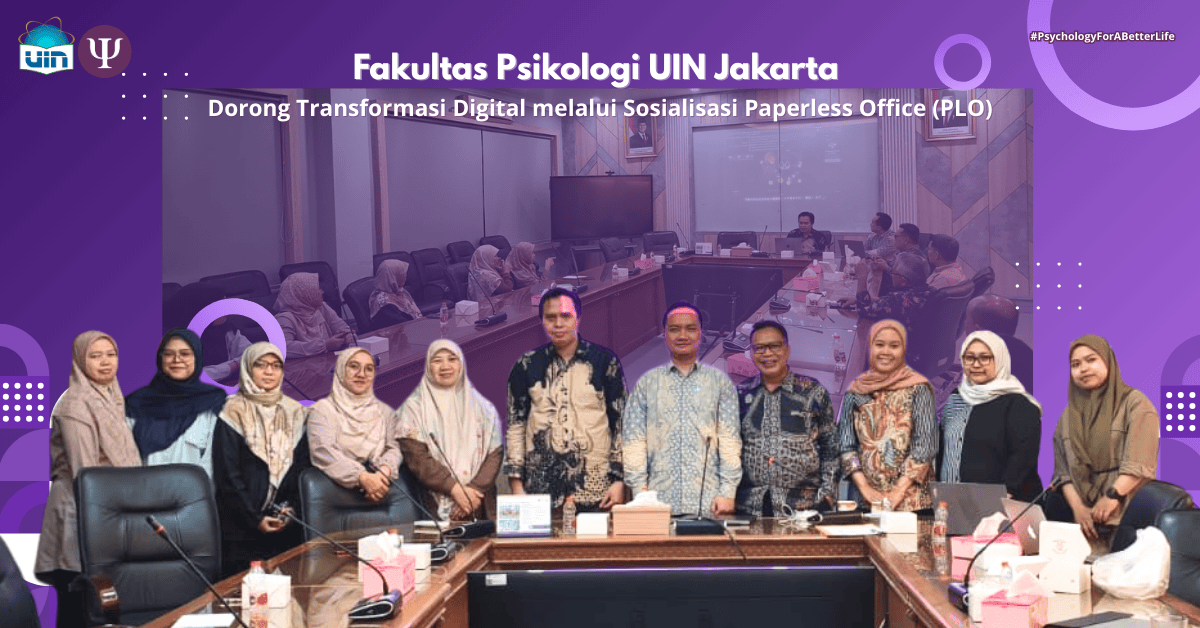
Jakarta, UIN Online News — The Faculty of Psychology at UIN Syarif Hidayatullah Jakarta continues to advance its commitment to modern, efficient, and sustainable institutional governance by introducing its Paperless Office (PLO) system. The socialization program, conducted in collaboration with the university’s Center for Information Technology and Database (Pustipanda), took place at the Faculty of Psychology’s Main Meeting Room on Friday (23/01/2026).
The event brought together faculty leaders, including Vice Dean for General Administration Mulia Sari Dewi, M.Si., Psychologist, Head of Administrative Affairs Feni Arifiani, S.Ag., M.H., Head of the Undergraduate Psychology Program M. Avicenna, Ph.D., Psychologist, Secretary of the Undergraduate Program Desi Yustiari Muchtar, M.Psi., Psychologist, along with administrative staff across the faculty.
Dean of the Faculty of Psychology, Dr. Yunita Faela Nisa, M.Psi., Psychologist, emphasized that implementing the Paperless Office system is a strategic step toward strengthening professional and sustainable institutional management.
“The implementation of the Paperless Office system reflects the Faculty of Psychology’s commitment to supporting UIN Jakarta’s digital transformation. Beyond improving administrative efficiency, it also fosters a more organized, transparent, and sustainable work culture,” she said.
The Paperless Office initiative is part of UIN Jakarta’s broader digital transformation agenda aimed at enhancing administrative services through integrated digital platforms. By digitizing document management and correspondence, the system is expected to accelerate administrative processes, improve archival management, ensure greater accountability, and significantly reduce paper consumption in support of the university’s sustainability goals.
During the session, the Pustipanda team provided comprehensive technical guidance on operating the Paperless Office platform, including digital document workflows, online approval mechanisms, electronic archive management, and data security protocols. The training was designed to equip participants with the practical knowledge required to implement the system effectively within their respective units.
An interactive discussion followed the presentation, allowing participants to raise questions, share feedback, and discuss potential challenges in adopting the digital system for everyday administrative operations. The exchange of ideas is expected to support the continuous refinement and successful implementation of the platform across the faculty.
Through this initiative, the Faculty of Psychology reaffirms its commitment to fostering a collaborative, adaptive, and digitally driven working environment. Supported by Pustipanda and the active participation of faculty members and administrative staff, the faculty is optimistic that the Paperless Office system will become an integral part of a modern, professional, and globally competitive university administration.