
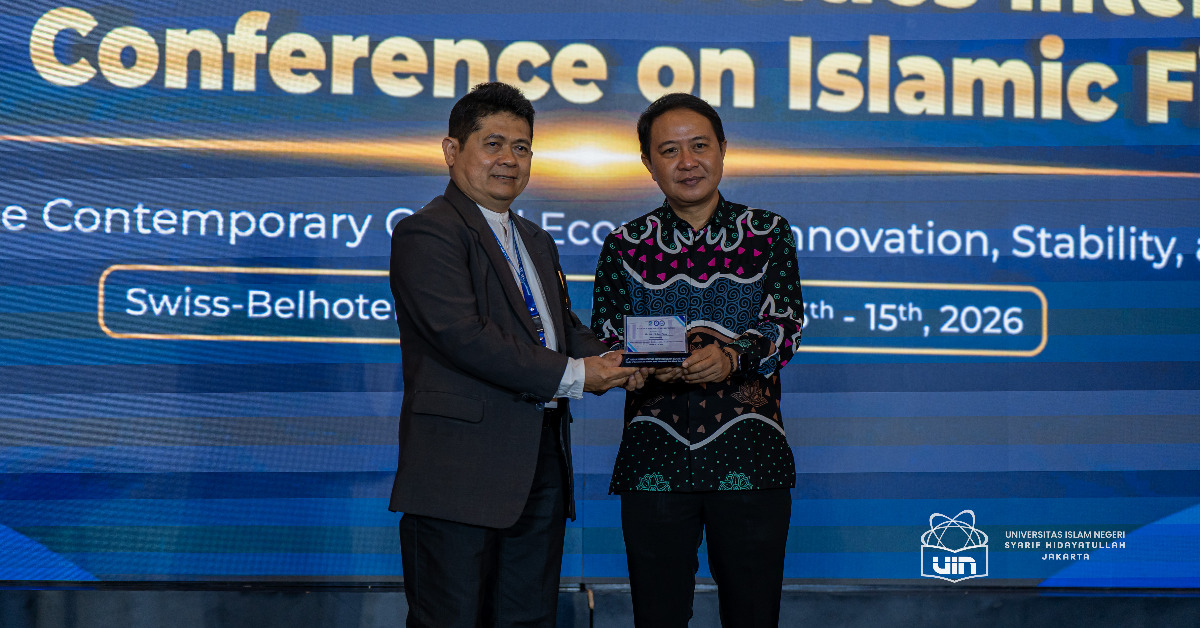
UIN Jakarta’s Faculty of Economics and Business Hosts 14th ASEAN Universities International Conference on Islamic Finance, Promoting a Stronger Regional and Global Role for Islamic Finance
Serpong — The Faculty of Economics and Business (FEB) at UIN Syarif Hidayatullah Jakarta officially opened the 14th ASEAN Universities International Conference on Islamic Finance (AICIF 2026) on Tuesday, October 13, 2026, in Serpong, South Tangerang. The international conference, themed “Islamic Finance in the Contemporary Global Economy: Innovation, Stability, and Sustainability,” brought together leading figures and experts in Islamic finance to examine contemporary developments in regional and global economies.
The conference was officially opened by UIN Jakarta Rector Prof. Asep Saepudin Jahar, M.A., Ph.D., accompanied by FEB Dean Prof. Dr. Ibnu Qizam, M.Si., the faculty’s vice deans, and AICIF 2026 Organizing Committee Chair Rahmawati, Ph.D. Academics, researchers, and practitioners from various countries also attended to discuss developments, challenges, and opportunities for strengthening the Islamic economy and finance amid changing global economic conditions.
In his opening remarks, Rector Asep Jahar expressed hope that AICIF would generate ideas and recommendations for advancing Islamic economics and finance, particularly in Southeast Asia.
“We hope this forum will serve not only as a platform for discussion but also make a significant contribution to the development of Islamic economics and finance worldwide, especially in Southeast Asia,” he said.
AICIF 2026 featured experts in Islamic economics and finance from Indonesia and abroad. The opening session included presentations by Prof. H. Hilman Latief, M.A., Ph.D., Commissioner of PT Bank Syariah Nasional; Prof. Dr. M. Kabir Hassan, Ph.D., Professor of Economics at the University of New Orleans in the United States; Prof. Dr. Noraini Mohd Ariffin, Vice President of the International Council of Islamic Finance Educators (ICIFE); and Prof. Ishak Bhatti of Universiti Brunei Darussalam (UBD).
The main sessions explored the role of artificial intelligence in Islamic banking, innovation and sustainability in Islamic finance within the global economy, and the future direction of ASEAN Islamic finance policies and markets. Participants also discussed evolving policies, regulations, and strategies in Islamic finance.
The conference brought together academics and experts from higher education institutions in Brunei Darussalam, the Philippines, and Malaysia. Representatives from Indonesian universities also attended, including UIN Sunan Kalijaga Yogyakarta, Universitas Darussalam Gontor, Universitas Islam Sultan Agung in Semarang, and other institutions.
FEB Dean Prof. Dr. Ibnu Qizam said AICIF 2026 was designed to respond to changing global economic conditions while strengthening the contribution of Islamic finance to addressing contemporary social and economic challenges.
“This conference is designed to respond to various global developments. The topics cover critical issues, including optimizing educational waqf, strengthening Sharia-based cooperatives, and the role of Islamic financial technology (fintech) in promoting economic inclusion,” he said.
Ibnu Qizam also expressed hope that the 14th AICIF would strengthen international collaboration in developing Islamic economics and finance. He emphasized the importance of expanding research exchanges, policy discussions, and academic networks to increase the global contribution of Islamic finance.
Panel Discussions Explore the Future of Islamic Finance
AICIF 2026 featured keynote speeches, panel discussions, parallel research paper presentations, academic networking sessions, and awards for outstanding papers and presenters. The panel discussions were designed to bring academic and professional perspectives together on strategic issues in Islamic finance.
On the first day, Tuesday, October 13, 2026, the conference featured two main panel discussions. The first, titled “Cross-Border Islamic Philanthropy in a Digital Age: Mobilizing Diaspora Giving for Sustainable Development in ASEAN,” explored cross-border Islamic philanthropy in the digital era and ways to mobilize diaspora contributions to support sustainable development across ASEAN.
The panel featured Dr. Hajah Nurul Nabilah binti Haji Ali of Sultan Sharif Ali Islamic University, Brunei Darussalam; Dr. Jawad Z. Salic of Mindanao State University, the Philippines; and Prof. Dr. Ibnu Khajar, S.E., M.Si., of Universitas Islam Sultan Agung in Semarang. The discussion was moderated by Ali Rama, S.E., Ph.D.
The second panel addressed “Future Capabilities in Islamic Finance Education in the Age of Artificial Intelligence.” It examined how Islamic finance education can develop the skills and competencies needed in the age of AI. Speakers included Prof. Dr. M. Kabir Hassan of the University of New Orleans, Prof. Ishak Bhatti of Universiti Brunei Darussalam, and Prof. Dr. Noraini Mohd Ariffin of ICIFE. The session was moderated by Rahmawati, S.E., Ph.D.
On the second day, Wednesday, October 14, 2026, AICIF was scheduled to hold a panel discussion titled “Reimagining Islamic Finance for the Future: Innovation, Resilience, Sustainability, and Global Impact.” The panel featured Olatunji Shobande, Ph.D., of Hartwick College in New York, United States; Assoc. Prof. Dr. Syarah Syahira Mohd Yusoff of the Institute of Islamic Banking and Finance (IIiBF), International Islamic University Malaysia (IIUM); Dr. Abdul Qoyyum, S.E.I., M.Sc.Fin., of UIN Sunan Kalijaga; and Prof. Dr. Akhmad Affandi Mahfudz, M.Ec., of Universitas Darussalam Gontor. The discussion was moderated by Deni Pandu Nugraha, Ph.D.
In addition to the panel discussions, AICIF 2026 scheduled a Parallel Paper Presentation session on the second day to facilitate the exchange of research findings and academic ideas. The presentations were organized around six topics:
Digitalization & Financial Technology, chaired by Prof. Dr. Syarah Syahira Mohd Yusoff of IIiBF, IIUM.
Governance, Regulation, and Ethics, chaired by Prof. Ir. Dr. Muhammad Nadratuzzaman Hosen, M.S., M.Sc., of UIN Syarif Hidayatullah Jakarta.
Islamic Social Finance & Inclusive Growth, chaired by Prof. Dr. Ibnu Khajar, S.E., M.Si., of Universitas Islam Sultan Agung in Semarang.
Green Economy & Sustainable Finance, chaired by Dr. M. Arsyadi Ridha, S.E., M.Sc., Ak., CA, ACPA, of UIN Sunan Kalijaga Yogyakarta.
Global Transformation & Comparative Studies, chaired by Dr. Hartomi Maulana, M.Sc., of Universitas Darussalam Gontor.
Future of Islamic Finance Education & Research & Halal Economy Ecosystem Development Report, chaired by Dr. Hajah Nur Annisa Binti H. Sarbini of Sultan Sharif Ali Islamic University, Brunei Darussalam.
According to the organizing committee’s official release, the paper presentation sessions were intended to provide researchers with opportunities to present their findings, receive academic feedback, and explore potential collaborations across institutions. Each panel session accommodated approximately seven to eleven academics presenting their research.
The conference also scheduled awards to recognize outstanding research and presentations. The award categories included Best Paper, Best Presenter, Best Theoretical Paper, Best Student Paper, and Best Paper by Theme.
Information and Public Relations Center, LP2M, UIN Syarif Hidayatullah Jakarta