
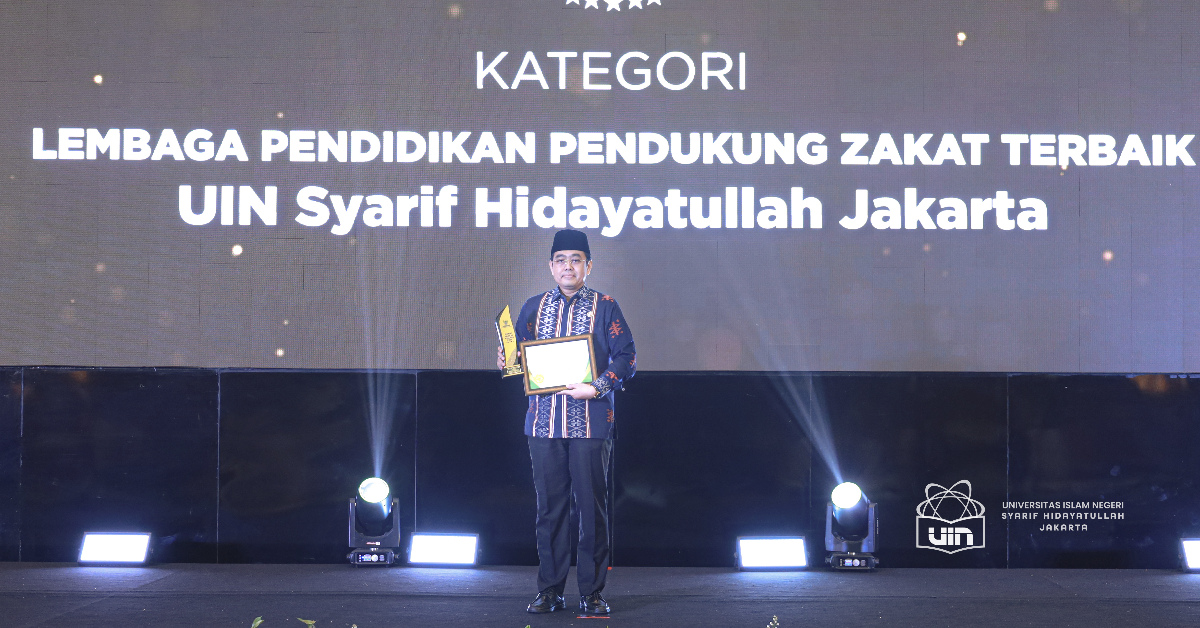
UIN Jakarta Wins Best Educational Institution Supporting Zakat at the 2026 BAZNAS Awards
Jakarta – UIN Syarif Hidayatullah Jakarta received the Best Educational Institution Supporting Zakat award at the 2026 Grand BAZNAS Awards. The award was presented during the National Coordination Meeting (Rakornas) of the Indonesian National Board of Zakat (BAZNAS), held under the theme “Consolidating a Productive and Impactful Zakat Sector” at the Ballroom of Grand Mercure Kemayoran Hotel on Thursday, October 15, 2026.
The national coordination meeting was attended by several prominent figures, including Chairman of BAZNAS Dr. Ir. H. Sodik Mudjahid, M.Sc.; Governor of the National Resilience Institute of the Republic of Indonesia (Lemhannas RI) Dr. H. TB. Ace Hasan Syadzily, M.Si.; Chairman of Syarikat Islam Dr. Hamdan Zoelva, S.H., M.H.; Vice Chairman of BAZNAS Dr. H. Zainut Tauhid Sa’adi, M.Si.; and Vice Chairman for Science and Technology, Agromaritime Affairs, and Environmental Affairs of the Central Executive Board of the Indonesian Muslim Intellectuals Association (ICMI), Prof. Dr. Ir. H. Mohammad Jafar Hafsah, IPU. The event was also attended by governors, mayors, BAZNAS leaders from various provinces, zakat management institutions, partners, and public figures.
In his remarks, BAZNAS Chairman Dr. Ir. H. Sodik Mudjahid, M.Sc., explained that the 2026 Grand BAZNAS Awards were part of efforts to build a productive and collaborative zakat ecosystem. These efforts align with BAZNAS’s Asta Strata Asta Priorities for 2026–2031, particularly the first priority, which emphasizes building a zakat ecosystem involving all relevant stakeholders.
“This is in line with the BAZNAS Asta Strata Asta Priorities for 2026–2031. The first Asta Strata priority is to build a productive ecosystem involving all stakeholders engaged with BAZNAS,” he said.
He added that the Grand BAZNAS Awards encompass 20 criteria across various categories involving a broad range of stakeholders. This inclusive approach is expected to strengthen networks and collaboration while encouraging innovation in zakat management across Indonesia.
“These awards cover 20 criteria involving various groups as part of our efforts to build a productive and collaborative zakat ecosystem,” he explained.
Furthermore, the BAZNAS chairman outlined five key aspirations that the organization seeks to strengthen through its programs and activities: to be remembered, trusted, accessible, loved, and respected by the public.
“These aspirations are intended to strengthen public trust, expand access to zakat payments, and provide solutions for people in need, including those facing challenges related to healthcare, disasters, and debt,” he said.
During the awards presentation, delivered by a representative of the Head of the National Research and Innovation Agency (BRIN), Prof. Dr. Arif Satria, S.Pi., M.Si., UIN Syarif Hidayatullah Jakarta was recognized alongside four other higher education institutions. Following UIN Jakarta, the other recipients in the Best Educational Institution Supporting Zakat category were Gadjah Mada University (UGM), Sebelas Maret University (UNS), Padjadjaran University (Unpad), and UIN Mahmud Yunus Batusangkar.
In closing, the BAZNAS chairman expressed his hope that the 2026 Grand BAZNAS Awards would strengthen cooperation, foster mutual respect, and encourage award recipients to continue improving their achievements and expanding their contributions to society.
“We hope these Grand Awards will further strengthen cooperation, foster mutual respect, and inspire everyone to continue striving for excellence,” he concluded.
UIN Jakarta Reaffirms Its Commitment to Zakat-Based Community Empowerment
UIN Jakarta Vice Rector for Academic Affairs, Prof. Dr. Ahmad Tholabi, M.A., M.H., who represented the university in receiving the award, stated that the recognition from BAZNAS serves both as an acknowledgment of UIN Jakarta’s contributions and as motivation to further strengthen the role of higher education institutions in developing Indonesia’s national zakat ecosystem.
“This award is a source of pride and, at the same time, a responsibility for UIN Jakarta to continue strengthening its support for the zakat movement. We view zakat not merely as a religious obligation, but also as a strategic instrument for strengthening social solidarity, promoting economic self-reliance, and empowering communities,” he said.
According to Prof. Tholabi, higher education institutions play an important role in improving zakat literacy through education and academic development, while also encouraging the application of research findings to support effective and impactful zakat management. Therefore, collaboration between UIN Jakarta, BAZNAS, and various stakeholders needs to be continuously strengthened.
Separately, UIN Jakarta Rector Prof. Asep Saepudin Jahar, M.A., Ph.D., expressed his appreciation to BAZNAS for the award. He noted that the recognition would motivate UIN Jakarta to strengthen its support for zakat management and expand the university’s contribution to community empowerment.
“We would like to express our gratitude and appreciation to BAZNAS for this award. This recognition is both an acknowledgment and a responsibility for us to further strengthen the role of higher education institutions in supporting zakat management that is productive, transparent, and delivers tangible benefits to society,” Prof. Asep said.
He emphasized that zakat has significant strategic potential beyond fulfilling religious obligations. It can also serve as an important instrument for improving public welfare, strengthening economic self-reliance, and expanding access to education.
“UIN Jakarta is committed to strengthening its support for the zakat movement through collaboration with BAZNAS and other stakeholders. We hope zakat will serve not only as a mechanism for collecting and distributing funds, but also as a means of promoting sustainable community empowerment, enhancing economic independence, and expanding opportunities for underserved communities,” he added.
Rector Asep Jahar also expressed his hope that collaboration between higher education institutions and BAZNAS would continue to grow through education, research, innovation, and community engagement. In this way, the academic expertise and intellectual resources of universities can contribute to the development of zakat programs that are better targeted and deliver broader benefits.
“As an Islamic university, UIN Jakarta has a responsibility to integrate Islamic values with meaningful contributions to society. We want to strengthen our support for zakat by improving zakat literacy among our academic community and developing collaborations that deliver measurable and sustainable community empowerment programs,” he explained. (Center for Information and Public Relations UIN Syarif Hidayatullah Jakarta)