UIN Jakarta Trains 4,000+ Students in Documentary Filmmaking for Regional Development during Mandatory Civic Mission
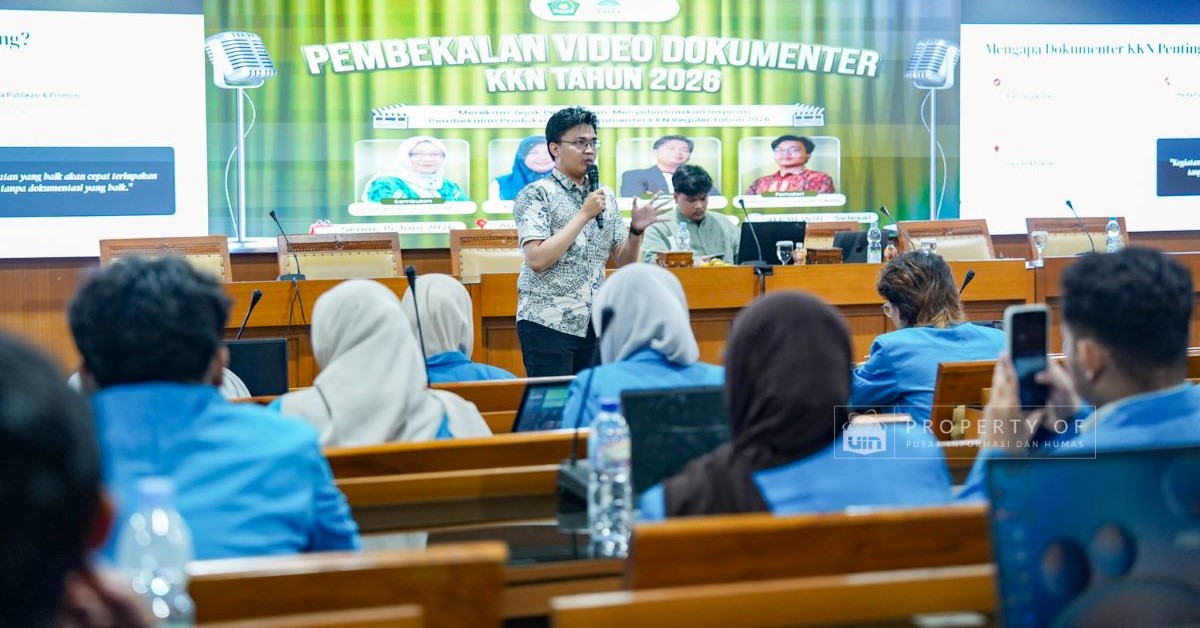
Diorama Room, UIN Online News – The Center for Civic Engagement (PPM) under the Institute for Research and Community Engagement (LP2M) at UIN Syarif Hidayatullah Jakarta launched a comprehensive documentary production boot camp. Carrying the theme “Recording Footprints of Engagement, Disseminating Inspiration: Briefing on Documentary Video Production for the 2026 Regular Civic Mission,” the training serves as a mandatory preparatory phase ahead of the university's large-scale 2026 field deployments, held at the central Diorama Auditorium on Monday, June 15, 2026.
The 2026 Regular Civic Mission framework involves a massive deployment of 4,041 student participants stationed across various strategic rural and urban zones. The initial documentary briefing session was attended by 180 group delegates assigned to the Bogor Regency. The entire preparatory camp is staged across a 3-day staggered schedule: Monday, June 15, for the Bogor Regency delegation; Wednesday, June 17, for the Tangerang Regency delegation; and Thursday, June 18, for the South Tangerang, Depok, International, Thematic, and Special Archipelagic (Nusantara) mission groups.
The Head of LP2M UIN Jakarta, Prof. Amelia Fauzia, highlighted that traditional civic missions must adapt dynamically to societal changes, explicitly utilizing modern multimedia systems to broadcast localized developmental progress.
“Our academic civic mission must adapt to contemporary realities and digital shifts. We understand that the individuals who truly succeed are not just the brilliant ones, but those who maintain high agility toward change. Because we live in a completely digitized era dominated by social media, public data sharing relies heavily on video assets. Therefore, I highly commend this specialized strategy to train our students in documentary filmmaking,” she stated.
Furthermore, Prof. Fauzia noted that these field deployments function as an extraordinary operational bridge connecting higher education research with grassroots community needs. Through this media initiative, the university aims to demonstrate the practical application of progressive Islamic values (Rahmatan lil 'Alamin), showcasing a faith that actively drives civilizational growth and sustainable regional development.
“We will prove through this civic mission that our scholarship yields tangible public benefits. Simultaneously, we want to broadcast to the global audience that our Islamic values emphasize social progress, comprehensive development, and direct infrastructure solutions for the community,” she added.
Echoing this vision, the Head of the Center for Civic Engagement, Ade Rina Farida, explained that the core objective of this digital camp is to equip students across all majors with baseline competencies in investigative journalism and audio-visual engineering. This ensures that every student unit produces an authentic, data-backed record of their field interventions, operating as a mandatory administrative graduation output for the 2026 cycle.
“The primary goal is to empower our students with foundational journalism and multimedia skills. This serves as a vital platform for them to deliver an authentic, transparent record of their field operations. We anticipate a robust output of high-quality digital assets and journalistic articles that are highly creative yet generate a definitive developmental impact for the rural communities,” Farida explained.
To provide professional industry perspectives, the university invited independent video editor Nur Muhammad Asnadi as the chief technical speaker. He emphasized that the structural success of an impactful documentary rests on the symbiotic balance of narrative architecture and visual composition.
“The absolute priority when engineering a powerful documentary lies within the core storytelling script, the structural narrative arc, and the visual framing. A high-impact documentary is defined by its ability to tell a compelling human story, backed by pristine audio engineering and careful visual editing,” Asnadi instructed.
A student participant from the Regular Civic Mission pool, Ari Indrawan, highly praised the intervention, noting that the cross-disciplinary training leveled the playing field for students who do not specialize in media studies.
“The training is exceptionally practical and mindful of our needs. Since the vast majority of our civic mission teams come from non-communication majors, learning how to correctly capture field shots, draft an engaging script, and execute digital post-production editing is incredibly useful for our fieldwork,” he concluded.