UIN Jakarta Strengthens Green Campus Initiative Through Maggot Waste Management Training and Launch of KALIFA Integrated Waste Management Facility
Ciputat, UIN News Online – UIN Jakarta organized a Training Seminar on Maggot-Based Organic Waste Management and officially inaugurated its Independent Integrated Waste Management Facility (TPSTM), named KALIFA (Kelola Alam dan Lingkungan Berfaedah), on Thursday (22/01/2026).
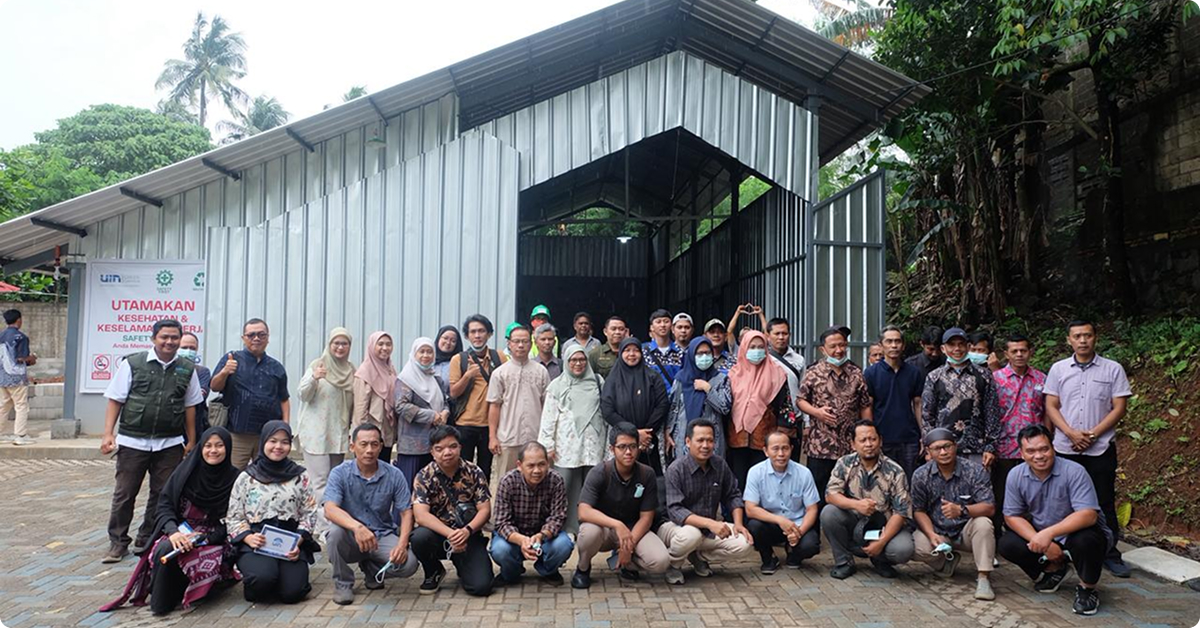
The seminar was held in the university's Diorama Room, while the newly established KALIFA TPSTM, located near the Teacher Professional Education (PPG) Building, will serve as the university's integrated waste management center, combining environmental education with hands-on waste processing practices.
The initiative forms part of UIN Jakarta's broader strategy to strengthen its Green Campus program by implementing an integrated, innovative, and sustainable waste management system. Beyond a ceremonial inauguration, the event represented a concrete step toward establishing an ecosystem for organic waste management that delivers both environmental and economic benefits.
The program opened with remarks from Prof. Dr. Hendrawati, M.Si., Head of the Green Campus Development Center, who emphasized the importance of collaboration across university units and the active participation of the entire academic community in creating an effective waste management system.
"We envision TPSTM KALIFA not only as a waste processing facility but also as a living laboratory and a sustainable environmental education center for our academic community," she said.
The welcoming remarks were followed by Dr. Fathudin Kalimas, S.HI., S.H., M.A. Hum., M.H., Secretary of the Institute for Research and Community Service (LP2M), who highlighted that the initiative reflects the university's commitment to integrating the Three Pillars of Higher Education (Tri Dharma Perguruan Tinggi)—education, research, and community engagement—in addressing environmental challenges through practical and systematic solutions.
The seminar featured two expert speakers. Johan Aristya Lesmana, M.Si., introduced the fundamentals of organic waste management, covering waste segregation at the source, decomposition processes, and the conversion of organic waste into value-added products.
Meanwhile, Arie Romanov Rakhman presented innovative approaches to processing organic waste using Black Soldier Fly (BSF) larvae, explaining their life cycle, their remarkable efficiency in decomposing organic waste, and their economic potential as a sustainable alternative source of animal feed.
The event concluded with the official inauguration of TPSTM KALIFA, marking the launch of UIN Jakarta's integrated, independently managed waste processing facility. The center is expected to significantly reduce the volume of organic waste generated on campus while fostering environmental awareness among students, faculty members, and staff. It is also envisioned as a model for educational institutions seeking to combine environmental sustainability with experiential learning.
Through this initiative, UIN Syarif Hidayatullah Jakarta reaffirms its commitment to developing innovative and sustainable environmental management systems while strengthening its position as a higher education institution actively advancing the transition toward a greener and more sustainable campus.