
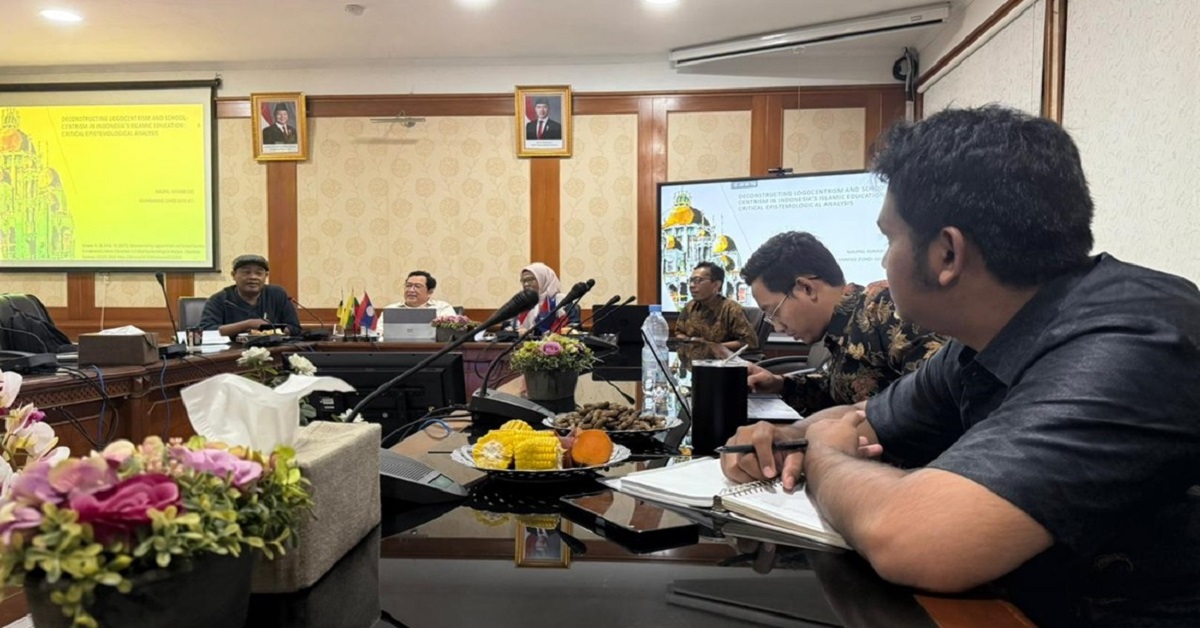
UIN Jakarta Scholars Examine Epistemological Challenges in Islamic Education
Jakarta, UIN News Online — Scholars at UIN Jakarta have called for a critical rethinking of the epistemological foundations of Islamic education, arguing that meaningful educational reform requires more than curriculum development—it demands a transformation in how knowledge is understood, produced, and taught.
The discussion, organized by the Master's Program in Islamic Education at the Faculty of Education and Teacher Training, explored the theme "Deconstructing Logocentrism and School-Centrism in Indonesia's Islamic Education: A Critical Epistemological Analysis." The forum brought together faculty members, researchers, and graduate students to reflect on contemporary challenges facing Islamic education in Indonesia.
Delivering the keynote presentation, Prof. Muhammad Zuhdi argued that Islamic education should move beyond the transmission of religious knowledge to cultivate critical thinking, ethical leadership, and meaningful social engagement.
"Islamic education should not be limited to nurturing ritual devotion. It should also develop individuals who are capable of critical inquiry, understanding social realities, and contributing constructively to society," he said.
A central theme of the discussion was the influence of logocentrism and school-centrism on contemporary Islamic education. Participants argued that treating particular interpretations or schools of thought as exclusive sources of truth may restrict intellectual dialogue, discourage critical reflection, and limit the diversity of scholarly perspectives.
Responding to the presentation, Dr. Makyun Subuki observed that while Islamic educational institutions in Indonesia have expanded considerably, this growth has not always been accompanied by comparable advances in epistemological development or social impact.
He suggested that issues such as intolerance, ideological polarization, and limited engagement with contemporary scientific knowledge highlight the need for a more reflective and interdisciplinary approach to Islamic education.
The discussion also examined how an imbalance between religious and broader scientific disciplines can influence educational priorities. Participants noted that strengthening intellectual openness requires a more integrated understanding of knowledge—one that encourages dialogue between Islamic scholarship, the humanities, the social sciences, and modern scientific inquiry.
Drawing on the epistemological framework of Mohammed Abed al-Jabri, the forum explored the complementary roles of bayani, irfani, and burhani modes of reasoning. Speakers emphasized the importance of reinforcing analytical and evidence-based reasoning while engaging critically with the rich intellectual heritage of Islamic civilization.
The forum concluded that the future of Islamic education depends not only on institutional reform but also on cultivating an intellectual culture that values critical inquiry, openness, and interdisciplinary scholarship. Participants expressed hope that such an approach would prepare graduates who are ethically grounded, intellectually rigorous, and equipped to contribute to the advancement of society in an increasingly complex world.