
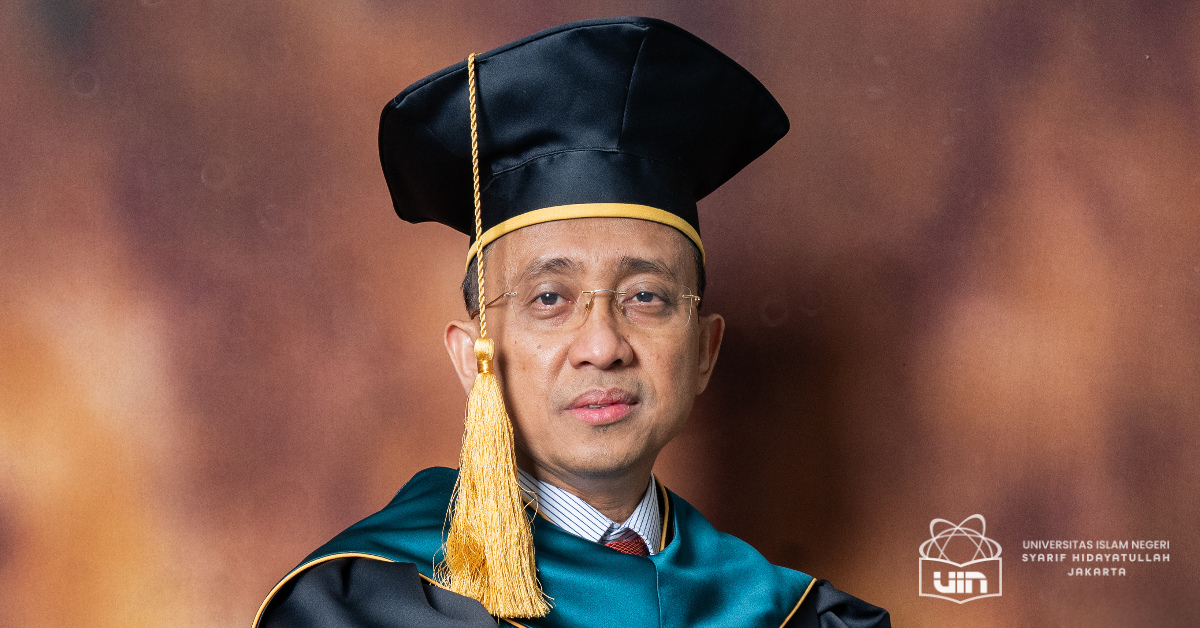
UIN Jakarta Professor Suwendi: Pesantren Subculture Has Become an Integral Identity in the National Education System

Jakarta (Kemenag) - Jakarta (Kemenag) - Professor at UIN Syarif Hidayatullah Jakarta, Prof. Dr. H. Suwendi, M.Ag., emphasized that the transformation of Islamic boarding schools (pesantren) from a subculture toward state recognition does not imply the erasure of their identity and distinct character. On the contrary, state recognition must serve as a avenue to position pesantren equitably as an integral part of the national education system.
Suwendi was inaugurated alongside 12 other professors in a ceremony attended by thousands of guests. Attendees included Minister of Religious Affairs Prof. Dr. KH. Nasaruddin Umar, M.A., Minister of Primary and Secondary Education Prof. Dr. Abdul Mu'ti, M.Ed., Minister of Religious Affairs for the 2014–2019 period Lukman Hakim Saifuddin alongside Hj. Trisna Willy, Director General of Research and Development at Kemdiktisaintek Fauzan Adziman, Chairman of KPU RI Afifuddin, Head of the National Police Educational and Training Institution Commissioner General Pol. R. Z. Panca Putra S., Director of PKUMI Prof. Ahmad Thib Raya, as well as various ministry/agency officials, university leaders, professors, lecturers, community leaders, and other distinguished guests.
According to Suwendi, the relationship between pesantren and the state has experienced its own dialectic. Throughout the journey of nearly seven decades following independence, this relationship tended to be diametral or, in his terms, “joined together but not yet integrated.” Pesantren have served as a critical component in national development, yet at the same time experienced alienation from the mainstream national education system.
A significant shift began to emerge when the state issued Presidential Decree Number 22 of 2015 designating National Santri Day. That policy, according to Suwendi, served as a catalyst driving a shift in how the state perceives pesantren, which subsequently led to the enactment of Law Number 18 of 2019 on Pesantren.
“The passage of this law represents the pinnacle of that fundamental change. Pesantren are no longer alienated as standalone educational institutions, but are integrated into a unified national education system, while their distinctiveness and unique characteristics remain fully guaranteed,” Suwendi stated.
He explained that the extended negotiation process between pesantren and the state stemmed in part from a lack of adequate attention and understanding toward the character of pesantren as a subculture within Indonesian society. In Gus Dur's perspective, Suwendi noted, pesantren possess a distinct value system, leadership paradigm, scholarly references, and social structure. However, subculture does not signify a marginalized, weak, or inferior group. The structural and cultural autonomy of pesantren is precisely an integral part of Indonesian society's social wealth.
“State recognition must not be interpreted as uniformization or the loss of pesantren subculture. On the contrary, the legislation accommodates the distinctiveness of pesantren rather than forcing uniformity with other educational models,” he explained.
In analyzing these transformations, Suwendi employed the framework of recognition theory developed by Axel Honneth, a German philosopher and sociologist recognized as a leading figure of the third generation of the Frankfurt School. Within Honneth's framework, recognition manifests across affective, legal, and social solidarity spheres.
Therefore, Suwendi continued, legal recognition of pesantren must be accompanied by social and institutional support. Recognition that stops at regulatory provisions without equivalent support risks generating misrecognition—a state where formal recognition is granted but remains substantively absent.
To ensure that recognition proceeds holistically and sustainably, Suwendi proposed three approaches. First, the “one house with many rooms” principle. According to him, the national education system is a single house containing various educational types and tracks. Each possesses distinct characteristics and uniqueness that must be respected.
“No room is more legitimate than another room, just as no type of education is more valid than another type of education,” he emphasized.
For this reason, pesantren education should not be coerced into following the models, standards, or curricula of other educational pathways. Concurrently, other types of education need not adapt themselves to pesantren educational models.
Second, the Gross Enrollment Ratio (GER) approach. Suwendi asserted that if educational GER is utilized as an indicator of national educational participation, then the presence of formal-track pesantren education units must be positioned proportionally within that system.
Formal Diniyah Education (PDF), Mu'adalah Educational Units (SPM), and Ma'had Aly form integral components of formal pesantren education. Consequently, according to Suwendi, all three hold the right to receive facility and financial support from the state's obligations, equal to other formal educational institutions.
“If School Operational Assistance (BOS), State University Operational Assistance (BOPTN), educator certifications, and other financial affirmations flow to public schools, madrasahs, and universities, then Formal Diniyah Education, Mu'adalah Educational Units, and Ma'had Aly are equally entitled to receive them,” he stated.
Third, the multi-entry multi-exit approach. This framework allows learners to enter specific educational levels through diverse tracks and types of education, and to progress to subsequent levels without being hindered by institutional barriers between educational categories.
Through this approach, graduates of formal pesantren education units, according to Suwendi, must receive equal opportunities to continue their education at higher levels across various types of educational institutions. Diplomas obtained must also carry equivalent civil effects to those issued by other formal educational institutions. Suwendi maintained that the transformation of pesantren from subculture to state recognition is ultimately not a process to dissolve pesantren identity. This transformation instead affirms the state's duty to recognize, protect, and treat pesantren equitably within the architecture of the national education system.
“Pesantren are not alienated; rather, they are fully integrated into a unified national education system without forfeiting their characteristics as a subculture,” he concluded.