UIN Jakarta Partners with Islamic Boarding School Forum to Expand Opportunities for Santri
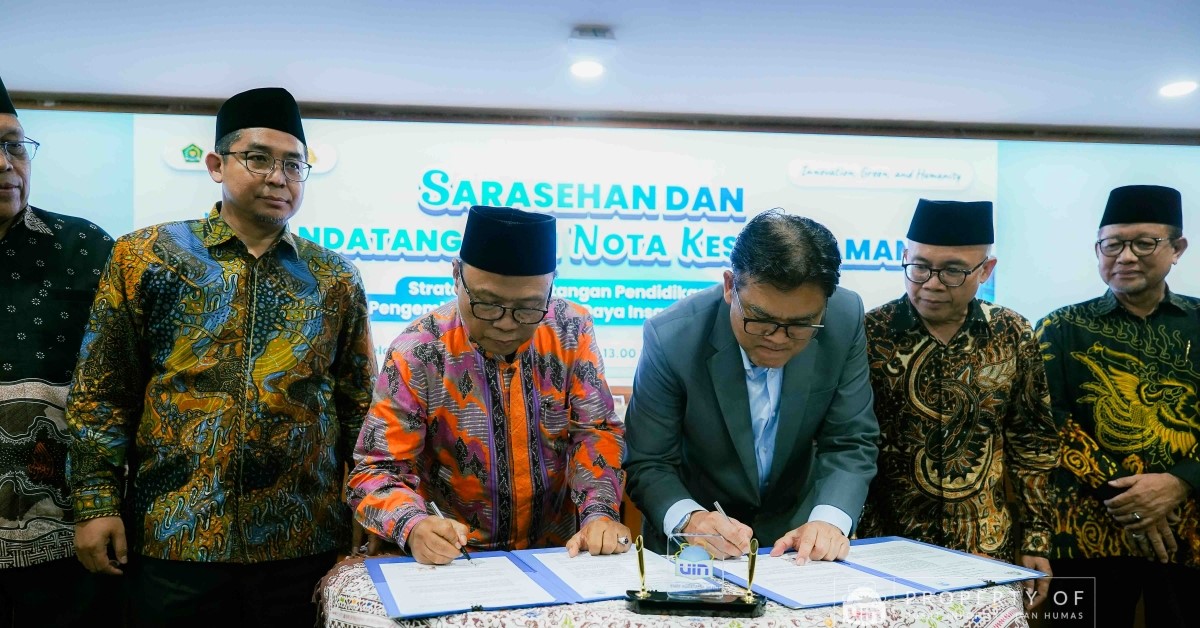
Diorama Room, UIN Online News — UIN Syarif Hidayatullah Jakarta has strengthened its commitment to advancing Islamic education by establishing strategic partnerships with leaders of Islamic boarding schools (pesantren). The collaboration was formalized through a Sarasehan (Academic Forum) and the signing of a Memorandum of Understanding (MoU) under the theme "Strategies and Challenges in Education and Human Resource Development in Islamic Boarding Schools" at the Diorama Hall, Ground Floor of the Harun Nasution Auditorium, on Tuesday (April 21, 2026).
Islamic boarding school education is increasingly recognized as an integral part of Indonesia's national education ecosystem rather than as a separate pathway. During the forum, pesantren leaders emphasized the importance of building strong partnerships with State Islamic Higher Education Institutions (PTKIN), including UIN Jakarta, to nurture highly qualified future generations.
Chairman of the Indonesian Association of Islamic Boarding School Caretakers (P2I), Dr. KH. Tata Taufiq, M.Ag., stressed that collaboration among educational institutions has become essential in today's rapidly evolving educational landscape. According to him, primary and secondary educational institutions, including pesantren, play a strategic role in preparing high-quality prospective students for higher education.
"Educational institutions must work collaboratively. Our role is to prepare quality students who are ready to continue their education at the higher education level," he said.
He further explained that pesantren graduates represent an important source of prospective students for PTKIN, not only for Islamic studies programs but also for various other academic disciplines. This is because pesantren graduates are equipped with strong moral values, intellectual curiosity, critical thinking skills, and a sense of social responsibility.
"Pesantren alumni are, in fact, an important source of students for PTKIN, regardless of the academic program they choose. PTKIN offers many programs that align with the educational foundations developed in pesantren," he added.
Dr. Tata also noted that changing societal demands require continuous improvement in human resource qualifications. While elementary-level education was once considered sufficient, today's educational standards require much higher academic qualifications. Referring to current national regulations, he highlighted that educators are increasingly expected to hold master's (S2) and doctoral (S3) degrees.
"Society has changed. In the past, graduating from elementary school was considered sufficient, but today students are expected to continue to senior high school and beyond. We must prepare future educators with at least bachelor's degrees, and according to current regulations, teachers are increasingly encouraged to pursue master's and doctoral qualifications," he explained.
He also emphasized that the Islamic Boarding School Law adopts a multi-entry and multi-exit education system, providing pesantren graduates with equal opportunities to continue their studies at any higher education institution without being restricted to a single educational pathway.
"The Islamic Boarding School Law enables pesantren graduates to become candidates for any academic program they choose. It guarantees that our graduates have equal opportunities to pursue higher education at universities across Indonesia," he concluded.
Currently, approximately 400 Islamic boarding schools are affiliated with the Indonesian Association of Islamic Boarding School Caretakers (P2I) through a voluntary membership system. The organization serves as a collaborative platform where pesantren leaders work together to shape the future direction and development of Islamic boarding school education throughout the country.