
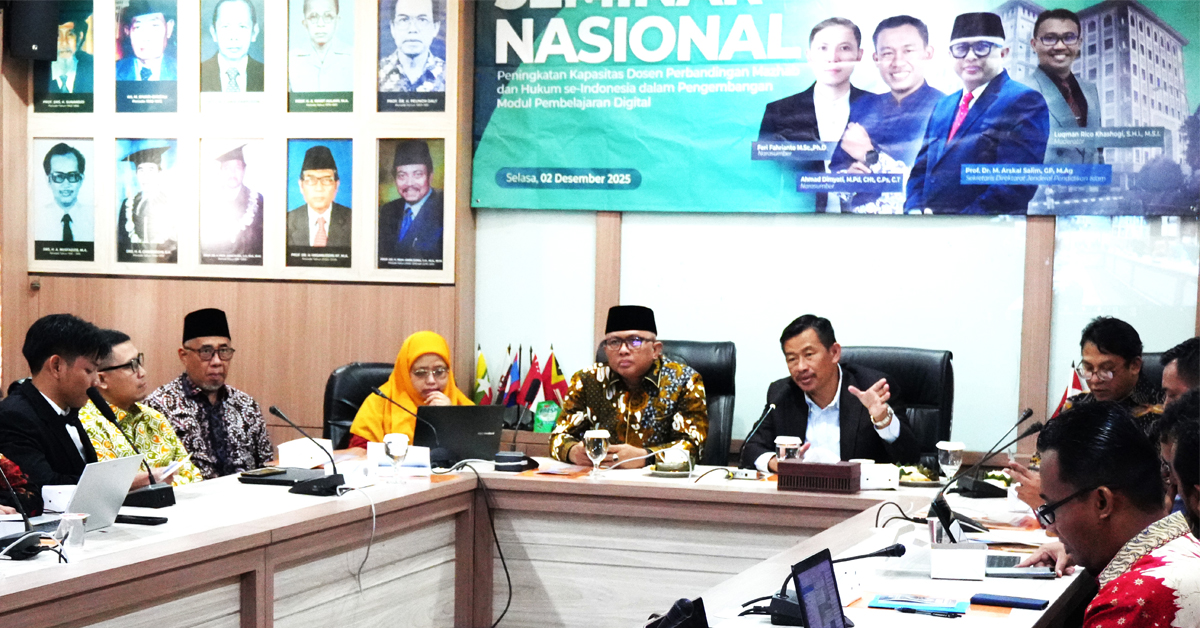
UIN Jakarta Hosts National Forum on Digital Transformation in Islamic Legal Education
Jakarta, UIN News Online — UIN Syarif Hidayatullah Jakarta convened academics and Islamic legal education experts from across Indonesia to examine how digital innovation is reshaping the teaching of Islamic law while preserving the discipline's scholarly traditions.
The National Seminar and Annual Meeting of the Association of Lecturers in Comparative Schools of Islamic Law (ADPMH) was organized by the University's Department of Comparative Madhhab and Law within the Faculty of Sharia and Law. The forum brought together representatives from Islamic higher education institutions nationwide to discuss emerging challenges and opportunities in legal education in the digital era.
Opening the event, Dean of the Faculty of Sharia and Law Prof. Muhammad Maksum highlighted concerns over declining student interest in Comparative Madhhab programs following changes in academic nomenclature. He emphasized the importance of maintaining the discipline's distinctive scholarly identity to ensure the continued development of experts in Islamic jurisprudence.
"Comparative Madhhab is a unique academic tradition that should continue to strengthen expertise in Islamic legal thought. Preserving its intellectual identity is essential to preparing future scholars capable of contributing to contemporary legal discourse," he said.
Delivering the keynote address, Prof. M. Arskal Salim GP, Secretary of the Directorate General of Islamic Education at Indonesia's Ministry of Religious Affairs, explored the theme "Digital Transformation in Islamic Legal Education: Challenges and Adaptations for Indonesian Islamic Higher Education."
He identified three major challenges facing higher education institutions: epistemological shifts, pedagogical transformation, and institutional readiness. He stressed that digital technologies should be viewed not merely as instructional tools but as catalysts for improving educational quality and expanding access to learning.
"Digital transformation represents a collective effort to ensure that Islamic higher education remains productive, adaptive, and relevant in responding to future challenges," he said.
The seminar also featured presentations by Feri Fahrianto, who introduced innovative teaching approaches—including blended learning, flipped classrooms, microlearning, gamification, artificial intelligence, and augmented and virtual reality—and Ahmad Dimyati, who emphasized the importance of interactive teaching strategies to enhance student engagement in increasingly digital learning environments.
The forum concluded with a shared commitment among participants to strengthen the attractiveness of Comparative Madhhab and Law programs, enhance lecturers' digital pedagogical competencies, and integrate educational technologies while safeguarding the intellectual heritage of Islamic legal scholarship.
The meeting reaffirmed UIN Jakarta's commitment to advancing innovation in Islamic higher education and fostering academic collaboration that responds to the evolving demands of the digital age.