
UIN Jakarta Graduates 1,643 Students at Its 142nd Commencement Ceremony
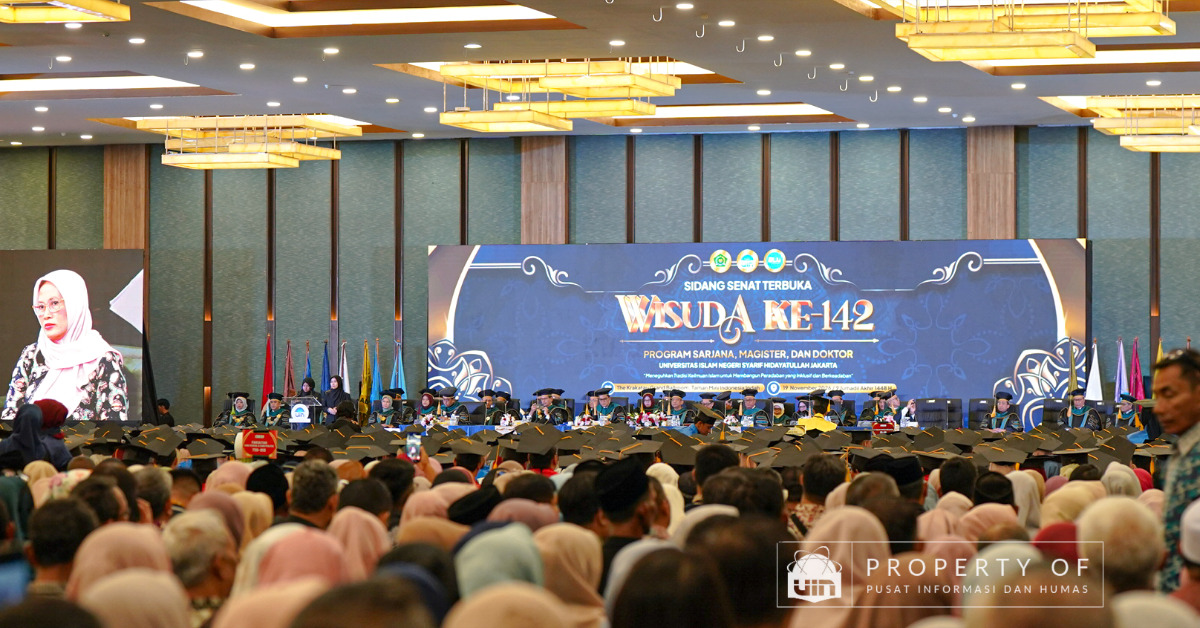
Jakarta, UIN News Online – UIN Syarif Hidayatullah Jakarta conferred degrees on 1,643 graduates at its 142nd commencement ceremony, held at The Krakatau Grand Ballroom, Taman Mini Indonesia Indah (TMII), on November 19, 2026. Bringing together graduates from undergraduate, master’s, and doctoral programs, the ceremony highlighted the university’s commitment to integrating Islamic scholarship with broader intellectual traditions and preparing graduates to contribute to society.
Held under the theme “Strengthening the Tradition of Islamic Scholarship to Build an Inclusive and Civilized Society,” the ceremony marked the university’s commencement for the 2026/2027 academic year.
The Faculty of Educational Sciences (FITK) recorded the largest number of graduates, with 296, followed by the Faculty of Adab and Humanities (FAH) and the Faculty of Economics and Business (FEB), each with 205. The Faculty of Da’wah and Communication Sciences (FDIKOM) and the Faculty of Science and Technology (FST) each graduated 201 students.
Other graduates came from the Faculty of Sharia and Law (FSH), with 122; the Faculty of Ushuluddin (FU), 106; the Faculty of Social and Political Sciences (FISIP), 86; the Faculty of Health Sciences (FIKES), 82; the Faculty of Psychology (FPsi), 69; the Graduate School (SPs), 36; and the Faculty of Islamic Studies (FDI), 34.
The open senate session was formally opened by UIN Jakarta Senate Chair Prof. Andi Faisal Bakti, M.A., Ph.D. The ceremony was attended by Rector Prof. Asep Saepudin Jahar, M.A., Ph.D., Vice Rector for Academic Affairs Prof. Dr. Ahmad Tholabi Kharlie, S.Ag., S.H., M.H., M.A., Vice Rector for General Administration Prof. Dr. Imam Subchi, M.A., Vice Rector for Student Affairs Prof. Ali Munhanif, M.A., Ph.D., and Vice Rector for Cooperation Din Wahid, M.A., Ph.D. Also present were Senior Policy Analyst for Research and Development at the Indonesian National Police Education and Training Institute, Inspector General Andry Wibowo, as well as faculty deans and members of the university community.
In his address, Rector Asep Saepudin Jahar reminded graduates that the integration of religious knowledge and science is a defining foundation of UIN Jakarta’s academic tradition. He encouraged them not to measure their future by their faculty backgrounds, grade point averages, or the limitations of campus facilities. Instead, he urged them to focus on developing strong character, a clear perspective, and firm intentions.
As an example of what graduates can achieve beyond disciplinary boundaries, the Rector highlighted the accomplishments of UIN Jakarta alumnus Prof. Burhanuddin Muhtadi, a professor of political science who graduated from the Faculty of Ushuluddin. Muhtadi’s academic journey from Islamic studies to internationally recognized political science, culminating in his receipt of the Habibie Prize, illustrated the value of intellectual openness and interdisciplinary learning.
“Life is not determined by where you come from, but by how you see the world, direct your life, and set your goals. A person’s destiny is shaped by their intentions and inner strength,” the Rector said.
Representing the alumni, Prof. Burhanuddin Muhtadi reflected on how Ciputat had shaped his intellectual outlook and career. He described it not merely as a geographical location but as an intellectual ecosystem that connected Islamic scholarship with modern social sciences.
He recalled the intellectual legacy of prominent figures associated with the Ciputat academic tradition, including Harun Nasution, Nurcholish Madjid, Azyumardi Azra, Fachry Ali, Komaruddin Hidayat, Bahtiar Effendy, and Saiful Mujani. His experiences in student organizations, including the Islamic Students Association (HMI) and his tenure as president of the Student Executive Board (BEM), further shaped his academic development.
Addressing questions about his transition from studying Qur'anic Exegesis and Hadith Studies to becoming a professor of political science, Muhtadi said that Ciputat’s academic environment had pioneered the use of social sciences as analytical tools for understanding religious issues.
“The Qur'anic exegesis I studied in university taught me how to read texts, while social sciences taught me how to read contexts,” he said.
A 2002 graduate of UIN Jakarta, Muhtadi later pursued his master’s studies at the Australian National University (ANU) and built part of his academic career at Duke University. In addition to receiving the Habibie Prize from the National Research and Innovation Agency (BRIN) and the Indonesia Endowment Fund for Education (LPDP), he was also recognized with the Distinguished Political Scientist Award.
Muhtadi encouraged graduates not to feel inferior when comparing their alma mater with institutions commonly associated with the Ivy League or Oxbridge. He said that UIN Jakarta alumni could demonstrate their competitiveness internationally through perseverance, commitment, and meaningful contributions.
“We do not need to feel inferior, because we have the opportunity to build excellence through perseverance. What matters most is not where we begin, but how much effort we make and how we open new chapters in our lives,” he said.
Concluding his address, Muhtadi offered three messages to the graduates: preserve their curiosity regardless of how many academic degrees they earn, do not be afraid of failure, and use knowledge as a means of service to others.
“Graduation is not the end of learning; it is the starting line for greater responsibility. Never stop learning, do not fear failure because it is often part of the journey toward success, and make knowledge a form of service,” he said.
Speaking on behalf of the graduates, Jujun Junaedi of the Faculty of Da'wah and Communication Sciences expressed his gratitude to the lecturers for their dedication and academic guidance. He emphasized that an academic degree should be understood not as the completion of one's learning journey, but as a responsibility to put knowledge to meaningful use in society.
“We realize that an academic degree does not mean we have finished learning. Rather, it marks the beginning of a greater responsibility to uphold and develop our knowledge. May the dedication of our lecturers be accepted by Allah SWT as a good deed, and may the knowledge they have imparted continue to grow and benefit our religion, nation, and country,” he said.
Jujun also paid tribute to the parents who had supported their children's education despite difficult circumstances. He acknowledged families from diverse occupational backgrounds, including farmers, livestock breeders, construction workers, market vendors, fishermen, tailors, and becak (pedicab) drivers. Their sacrifices, he said, often meant setting aside personal needs and concealing their own exhaustion to help their children earn academic degrees.