
UIN Jakarta Executives Engage in Open Dialogue with Hundreds of Students Over Tuition Policies and Campus Autonomy
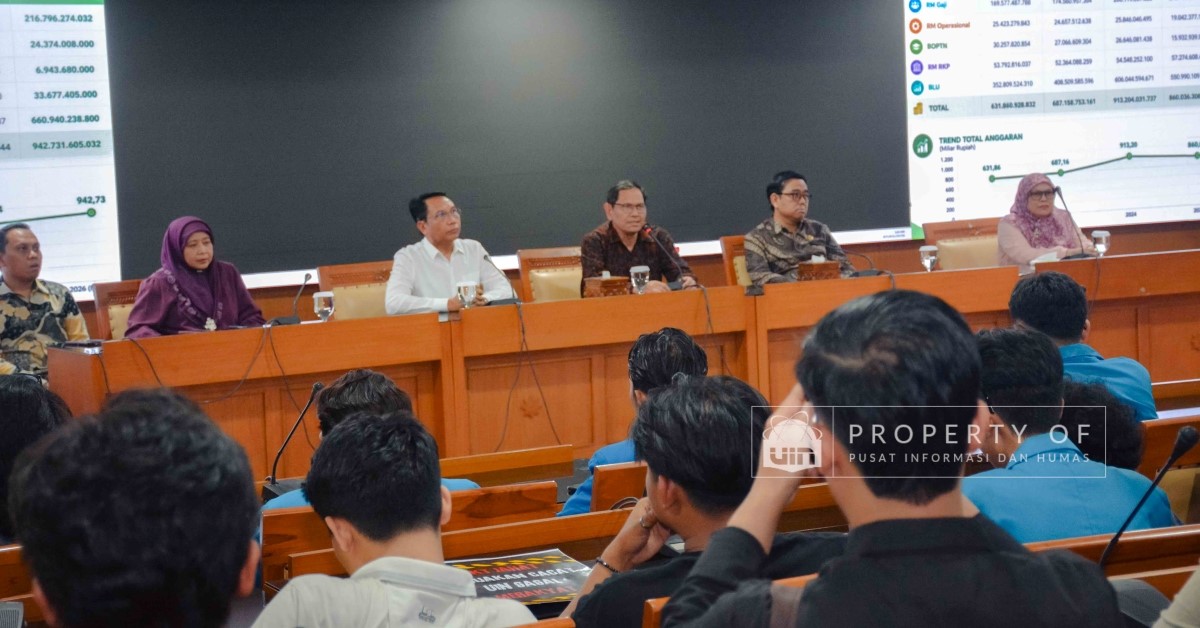
Diorama Room, UIN Online News – UIN Syarif Hidayatullah Jakarta held a dynamic town-hall-style dialogue with hundreds of students represented by the UIN Jakarta Student Body. The meeting, held at the Diorama Room on the ground floor of the Harun Nasution Auditorium on Thursday, September 2025, served as a platform to address strategic university development, the Single Tuition Fee (UKT) policy, gender-inclusive and disability-friendly campus programs, and the university's transition toward Autonomous State University (PTN-BH) status.
The two-hour session featured a panel of university leadership, including the Vice Rector for General Administration, Prof. Dr. Imam Subchi, the Vice Rector for Academic Affairs, Prof. Dr. Ahmad Tholabi, and the Vice Rector for Student Affairs, Prof. Ali Munhanif.
They were joined by the Head of the Center for Gender and Child Studies (PSGA), Dr. Wiwi Siti Syajaroh, and the Head of the Green Campus Development Center, Prof. Dr. Hendrawati. The dialogue was moderated by the Head of the Information and Documentation Management Center (PPID), Dr. Deden Mauli Anwar.
During the presentation, Professor Imam Subchi outlined the university’s strategic steps to optimize underutilized land and institutional assets as alternative funding sources for academic activities.
"Rather than leaving assets idle, it is far more beneficial to optimize them through strategic partnerships and leasing frameworks. The generated revenue can directly subsidize the university's academic operational needs," he explained.
He also reaffirmed the administration's commitment to stabilizing education costs for students, emphasizing that UIN Jakarta is aggressively pushing for non-tuition revenue streams to ease the financial burden on students.
"Tuition fees currently account for only 42% of our annual budget. Therefore, strategic measures must be taken to secure alternative, non-tuition revenue through asset optimization," he emphasized.
Addressing the tuition system, Professor Ali Munhanif explained that the UKT operates on a cross-subsidization model, where students from financially capable families contribute more to support underprivileged students. He noted that individual tuition brackets are calculated through a rigorous mechanism that evaluates the financial capacity of a student's family.
"The core logic of this system is mutual support among students. It ensures that students from affluent backgrounds and those from lower-income families do not bear the exact same financial weight," he explained.
He added that the university continues to expand its financial aid network through various scholarship partnerships with institutions such as BAZNAS, LPDP, the Ministry of Religious Affairs, the Djarum Foundation, BNI, KSE, local governments, and various corporate partners.
Furthermore, he acknowledged student concerns regarding tuition assessment errors, stating that the university continuously monitors, evaluates, and recalibrates its assessment standards to ensure precision and fairness.
On the same occasion, the Head of PSGA, Dr. Wiwi Siti Syajaroh, detailed the university’s ongoing measures to reinforce a gender-fair environment and prevent sexual misconduct on campus. She explained that PSGA holds a mandate to mainstream gender equality while fully backing the campus Task Force for the Prevention and Handling of Sexual Violence (PPKS).
"Ensuring a safe environment is not the sole duty of PSGA, it is a collective responsibility shared by faculty, administrative staff, and students alike," she stated.
The PSGA has also launched the Rumah Ramah Rahmah (R3) support center, which provides a secure, confidential space for advocacy and incident reporting. Students can report grievances through the task force, student affairs deans, department chairs, or academic advisors without fear of administrative bottlenecks.
Additionally, Prof. Hendrawati highlighted UIN Jakarta’s commitment to sustainable green campus initiatives and the expansion of disability-friendly infrastructure. She noted that while campus buildings are progressively equipped with supportive facilities for individuals with disabilities, upgrades and long-term maintenance remain continuous priorities.
Turning to institutional evolution, Prof. Ahmad Tholabi detailed the roadmap and challenges involved in transitioning into an Autonomous State University (PTN-BH), the highest tier of public university governance in Indonesia.
He explained that UIN Jakarta has been projected for this autonomous status since the previous administration and stands as one of the pilot projects monitored by the Ministry of Religious Affairs. However, achieving full autonomy requires a meticulous, multi-stage process, including independent readiness audits.
"We deeply appreciate the sincerity of our students in delivering constructive criticism and feedback. A student body that is courageous enough to offer corrections is vital to the university's progress," he concluded.
The open forum concluded with interactive Q&A sessions, where students raised vital inquiries concerning facility upgrades, policy transparency, student welfare, and the future of UIN Jakarta’s academic ecosystem.
(Aida/Zaenal/Arifin)