Two Years of Asta Cita: Indonesia’s Ministry of Religious Affairs Delivers Programs with Tangible Impact
Jakarta, Berita UIN Online— Indonesia’s Ministry of Religious Affairs has reported a range of programs that have reached millions of people during the first two years of President Prabowo Subianto and Vice President Gibran Rakabuming Raka’s administration. The programs address access to education, teacher welfare, student and Islamic boarding school student (santri) health and nutrition, as well as community economic empowerment.
Minister of Religious Affairs Professor Dr. Nasaruddin Umar, M.A., said the programs represent the Ministry’s contribution to advancing four of the eight Asta Cita national priorities that closely align with its mandate and responsibilities: the third, fourth, seventh, and eighth priorities.
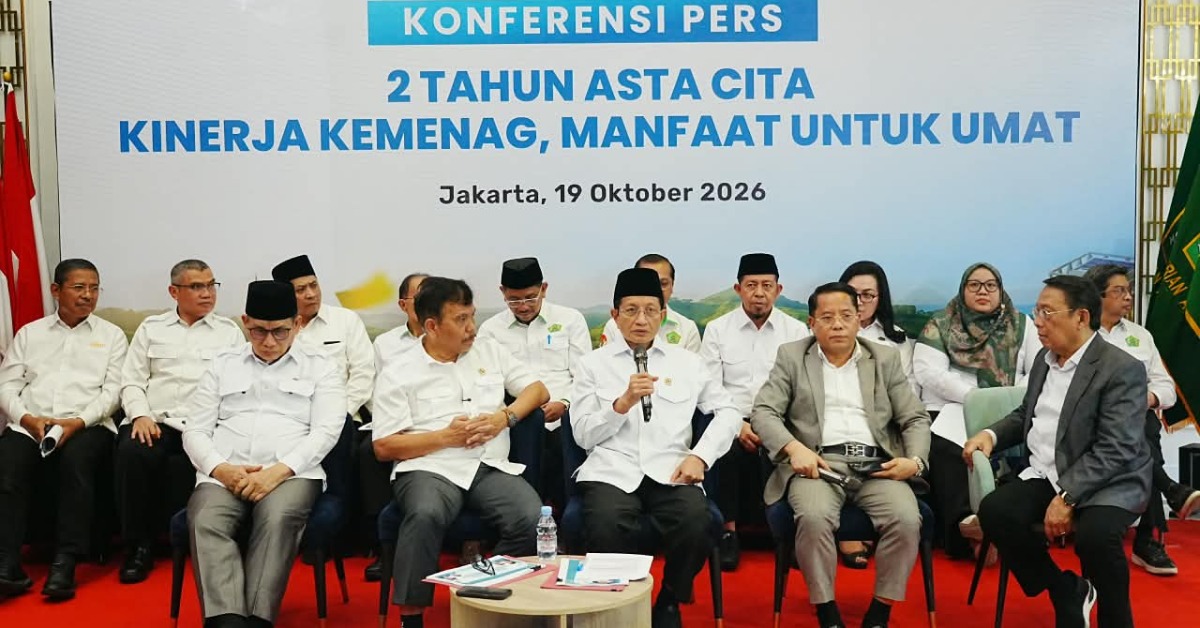
“When asked what we hope to achieve through all these efforts, the answer is simple. Once again, this is a mandate from President Prabowo: we want the government, through the Ministry of Religious Affairs, to have a greater and more tangible presence in people’s lives,” the minister said at a press conference on the achievements of the first two years of Asta Cita on Monday (October 19, 2026).
One of the largest areas of program outreach has been education. Throughout 2025–2026, the Indonesia Smart Program (Program Indonesia Pintar/PIP) reached 5,216,294 students at madrasahs and Christian, Catholic, and Hindu educational institutions, with a budget allocation of IDR 4.07 trillion.
At the higher education level, the Smart Indonesia Card for Higher Education program (KIP Kuliah) supported 289,255 students at Islamic, Christian, Catholic, Hindu, and Buddhist religious higher education institutions, with funding totaling IDR 3.032 trillion. The Ministry of Religious Affairs–Indonesia Endowment Fund for Education (LPDP) Indonesia Bangkit Scholarship Program also supported 3,659 recipients in 2024–2025, with a total allocation of IDR 1.377 trillion.
“In education, our primary concern is ensuring that financial hardship does not deprive Indonesian children of the opportunity to learn,” the minister emphasized.
The Ministry has also expanded religious education opportunities for the Confucian community by establishing the State College of Confucian Studies (Sekolah Tinggi Agama Khonghucu Negeri/SETIAKIN) in the Bangka Belitung Islands.
Support for educators’ welfare has also been strengthened. In 2025, a total of 452,796 madrasah teachers and religious education teachers serving Islamic, Christian, Catholic, Hindu, and Buddhist communities received professional allowances worth IDR 19.148 trillion. In 2026, the program covered 671,704 madrasah and religious education teachers, with an allocation of IDR 25.996 trillion.
6.3 Million Students and Santri Reached by the Free Nutritious Meals Program
Support for students and santri has also been provided through the Free Nutritious Meals (Makan Bergizi Gratis/MBG) and Free Health Checkup (Cek Kesehatan Gratis/CKG) programs. The MBG program has reached 6,335,217 students and santri, while the CKG program has served 3,209,783.
Deputy Minister of Religious Affairs Father Muhammad Syafi’i said meeting nutritional and healthcare needs is an essential part of improving the quality of future generations.
“Children who are healthy and receive adequate nutrition naturally have better opportunities to learn, grow, and develop their potential,” the deputy minister said.
He noted that expanding the MBG program to Islamic boarding schools must be accompanied by accurate student data collection, targeted distribution, and consistent food quality. Islamic boarding schools are also expected to become more actively involved in the MBG ecosystem so that the program delivers benefits beyond nutritional support and helps stimulate economic empowerment within pesantren communities.
“Strong pesantren must be supported by healthy, capable santri who have opportunities to grow,” he emphasized.
Presidential Attention to Religious Communities
The deputy minister added that various policies introduced over the past two years demonstrate President Prabowo’s commitment to addressing the needs of religious communities.
According to him, this commitment is also reflected in institutional strengthening and the restructuring of several religious affairs portfolios to ensure they receive more focused attention.
“I would like to invite everyone to recognize that this reflects the President’s commitment to giving serious attention to religious communities,” he said.
He explained that institutional strengthening is not merely a matter of changing the structure of government. More importantly, it ensures that each strategic area receives greater attention and more effective management.
One example is the strengthening of pesantren institutions through the establishment of the Directorate General of Pesantren. According to the deputy minister, this initiative supports the three core functions of pesantren mandated by the Pesantren Law: education, religious outreach (dakwah), and community empowerment.
“Strengthening the Directorate General of Pesantren is not simply about adding another administrative structure to the Ministry of Religious Affairs. Our goal is to strengthen the pesantren ecosystem and expand its benefits for the community,” he said.
He added that the Ministry has a broad mandate for public service, ranging from improving the quality of religious life and education to strengthening pesantren and serving religious communities. These efforts form part of the Ministry’s collective contribution to advancing President Prabowo’s government agenda.
Community Economic Empowerment and Religious Harmony
Secretary General of the Ministry of Religious Affairs Professor Dr. Phil. Kamaruddin Amin, M.A., reported that efforts to empower community economies had generated IDR 44.698 trillion through the collection of zakat, *infaq*, *sadaqah*, and other religious social funds, with 149.954 million beneficiary records reported.
Cash waqf assets also reached IDR 4.7 trillion, benefiting 750,000 people through initiatives including educational scholarships and productive waqf incubation programs.
“For us, what matters is not merely how much money is collected, but how much benefit it brings to the community,” the secretary general said.
Community empowerment programs have also been developed through 267 Zakat Villages, 287 economic empowerment locations based at Religious Affairs Offices (Kantor Urusan Agama/KUA), which reached 2,141 beneficiaries in 2025–2026, and 25 Waqf Cities.
In addition, religious community funds have been managed through several institutions, including IDR 6.16 billion through the Kasih Persaudaraan Bangsa Foundation (Christian), IDR 3.17 billion through the National Dharma Fund Agency (Hindu), and IDR 11 billion through the Paramita Fund (Buddhist).
“Our hope is that people will not only receive assistance today but also become increasingly empowered to build a better future,” he added.
Meanwhile, efforts to strengthen religious harmony have yielded measurable progress. The Religious Harmony Index rose from 76.47 in 2024 to 77.89 in 2025, exceeding the 2025 National Medium-Term Development Plan (RPJMN) target of 76.77.
Government Communications Agency Commends the Ministry
Head of the Government Communications Agency (Badan Komunikasi Pemerintah/Bakom), Dr. Syahganda Nainggolan, commended the Ministry of Religious Affairs for promoting religion as a positive force with a tangible impact on people’s lives. He said this role can be seen in efforts to strengthen national unity, build integrity, and improve human resource quality.
Syahganda said one of the Ministry’s important roles is to position religion as a force that reinforces national unity. In Indonesia’s diverse society, religious values can serve as a source of strength for maintaining solidarity and togetherness.
“On behalf of Bakom, we greatly appreciate the three points I noted earlier. First, the Minister of Religious Affairs and his team have succeeded in strengthening the role of religion as a force for national unity,” Syahganda said.
He noted that the achievements presented by Minister Nasaruddin Umar and his team demonstrated how religion contributes to strengthening national life. Religion’s role in fostering unity was one of the key areas highlighted by Bakom in its assessment of the Ministry’s performance.
Syahganda also praised the Ministry’s efforts to position religion as a force for freeing society from a culture of corruption. He said religious values can foster awareness of the importance of living honestly and maintaining integrity.
“Second, they have succeeded in making religion a means of liberating society from a culture of corruption,” he said.
He explained that the Ministry’s reported achievements illustrated how religious values could encourage people to reject corrupt practices. According to him, the Minister of Religious Affairs continues to pursue these efforts by strengthening the role of religion in everyday life.
“I saw how religion can persuade people to live with integrity and stay free from corruption,” he remarked.
The third achievement highlighted by Syahganda was the Ministry’s contribution to improving human capital. He cited distance learning and scholarship programs as examples of initiatives that support human resource development.
“Third, religion also plays a role in advancing human development and improving human resources through initiatives such as distance learning, scholarships, and other programs,” he said.
On the occasion, Syahganda emphasized that reporting the achievements of the first two years of Asta Cita was part of the accountability of President Prabowo Subianto and Vice President Gibran Rakabuming Raka’s administration to the public.
“Reporting these achievements is part of the government’s accountability and commitment to public information transparency,” he stressed.
According to Syahganda, the government has an obligation to disclose information about its work and results because these programs are funded by public resources, including tax revenues.
He explained that ministries and government agencies would communicate the administration’s two-year achievements through various channels, including direct briefings with journalists, press releases, and coverage in the mass media.
Beyond presenting achievements, the forum also provided an opportunity to receive feedback on the implementation of government programs. Syahganda expressed hope that the media would convey public complaints and outstanding issues requiring further attention, including matters related to the Ministry of Religious Affairs’ services.
“Feedback from our media colleagues is something we welcome and hope to convey to the President and the government,” he said. (zm)