Transnational Academic Mobility Compacts: UIN Jakarta Hosts 200 Asian Rectors to Restructure Islamic University Standards
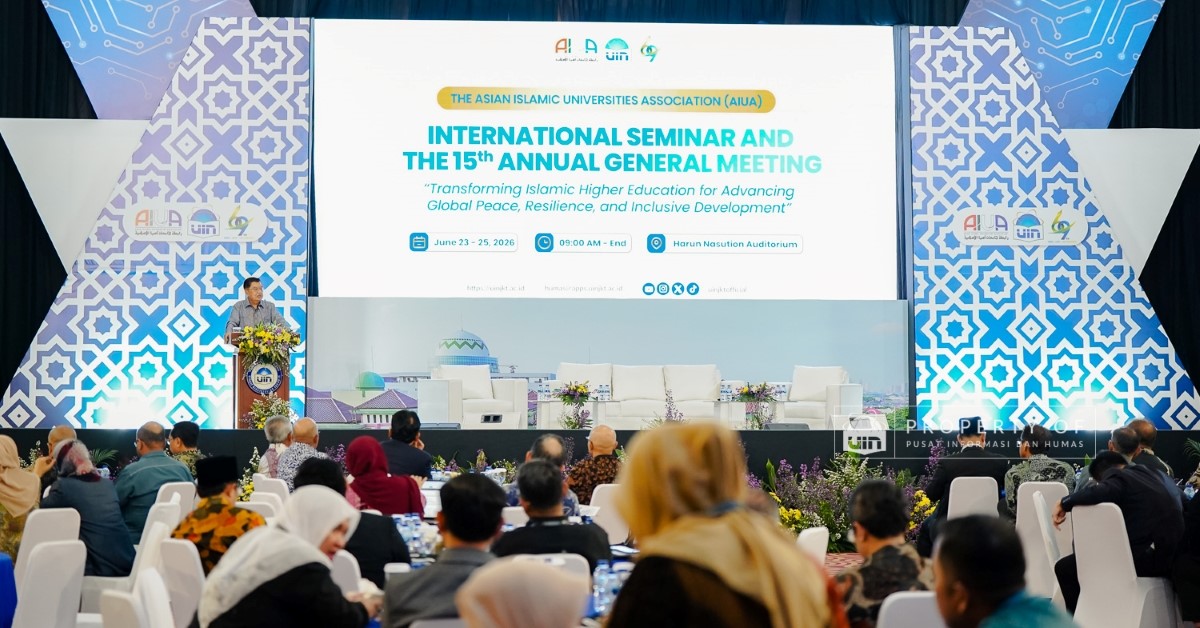
JAKARTA, UIN Online News – Dozens of university rectors, geopolitical strategists, international diplomats, and educational policymakers from across Southeast Asia and the broader Asian continent gathered at UIN Syarif Hidayatullah Jakarta for the opening of the 15th Asian Islamic Universities Association (AIUA) Annual General Meeting and International Seminar. Running through late June 2026 (Wednesday, 24 June), the high-level academic consortium is operating under the strategic theme “Transforming Islamic Higher Education for Advancing Global Peace, Resilience, and Inclusive Development.”
Serving a dual role as both the Rector of UIN Jakarta and the sitting President of the AIUA, Professor Asep Saepudin Jahar, Ph.D., officially inaugurated the summit. He framed the assembly as a critical vehicle for transnational academic diplomacy in an era marred by fragmented global security orders.
"Islamic universities command a strategic mandate that extends far beyond standard pedagogical delivery," Rector Jahar stated during his opening address. "We bear an institutional accountability to construct regional peace architectures, fortify social resilience, and drive inclusive, sustainable public policies. As the world faces compounding crises—ranging from brutal geopolitical conflicts and climate displacement to hyper-accelerated digital transformations—higher education must actively engineer human-centric ethical policies."
The international seminar featured two of Indonesia’s most prominent national figures who delivered high-impact keynote papers targeting the future of global education governance.
The 10th and 12th Vice President of the Republic of Indonesia, H.M. Jusuf Kalla, delivered a sharp, pragmatist paper titled “Islamic Leadership and Peacebuilding in a Fragmented Global Order.” Kalla argued that the true power of modern nations is no longer calculated by military deployment or population size, but by their velocity in mastering advanced scientific research and technological engineering. He mandated that Islamic universities must evolve into hyper-efficient incubators for innovation to breed a new generation of researchers capable of anchoring regional peace.
Reinforcing this vision, the Governor of the National Resilience Institute of the Republic of Indonesia (Lemhannas RI), Dr. Ace Hasan Syadzily, delivered a strategic brief titled “Islamic Higher Education, Democracy, and Global Transformation.” Governor Syadzily argued that State Islamic Universities hold a unique competitive advantage by injecting deep moral and spiritual frameworks directly into the tech sector.
"Islamic higher education must act as the primary incubator for ethics in an era of disruptive, unchecked technological growth," Governor Syadzily asserted. "Religious ethics are not regressive; they serve as the ultimate moral compass to ensure that global civilization does not lose its humanity amid rapid digital transitions."
The summit deployed two high-profile panel discussions to operationalize these ethical mandates.
The first executive panel, “Islamic Higher Education as a Strategic Actor in Peacebuilding and Social Cohesion,” featured Dr. Shukree Langputeh from the Ibn Auf Institute of Technology Thailand and Professor Noorhaidi of UIN Sunan Kalijaga Yogyakarta, moderated by international political analyst Professor Ali Munhanif, Ph.D. The dialogue focused on leveraging campus networks to de-escalate cross-border social frictions.
The second panel, “Repositioning Islamic Higher Education in the Age of Global Disruption: Innovation, Integration, and Impact,” interrogated the mechanics of curriculum integration. The panel brought together Dr. Haji Hambali from Universiti Islam Sultan Sharif Ali Brunei Darussalam, Professor Dato’ Dr. Wan Sabri Bin Wan Yusof from Universiti Sultan Azlan Shah Malaysia, and Professor Mujiburrahman of UIN Antasari Banjarmasin, under the moderation of global education expert Professor Muhammad Zuhdi, Ph.D.
To institutionalize these discussions, the 200 university delegates executed a massive multilateral signing of Memorandums of Understanding (MoUs). This legal compact directly locks in cross-border student credit transfers, joint-degree manufacturing pipelines, international faculty exchanges, and multi-author Scopus publication networks.
The evening session shifted toward state-level institutional integration, featuring a diplomatic dinner headlined by the Director General of Islamic Education at the Indonesian Ministry of Religious Affairs, Professor Muhammad Amin Suyitno. He delivered an executive brief titled “Strengthening PTKIN Global Engagement through Networking, Collaboration, and Institutional Synergy,” mapping out state funding for global university networks.
The summit will reach its legislative climax during the 15th AIUA Annual General Meeting. The closed-door executive session will audit the association’s 2024–2026 financial and strategic accounts, execute institutional capability presentations, and draft the highly anticipated AIUA Strategic Plan 2026–2028. The general assembly will conclude with the election of the next AIUA President and the restructuring of its transnational executive board, permanently upgrading the global visibility of Asian Islamic higher education.
(Zaenal/Arifin/Photo: Azka Raysa)