
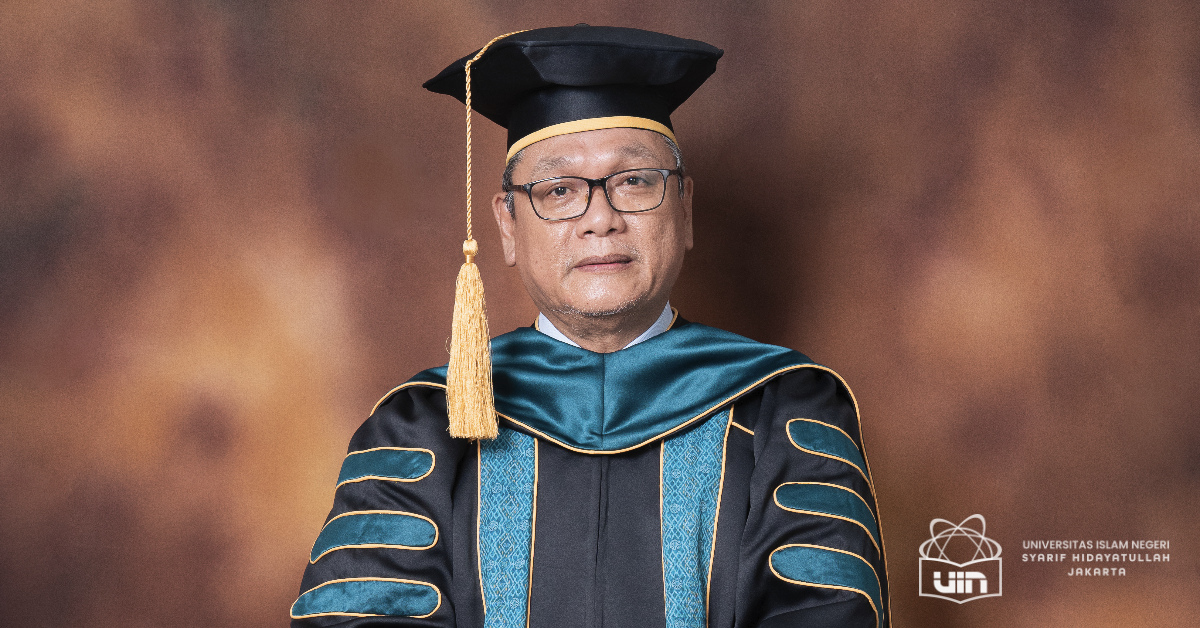
Transforming Fiqh Pedagogy in the Digital Era, Prof. Sapiudin Proposes the SMART and Cyber Scientific Models



Harun Nasution Auditorium, UIN News Online – Amidst the rapid surge of digital information, learning Fiqh (Islamic jurisprudence) can no longer rely solely on memorizing ruling outcomes. Students must also comprehend why and how a ruling is established. This core issue formed the centerpiece of Prof. Dr. Sapiudin Shidiq, M.Ag.'s professorial address titled “Ushul-Based Transformation of Fiqh Learning through the SMART Model and Cyber Scientific Approach” delivered during the Open Senate Session for the Professorial Inauguration at UIN Syarif Hidayatullah Jakarta in the Harun Nasution Auditorium on Wednesday (30/09/2026). On this occasion, Prof. Sapiudin was officially inaugurated as Full Professor of Fiqh Pedagogy.
In his address, Prof. Sapiudin highlighted that Fiqh instruction remains predominantly oriented toward fiqh as product—the rote mastery of historical ijtihad outputs. Students are taught to recognize legal rulings rather than understanding the underlying rationales and methodologies through which those rulings were derived. According to him, this instructional paradigm must shift to effectively address continuously evolving contemporary issues.
“Instruction must pivot from a fiqh as product orientation toward fiqh as process by strengthening the epistemology of Ushul Fiqh (jurisprudential methodology),” he explained.
“Therefore, Fiqh learning should not conclude with the mere transmission of legal codes, but must actively cultivate legal reasoning, enabling students to grasp the rationality of Islamic law while applying it accurately amidst modern dynamics,” Prof. Sapiudin noted.
To address this challenge, Prof. Sapiudin positioned Ushul Fiqh as the fundamental bedrock for cultivating Islamic legal reasoning. Students are guided beyond passive acceptance of legal rules toward analyzing the underlying arguments, methods, and principles behind legal deduction. In this manner, Fiqh instruction transitions from product consumption to a methodological understanding of legal deduction (istinbāṭ).
He translated this concept into the SMART Model (Systematic, Meaningful, Analytical, Reflective, and Technology-Integrated) combined with a Cyber Scientific approach. This framework bridges Ushul Fiqh reasoning with digital technology through observation, information exploration, critical analysis, and reflection.
Through the Cyber Scientific approach, digital technology serves as more than a search tool for religious information. Students are guided to evaluate source credibility, compare scholarly arguments, and construct rational legal conclusions grounded in Ushul Fiqh principles. Empirical research presented by Prof. Sapiudin demonstrated that implementing the SMART Model increased students' average learning scores from 65.87 on pre-tests to 86.13 on post-tests.
Prof. Sapiudin's academic trajectory is closely tied to the domain of his address. Since 2000, he has served as a lecturer in Islamic Religious Education at the Faculty of Educational Sciences and Teacher Training (FITK) UIN Jakarta, specializing in Fiqh and Ushul Fiqh. His experience evolved into extensive research and pedagogical model development, culminating in his appointment as Head of the Doctoral Program in Islamic Religious Education at FITK UIN Jakarta in 2024.
For Prof. Sapiudin, digital transformation represents more than a change in teaching techniques; it signifies a shift in how students engage with and understand Fiqh. Instruction is designed to build critical, argument-driven, and reflective thinking skills, alongside responsible digital media literacy.
“Consequently, learning Fiqh is no longer understood as memorizing legal clauses, but as a scientific process that trains Higher Order Thinking Skills (HOTS),” he stressed.
By integrating Ushul Fiqh, the SMART Model, and Cyber Scientific methods, Prof. Sapiudin offers a Fiqh instructional model firmly rooted in classical Islamic tradition while fully equipped to address modern transformations. The goal is not merely to produce students who know Islamic law, but scholars capable of understanding legal deduction, evaluating religious information critically, and constructing sound arguments when confronting complex issues in a digital society.
Watch the complete proceeding of the Open Senate Session for the Professorial Inauguration on UIN Syarif Hidayatullah Jakarta's official YouTube channel: