Top Graduate Calls for Digital Intelligence and Moral Leadership at UIN Jakarta’s 140th Commencement
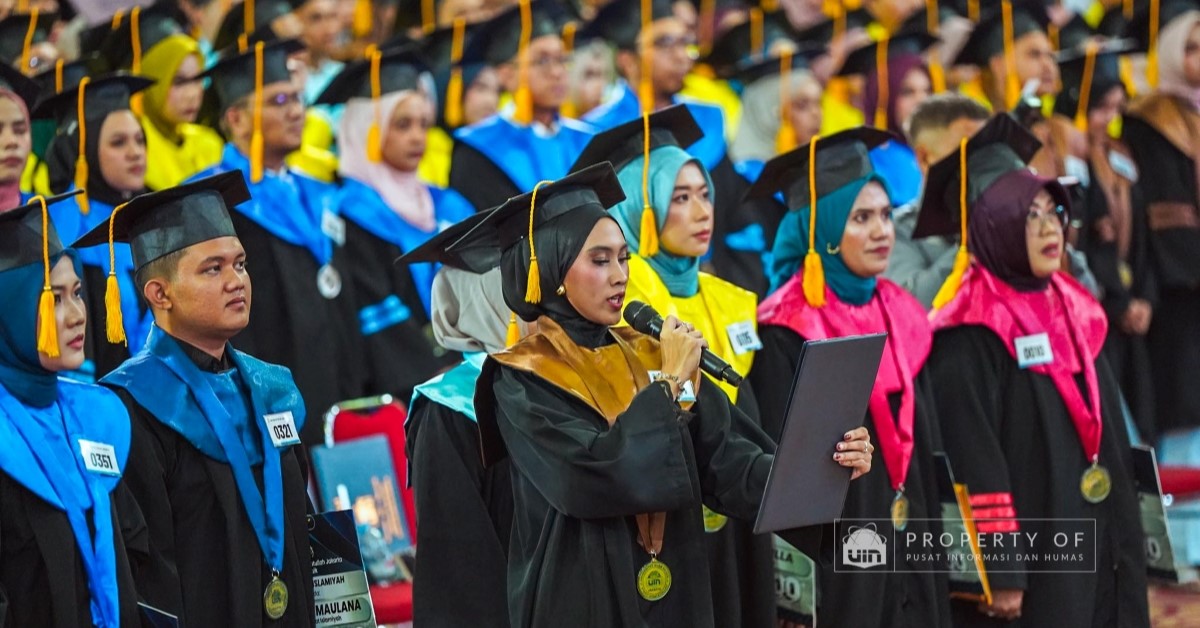
Harun Nasution Auditorium, UIN News Online — UIN Syarif Hidayatullah Jakarta officially conferred degrees upon 1,557 graduates during its 140th Commencement Ceremony for the 2025/2026 Academic Year, celebrating the achievements of students from undergraduate, master's, and doctoral programs.
The second day of the ceremony, held on Sunday (May 24, 2026), recognized 789 graduates from seven faculties: the Faculty of Sharia and Law, Faculty of Dirasat Islamiyah, Faculty of Psychology, Faculty of Economics and Business, Faculty of Science and Technology, Faculty of Social and Political Sciences, and Faculty of Medicine.
Among the graduates honored during the ceremony were several recipients of Outstanding Graduate Awards for their exceptional academic performance.
At the master's level, the distinction was awarded to Nur Miftahul Jannah from the Master’s Program in Sharia Economic Law and Taslimah from the Master’s Program in Dirasat Islamiyah, both graduating with cum laude honors.
At the undergraduate level, outstanding graduates included Muhammad Khosyi Akhdan Sasongko (Law), Alilah Najwa (Dirasat Islamiyah), Lucy Rachmawati (Psychology), Devara Dipa Dirana (Management), Muhammad Abdul Ghopur (Mathematics), Arinatul Ulya (International Relations), and Dyanata Irdina Anthea (Medicine), all of whom achieved outstanding academic records and graduated with cum laude distinctions.
The university also recognized exceptional undergraduate research projects. The award for Best Thesis in Social Sciences was presented to Devara Dipa Dirana for his study on forecasting the volatility of Bitcoin, Indonesia’s Composite Stock Price Index (IHSG), and gold using a GARCH modeling approach. Meanwhile, the Best Thesis in Science was awarded to Rahma Raudia Faizin from the Faculty of Medicine for her research on oral bacterial biodiversity among Islamic boarding school students using siwak (Salvadora persica), analyzed through 16S rRNA gene detection.
Representing the graduating class, Devara delivered a speech reflecting on the responsibilities that accompany academic achievement in an era shaped by rapid technological transformation.
She expressed gratitude to the university’s leadership, lecturers, and academic staff for their guidance and support throughout the graduates’ educational journey.
“Our success today is the result of countless acts of dedication from those who helped shape us. On behalf of all graduates, I extend our deepest appreciation to the university leaders, faculty members, and lecturers for their knowledge, patience, and guidance,” he said.
In his address, Devara noted that graduates are entering a world where technological advancement is reshaping traditional boundaries and transforming nearly every aspect of life. However, she cautioned that technological progress does not always go hand in hand with wisdom and ethical responsibility.
“Many people today are capable of using technology, but not everyone knows how to use it wisely. Many can speak quickly and confidently on social media, yet only a few are able to communicate with responsibility and integrity. Many aspire to become viral, but only a few strive to become truly meaningful,” he remarked.
According to Devara, the key challenge facing today’s graduates is developing a distinctive competitive advantage that sets them apart in an increasingly complex and interconnected world.
He argued that such an advantage cannot be built solely on technical skills or academic excellence. Instead, it requires a balance between digital competence and strong ethical values.
“Our competitive advantage lies in the integration of digital intelligence and a strong moral and spiritual compass. Technology without morality can lead to harmful disruption, while morality without technological competence risks leaving us behind. The future belongs to those who are able to combine both,” she said.
His message resonated with the broader theme of the commencement ceremony: preparing graduates not only to succeed professionally, but also to contribute responsibly to society. As UIN Jakarta welcomed 1,557 new alumni into its global community, graduates were encouraged to embrace lifelong learning, uphold ethical values, and develop the adaptability needed to thrive in an increasingly digital world.