
Thou Shall Not Kill in the Name of God
Rumadi Ahmad
Professor at FSH UIN Jakarta
In the volatile landscape of 2026, the drumbeats of war between the U.S.-Israeli alliance and Iran have taken a chillingly theological turn. Religion is once again being hijacked—not as a spiritual anchor, but as a divine mandate for mass destruction.
On April 4, 2026, U.S. Secretary of Defense (also read: Secretary of War) Pete Hegseth issued a declaration that stripped away the mask of modern statecraft: “US troops are fighting for Jesus.” This rhetoric follows a darker pattern of dehumanization, where Hegseth previously claimed that the enemy is not a country, but a belief system. To manufacture consent for this new conflict, President Donald Trump has transformed the Oval Office into a stage for moral theater, inviting religious leaders to pray over his desk as he prepares to ignite the Middle East.
The 9/11 Playbook
For a growing number of Americans, this "Holy War" script is a recycled nightmare. In 2026, the silence surrounding the tragedy of September 11 is finally breaking, with many viewing it as the original internal orchestration used to justify decades of eternal war. However, today’s skepticism is fueled by another urgent crisis: the looming shadow of the Epstein Files.
As the public demands the full unmasking of the powerful figures involved in the Jeffrey Epstein scandal, the sudden escalation of war in the Strait of Hormuz feels like a strategic diversion. Veterans and activists alike argue that "Fighting for Jesus" is the perfect smoke screen—a way to wrap the state in the flag and the cross just as its darkest domestic secrets are about to be exposed. For many, the war isn't just about regional hegemony; it's a desperate attempt to bury the "Epstein Files" under the rubble of a new, sanctified conflict.
Furthermore, some veterans argue that the 9/11 narrative was the first Great Hijacking. It was a tragedy leveraged to weaponize fear, allowing the industrial-military complex to invade sovereign nations under a banner of sanctified national security. Today, as Hegseth calls for a new crusade, a nation scarred by the lies of the past is finally waking up. They see that the enemy was not just "out there"; it was also in the rooms where war is planned for profit by companies like Lockheed Martin, Morgan Stanley, ExxonMobil & Chevron, and others.
The Pope vs. The Pentagon
This historical skepticism is why Pope Leo XIV’s anti-war stance has resonated so deeply. By labeling the current conflict a scandal against humanity and stating that "God does not bless any conflict," the Pope is directly sabotaging the symbolic foundation of the Trump administration’s war machine.
When the President threatened the Holy See, labeling the Pope weak, he was actually reacting to the collapse of his moral monopoly. The Pope is not just advocating for peace; he is reclaiming the figure of Christ from those who would use his name to sell Hellfire missiles.
Indonesia’s "Third Way": The Istiqlal Signal
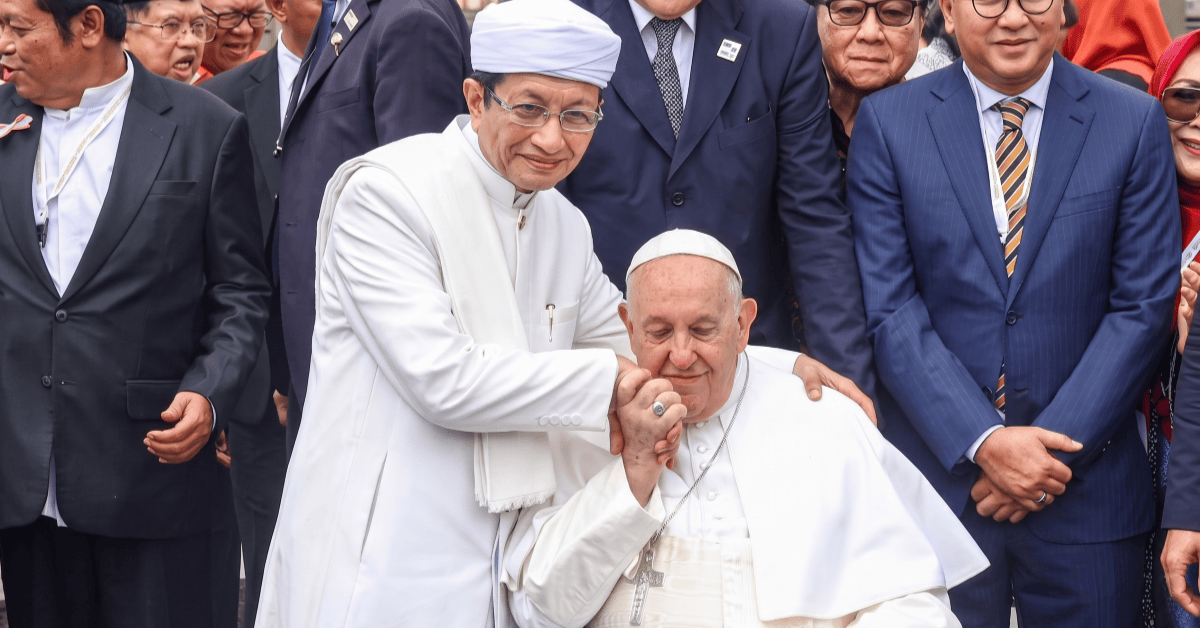
While Washington preaches an Orientalist's approach of "Us vs. Them," the image of Indonesian Religious Affairs Minister Nasaruddin Umar and Pope Francis at the Istiqlal Mosque stands as a quiet but defiant rebuttal. This is the spirit of Indonesia’s non-aligned heritage—a refusal to participate in the sacralization of violence that has defined Western foreign policy since 2001.
Indonesia proves that the world’s most populous Muslim nation and the head of the Catholic Church can stand together against the Crusade narrative. It suggests that the true divide is not between Sunni and Shia, or Christian and Muslim, but between those who seek peace and those who use the altar to build an arsenal.
True leaders never start a war
Ultimately, we are witnessing a struggle between two irreconcilable visions of faith. On one side stands a theology of power, where God is reduced to a tribal deity who validates the geopolitical ambitions of an empire—a vision that views the tragedies of the past, from 9/11 to the present, as mere tools for mobilization.
On the other side stands a theology of humanity, echoed by the Pope and the spirit of Istiqlal, which believes that the Divine is found in the preservation of life, not its destruction. While the warriors for Jesus in Washington bank on the belief that fear and flags can still fuel a crusade, a growing global chorus is betting on a different conviction: that true faith begins where the state’s manipulation ends.
In this final standoff, the victory will not be measured by the fall of a distant capital, but by whether we can finally strip the mask of holiness from the face of greed.
This article was published in Media Indonesia on Tuesday (28/4/2026). Credit: Harian Jogja