
The Faculty of Adab and Humanities Convenes Strategic FGD, Dissecting UIN Jakarta’s Post-Transformation Identity and Global Competitiveness
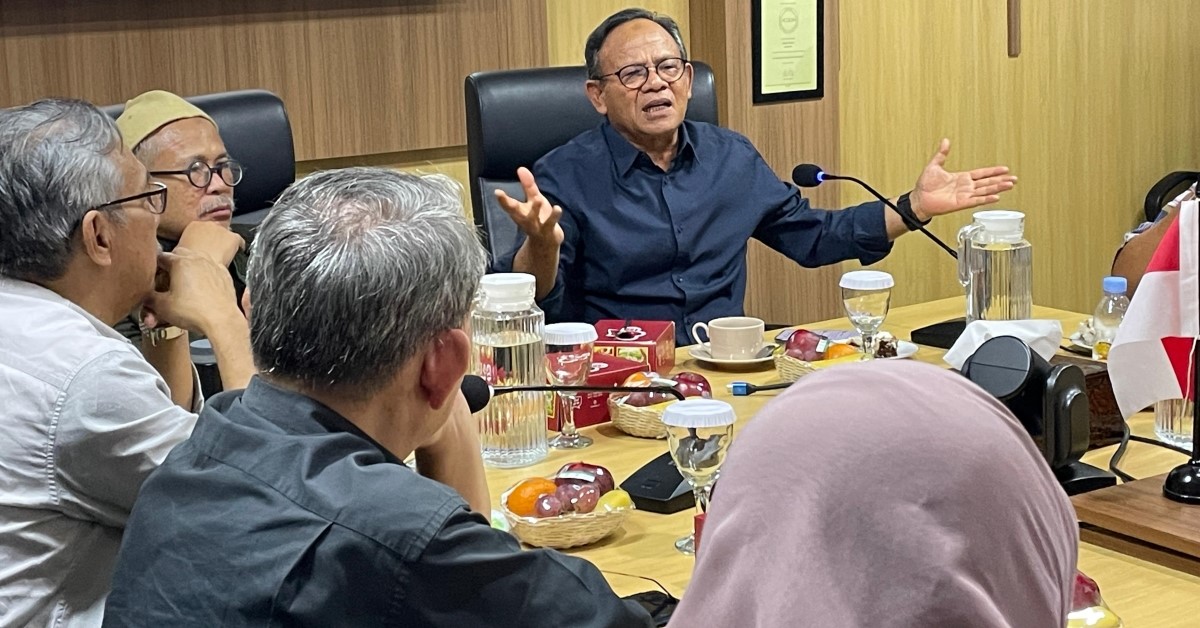
FAH, UIN Online News – The Faculty of Adab and Humanities (FAH) at UIN Syarif Hidayatullah Jakarta organized a high-level Focus Group Discussion (FGD) under the executive theme “UIN Jakarta’s Post-Transformation Development.” The academic forum was convened to re-examine the historical trajectory of UIN Jakarta’s institutional evolution—spanning from the ADIA era to its comprehensive university status—by evaluating the intellectual model of integrating secular and Islamic sciences at the Main Conference Room on Friday, May 8, 2026.
The intellectual convention featured prominent Indonesian Muslim scholars and university executives, including the Rector of UIN Jakarta for the 2006–2010 and 2010–2015 administrations, Prof. Dr. Komaruddin Hidayat; Senior University Professor, Prof. Hamid Nasuki; the Rector of the Indonesian International Islamic University (UIII), Prof. Jamhari; alongside Senior Scholar, Prof. Amsal Bakhtiar.
In his keynote address, Prof. Komaruddin Hidayat analyzed that developed nations allocate massive economic capital to back higher education because of a generational determination to address international challenges, economic expansion, and technological dominance.
“Analyzing Indonesia’s geopolitical stance, we do not operate under the same state spirit as Iran, China, or Russia, which aggressively strive to become superpowers within their respective territories. Therefore, Indonesia possesses a deeper, structural necessity for an education that is culturally rooted, a primary example of which is advanced religious and ethical education,” he explained.
Aligning with this geopolitical view, Prof. Hidayat emphasized the importance of evaluating the historical sociology of Muslim communities in Southeast Asia. He noted that Islam integrated into the Indonesian archipelago via trade routes, interacting with a society that already maintained established spiritual rituals. This engineered an educational ethos centered on social harmony rather than cutthroat geopolitical competition.
“Alhamdulillah, modern UIN Jakarta is successfully competing on the global stage, operating as a central hub for progressive Islamic scholarship in Asia. It is safe to assert that UIN Jakarta has officially broken out of the mediocre campus tier in Indonesia, backed by the empirical achievement of our internationalization targets,” he added enthusiastically.
Talent Mobilization and International Benchmarking
Furthermore, Prof. Amsal Bakhtiar added that to accelerate these global milestones, UIN Jakarta must implement aggressive student and alumnus empowerment frameworks through international student exchanges and prestigious scholarship pipelines.
“This can be initiated by optimizing our scholarship offerings, including the specialized BAZNAS fellowship from the Ministry of Religious Affairs. For a contemporary model, we can evaluate UIII as an institutional benchmark. If necessary, we should recruit top-tier visiting educators from elite institutions like ITB or UGM, alongside global experts from overseas, to cultivate excellent, world-ready students here,” Prof. Bakhtiar asserted.
Addressing structural challenges, Prof. Hamid Nasuki analyzed the operational bureaucratic friction that occasionally complicates the development of an Islamic-based academic terrain. “Tracking our genealogy from ADIA, STAIN, and IAIN up to our modern university transformation, we have successfully expanded our academic disciplines without sacrificing our unique intellectual identity. However, state Islamic higher education networks must remain careful not to let standard general curricula diminish the distinct qualitative output of Islamic academic institutions,” he cautioned.
Concluding the FGD, Prof. Amsal Bakhtiar urged UIN Jakarta, particularly the Faculty of Adab and Humanities, to safeguard its academic brand and ensure that its core humanities study programs maintain direct relevance within the Indonesian national education framework.
“If we successfully preserve UIN Jakarta's foundational identity, then FAH will continue to operate as the definitive turning point and structural base for advanced Islamic studies,” he concluded.
Today, FAH UIN Jakarta actively operates four postgraduate programs that have officially secured international accreditation from ACQUIN, a prestigious European auditing agency. These certified programs include the Master's (S2) and Doctoral (S3) tracks in the History of Islamic Civilization and Arabic Language and Literature, cementing the faculty's status as a globally verified center of academic excellence.