Supporting Women's Development through Mentoring, Academic Guidance and Leadership Initiatives
Syarif Hidayatullah State Islamic University Jakarta recognises that mentoring, academic guidance, and leadership development can play an important role in empowering female students and strengthening their participation in higher education. Through institutional initiatives coordinated by the Center for Gender and Child Studies (PSGA), student development activities, and collaboration with external organisations, the University provides opportunities for women to develop confidence, leadership capabilities, professional networks, and academic skills.
During 2024–2025, UIN Jakarta implemented several programmes relevant to women's development, including participation in an international women's mentoring event, the establishment of its Gender Academy, and structured guidance activities for female students within its residential education system. These initiatives contribute to the University's broader commitment to Sustainable Development Goal 5: Gender Equality.
1. Participation in International Women's Mentoring

On 6 March 2025, UIN Jakarta participated in the International Women's Day Speed-Mentoring Roundtables, organised by the Embassy of Canada in Jakarta in collaboration with the Canadian Mission to ASEAN. The event brought together influential female leaders and participants from educational and professional backgrounds to discuss women's development, career opportunities, leadership, and gender equality.
The mentoring sessions allowed participants to interact directly with experienced women leaders through short, structured discussions. The programme featured mentoring conversations on professional development, leadership challenges, and opportunities for women to strengthen their contributions to society. PSGA UIN Jakarta facilitated the participation of a delegation that included female lecturers and a female student from the Social Welfare Study Programme.
The participants received opportunities to exchange ideas, learn from professional experiences, and develop connections with women leaders from different institutions. The University's participation reflected its efforts to expose female students to professional mentoring and women's leadership networks. This activity provides direct evidence of female student participation in mentoring during 2025. However, the event was organised by external partners, and the documented student participation does not establish the scale of a university-wide mentoring programme.
2. Establishment of the Gender Academy

The University strengthened its institutional gender-development activities through the launch of the Gender Academy, coordinated by PSGA. The initiative was introduced during a three-day Focus Group Discussion held on 4–6 June 2024.
The programme involved discussions on gender equality, women's empowerment, social barriers, and gender-responsive approaches within higher education. The Gender Academy was introduced as an institutional initiative intended to provide continued educational activities on gender-related issues for members of the University community.
Its establishment reflects the University's recognition that capacity-building and institutional awareness are essential to supporting women's participation. The programme provides a foundation for gender-responsive education and the development of future mentoring activities. However, the available public documentation does not establish that the Gender Academy operated as a formal female-student mentoring scheme or provide a complete register of female students participating in mentoring sessions.
3. Academic and Personal Development through Female Residential Guidance

UIN Jakarta also provides structured student development activities through Ma'had Al-Jami'ah, its residential education system. Several residential units serve female students, including Mabna Syarifah Mudaim, Mabna Syarifah Fatimah, and Mabna Syarifah Khadijah.
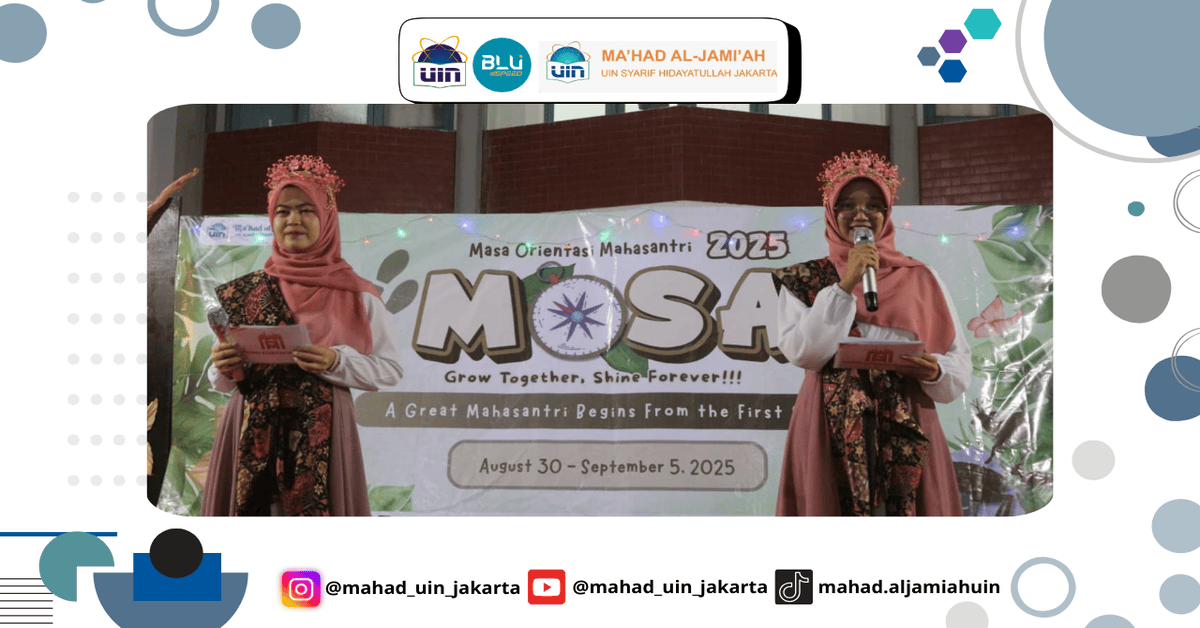
These residential communities provide academic, religious, character-building, and personal development activities designed to strengthen students' readiness for university life. Female student coordinators and residential supervisors contribute to student guidance, learning activities, leadership development, and adaptation to the academic environment. In September 2024, Mabna Syarifah Mudaim organised orientation and development activities attended by approximately 280 new female residential students.
Activities included opportunities for female residential leaders to demonstrate their skills and encourage students to develop confidence, creativity, and academic and non-academic capabilities. In August and September 2025, the same residential unit continued its orientation and character-development activities, including discussions, spiritual guidance, and academic preparation. These activities demonstrate the existence of structured educational guidance for female students within the University's residential system. Nevertheless, the documented orientation attendance should not automatically be counted as participation in a mentoring scheme without evidence that the students undertook qualifying mentoring activities.
4. Encouraging Women's Leadership and Professional Engagement

The University also provides educational forums that expose students to women leaders and encourage greater participation in public life. On 4 November 2025, the Faculty of Social and Political Sciences organised a seminar on Women and Public Diplomacy. The event brought together women leaders, academics, civil society representatives, and students to discuss women's contributions to diplomacy, leadership, cultural engagement, and international affairs.
The discussions encouraged female students to consider wider opportunities for leadership and public participation. Such activities contribute to women's professional development by providing exposure to experienced leaders and opportunities to learn about challenges and achievements in different fields. However, participation in a seminar does not by itself constitute participation in a structured mentoring programme. These events therefore provide supporting evidence of women's empowerment, rather than direct evidence of the mentoring participation threshold.
5. Monitoring Participation in Women's Mentoring Schemes
THE Impact Rankings Indicator 5.6.6 requires evidence that at least 10% of the University's female students participate in women's mentoring schemes. To demonstrate this requirement, the University must maintain reliable data on the total number of enrolled female students and the number of distinct female students participating in eligible mentoring programmes during the reporting period.
Participation should be supported by programme documentation, attendance records, mentoring schedules, and clearly identified student beneficiaries. The available 2024–2025 documentation establishes several relevant activities, but it does not provide a consolidated university-wide count of female mentoring participants. Consequently, the required 10% participation threshold cannot currently be verified. Establishing a coordinated participation register across PSGA, faculties, and student development units would strengthen the University's capacity to demonstrate its mentoring outcomes.
6. Contribution to SDG 5: Gender Equality
Through gender education, female residential guidance, leadership development, and participation in international mentoring activities, Syarif Hidayatullah State Islamic University Jakarta demonstrates efforts to support women's academic and professional development. The University's participation in the March 2025 Speed-Mentoring Roundtables provides direct evidence of mentoring opportunities involving a female student.
The Gender Academy and residential student development programmes provide additional evidence of institutional efforts to strengthen gender awareness, confidence, and women's capacity for participation. Together, these initiatives contribute to the broader objectives of Sustainable Development Goal 5. While UIN Jakarta has documented mentoring-related and women's development activities during 2024–2025, available evidence does not yet establish that at least 10% of all enrolled female students participated in qualifying women's mentoring schemes.
Further university-wide participation data would be required to demonstrate full compliance with Indicator 5.6.6.
Source :
https://uinjkt.ac.id/id/perayaan-hari-perempuan-internasional-2025-psga-uin-jakarta-kirim-delegasi-di-forum-diskusi-kedutaan-besar-kanada
https://www.uinjkt.ac.id/id/pertegas-gender-mainstreaming-di-perguruan-tinggi-islam-psga-luncurkan-akademi-gender
https://mahadaljamiah.uinjkt.ac.id/id/mudabbiroh-show-semarakkan-mosa-internal-mabna-syarifah-mudaim
https://mahadaljamiah.uinjkt.ac.id/id/mosa-mabna-syarifah-mudaim-a-great-mahasantri-begins-from-the-first-step
https://fisip.uinjkt.ac.id/id/seminar-perempuan-dan-diplomasi-publik