Strengthening Public Institutions through Policy Outreach, Education, and Capacity Building
Syarif Hidayatullah State Islamic University Jakarta contributes to stronger and more responsive public institutions by providing research-based outreach, knowledge dissemination, education, and capacity-building to government representatives and public-sector professionals.
Through academic units including the Center for the Study of Islam and Society (PPIM), the Graduate School, and other University centres, academic expertise is translated into forums, technical guidance, policy discussions, and educational activities covering environmental policy, climate change, religious moderation, public service, education policy, and conflict resolution. These activities enable government representatives and public-sector actors to access academic evidence and practical knowledge that can support informed decision-making and strengthen the implementation of public policy.
1. Climate and Environmental Policy Outreach to National Government Institutions

One of the strongest examples of policy outreach is the Religious Environmentalism Actions (REACT) Project implemented by PPIM of Syarif Hidayatullah State Islamic University Jakarta. On 25 April 2024, PPIM convened a REACT Project Board Meeting involving representatives from major national institutions, including the Ministry of Environment and Forestry, Ministry of Education, Culture, Research and Technology, Ministry of Religious Affairs, and the National Research and Innovation Agency.
The meeting created a structured environment for government representatives and researchers to exchange knowledge concerning environmental degradation, climate change, environmental education, and the role of religion in encouraging sustainable behaviour. PPIM presented the REACT research agenda and promoted the use of research findings as a basis for evidence-based policymaking. Government participants also contributed their respective institutional perspectives, creating a two-way learning process between academic researchers and public-sector policymakers. The forum therefore functioned not only as stakeholder consultation, but also as a mechanism for communicating academic evidence and strengthening policymakers' understanding of religious environmentalism and climate-related interventions.
2. Translating Research into Policy Learning
Policy outreach continued throughout the REACT programme. PPIM's institutional policy-advocacy approach is explicitly designed to connect research findings with the public-policy process. Research results are communicated through policy briefs, ministerial audiences, Project Board Meetings, focus-group discussions, and stakeholder forums. These mechanisms enable policymakers to engage with evidence concerning environmental sustainability, religious institutions, community behaviour, education, and climate action.
The University therefore provides more than written research reports. It facilitates opportunities in which government representatives can discuss the implications of research findings, examine implementation challenges, and consider how evidence can be incorporated into government programmes and strategic planning. This approach strengthens evidence literacy among policymakers and supports more informed policy development.
3. Educating Government Officials on Religious Moderation and Non-Discriminatory Public Service

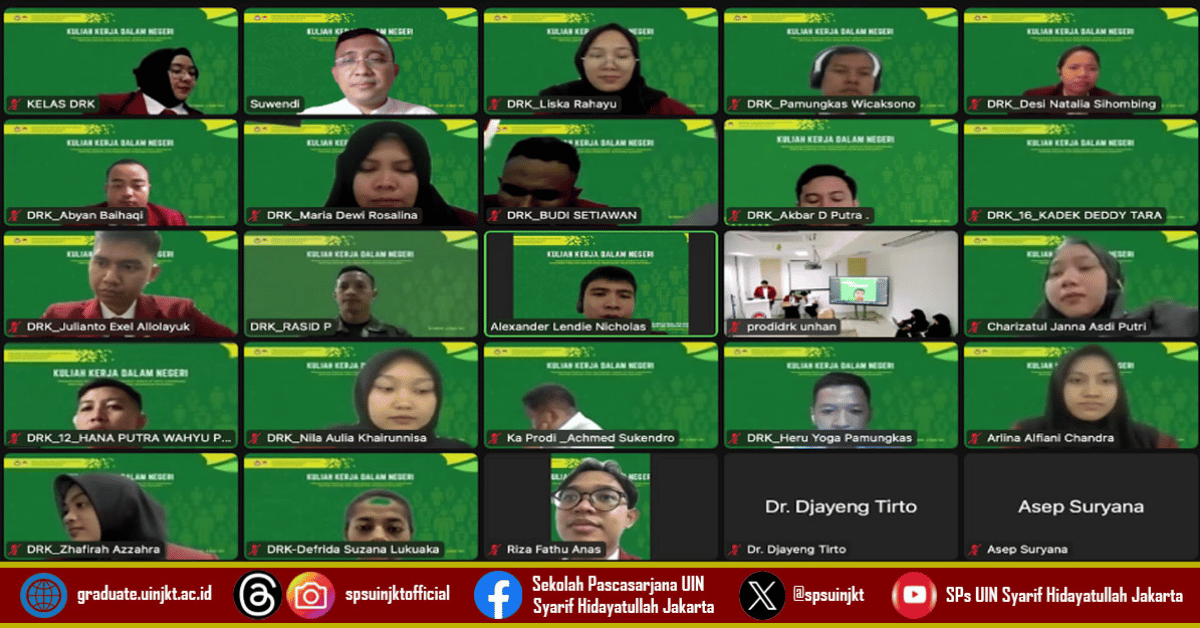
Syarif Hidayatullah State Islamic University Jakarta also provides direct education and capacity-building to public-sector officials. On 6 March 2024, Dr. Suwendi, M.Ag., a lecturer at the Graduate School, served as a resource person in the Integrated Technical Guidance for PPIH Kloter and Regional Hajj Officers (PHD) of West Java Province, organised by the Regional Office of the Ministry of Religious Affairs. The programme involved 754 government Hajj officers from across West Java. The training focused on religious moderation and its practical application in public service. Participants were encouraged to understand that public officials must provide services fairly and without discrimination regardless of differences in religion, ethnicity, background, health condition, or other characteristics.
The training connected religious moderation with civil rights, equality in public service, human dignity, and the responsibility of government personnel to provide inclusive services. By bringing academic expertise into an official government training programme, Syarif Hidayatullah State Islamic University Jakarta contributed directly to the professional development of public-sector personnel responsible for implementing government services.
4. Supporting Policy Learning on Peaceful and Inclusive Education

In August 2025, Syarif Hidayatullah State Islamic University Jakarta hosted the academic forum “Implementation of the Love-Based Curriculum for a Peaceful World.” The forum brought together University academics and representatives from the Ministry of Primary and Secondary Education and the Ministry of Religious Affairs. The discussion addressed the implementation of national education policy, including deep learning, character education, artificial intelligence and coding education, religious education, tolerance, empathy, and peaceful coexistence.
Representatives of the ministries explained current government policy directions, while University academics provided perspectives on how values such as compassion, openness, inclusivity, and human dignity can be implemented in education. This interaction created a policy-learning environment in which government officials, academics, and education stakeholders could jointly examine the practical implementation of national education reforms. The forum illustrates the University's broader role as a knowledge platform supporting education policymakers and government institutions.
5. Capacity Building on Conflict Resolution and National Security
The University's policy-education contribution also extends to conflict prevention and national security. In February 2024, a Graduate School lecturer from Syarif Hidayatullah State Islamic University Jakarta provided academic dissemination on religious moderation as an approach to multicultural conflict resolution through a programme organised by the Indonesian Defense University. The programme addressed conflict management in urban multicultural societies and its relevance to national security. Participants included officials, academics, and postgraduate students within the Defense University environment.
The session explained how religious moderation, cultural awareness, constitutional principles, pluralism, and respect for diversity can contribute to preventing and managing social conflict. Such educational outreach is relevant to public-sector capacity because conflict prevention and social cohesion are important dimensions of effective governance, security policy, and peaceful institutions.
6. Building Government Capacity through Academic Knowledge
Across these activities, the University's contribution can be understood through several complementary mechanisms. Research dissemination makes academic findings accessible to government representatives. Policy forums allow evidence to be discussed in relation to government priorities. Technical guidance and training strengthen the practical capacity of government personnel.
Academic–government dialogue enables officials and researchers to exchange perspectives and identify implementation challenges. Together, these mechanisms allow Syarif Hidayatullah State Islamic University Jakarta to serve as a bridge between academic knowledge and public-sector practice.
7. Linking Outreach to Evidence-Based Government
PPIM's REACT Project provides a particularly strong example of this relationship. Policy engagement undertaken during 2023–2025 involved representatives from key ministries and multiple organisations. The research generated by REACT subsequently contributed to discussions concerning the Strategic Plan of the Ministry of Religious Affairs and the development of national guidance concerning environmentally friendly pesantren. This illustrates why policy outreach and education are important.
Government representatives receive access to research evidence, while researchers gain a better understanding of government priorities and implementation constraints. The interaction allows academic evidence to become part of a continuous process of policy learning, rather than remaining within universities.
8. Contribution to SDG 16: Peace, Justice and Strong Institutions
Syarif Hidayatullah State Islamic University Jakarta demonstrates an active role in strengthening government knowledge and institutional capacity through policy outreach, education, and professional development.
Its contributions include:
-
environmental and climate-policy outreach to national ministries;
-
research dissemination and evidence-based policy dialogue;
-
technical education for government Hajj officers on religious moderation and non-discriminatory public service;
-
government–university dialogue on national education policy;
-
academic education on multicultural conflict resolution and national security; and
-
communication of research findings and recommendations to public-sector stakeholders.
These initiatives demonstrate that the University's expertise is made available beyond the academic community and is used to support the knowledge, skills, and decision-making capacity of government and public-sector actors.
Through research-based policy outreach, technical guidance, professional education, and government–university knowledge exchange, Syarif Hidayatullah State Islamic University Jakarta contributes to strengthening the capacity of public institutions to respond to social, educational, environmental, and governance challenges.
These activities provide substantive evidence for SDG Indicator 16.3.2: Policy- and Lawmakers Outreach and Education.
Source :
https://ppimcensis.or.id/2024/04/26/dorong-kolaborasi-hadapi-krisis-iklim-dan-lingkungan-ppim-uin-jakarta-gelar-project-board-meeting-program-religious-environmentalism-actions-react/
https://www.uinjkt.ac.id/id/dosen-sps-uin-jakarta-desiminasikan-moderasi-beragama-kepada-754-petugas-haji-se-jawa-barat
https://ppimcensis.or.id/profil/policy-advokasi/
https://www.uinjkt.ac.id/id/uin-jakarta-bersama-kemendikdasmen-dan-kemenag-dorong-kurikulum-cinta-dalam-pendidikan-nasional
https://graduate.uinjkt.ac.id/id/dosen-sps-uin-desiminasikan-kepada-universitas-pertahanan-tentang-moderasi-beragama-sebagai-resolusi-konflik-multikultural
https://ppimcensis.or.id/2025/12/18/ppim-gelar-project-board-meeting-ke-3-paparkan-capaian-dan-pelajaran-penting-proyek-react/