Strengthening Disability Access Schemes through Targeted Support and Academic Assistance at UIN Jakarta
Syarif Hidayatullah State Islamic University Jakarta is committed to promoting equitable access to higher education by developing targeted support mechanisms for students with disabilities. The University recognises that students with disabilities may experience barriers to academic participation that cannot be addressed solely through general university services or physical accessibility improvements.
To respond to these challenges, UIN Jakarta has developed institutional support through its Center for Students with Special Needs (CSSN), complemented by academic assistance, disability-awareness activities, and programmes designed to improve independence and participation. These initiatives contribute to Sustainable Development Goal 10: Reduced Inequalities, particularly Indicator 10.6.9 concerning mentoring and other targeted support schemes for persons with disabilities.
1. Establishing Institutional Support for Students with Disabilities
UIN Jakarta maintains the Center for Students with Special Needs (CSSN) as an institutional mechanism supporting disability inclusion. The Centre contributes to the University's efforts to promote accessibility in learning and reduce barriers experienced by students with special needs.
According to the University's 2025 Performance Report, CSSN has an important role in providing assistance services, facilitating accessible learning, and improving disability literacy among members of the academic community. These responsibilities establish a foundation for targeted support beyond the provision of general student services.
The University's performance reporting also emphasises the importance of strengthening CSSN as part of its commitment to inclusive higher education. Through this institutional framework, disability-related educational needs are recognised as matters requiring dedicated attention and coordinated support.
2. Facilitating Academic Assistance and Accessible Learning
Academic participation requires students to access teaching materials, engage in classroom activities, complete assignments, and participate in assessments. Students with disabilities may require additional support to overcome barriers within these processes.
UIN Jakarta's official performance documentation identifies learning accessibility and assistance as specific areas of responsibility within CSSN. These services support the University's efforts to develop educational arrangements that respond to disability-related needs.
The provision of targeted assistance is particularly important in promoting equitable participation, as students may encounter different challenges depending on their accessibility requirements. CSSN's documented role demonstrates that the University recognises the importance of individual assistance and accessible learning as components of disability inclusion.
3. Documenting Academic Mentoring and Assistance Practices
The role of student assistance has also been examined through academic research conducted at UIN Jakarta. A study published in July 2025, entitled The Role of Companions for Students with Visual Impairments in the Learning Process at UIN Syarif Hidayatullah Jakarta, explored the experiences of students with visual impairments, their companions, lecturers, and University representatives. The research identified five dimensions of assistance relevant to students with visual impairments:
- Academic assistance: Supporting access to learning materials, understanding course content, and completing assignments and examinations.
- Social support: Facilitating interaction with other members of the campus community and encouraging social participation.
- Psychological and emotional assistance: Providing emotional support and helping students manage challenges associated with academic participation.
- Advocacy: Supporting communication and coordination between students, lecturers, and relevant University stakeholders.
- Empowerment: Encouraging independence, confidence, and more inclusive educational experiences.
These research findings provide evidence that student-assistance practices have been observed within the University's learning environment. They also illustrate how mentoring-related support can address multiple aspects of academic participation. However, the research should be distinguished from administrative evidence of a formally established University-wide mentoring programme.
4. Providing Targeted Disability Empowerment Programmes
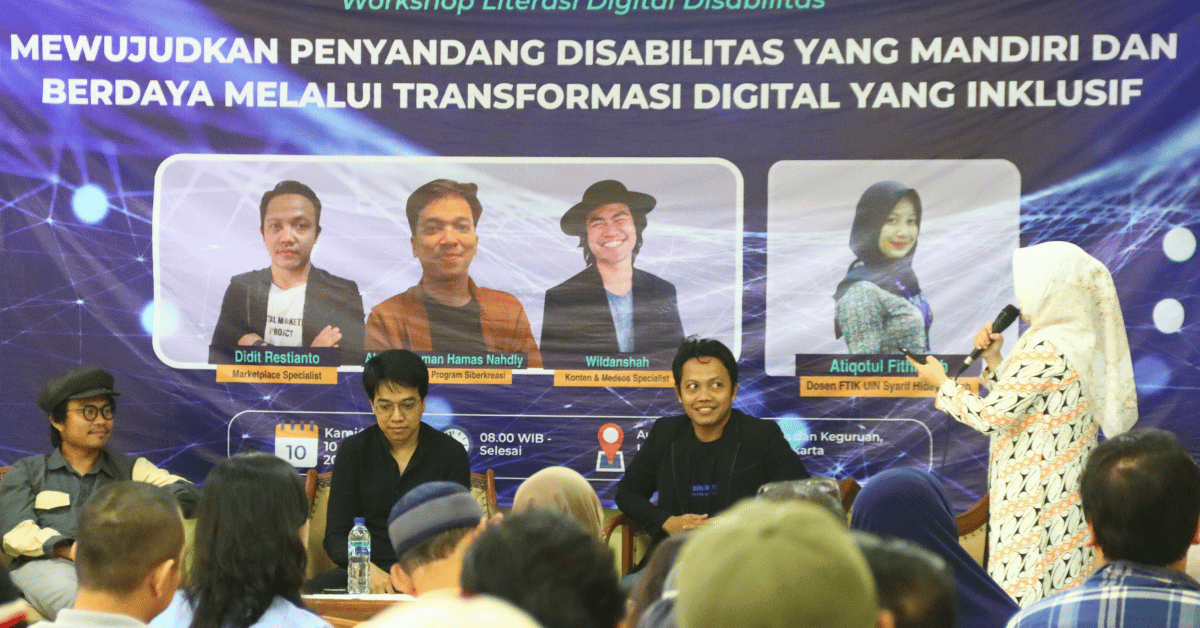
UIN Jakarta has also implemented targeted educational activities designed to strengthen the skills and independence of persons with disabilities. On 10 August 2023, CSSN organised a Disability Digital Literacy Workshop focusing on independence and empowerment through inclusive digital transformation.
The programme involved 70 participants with disabilities from the Greater Jakarta area and 30 members of the general public. The workshop introduced digital-literacy opportunities and discussed the use of technology for personal branding, economic participation, and independent development.
The activity demonstrates CSSN's previous experience in delivering programmes specifically designed for the needs of persons with disabilities. Although the event took place before the 2024 reporting period, it provides relevant background on the University's development of targeted disability-support activities.
5. Strengthening Disability Awareness and Peer Engagement

During 2024, UIN Jakarta continued to organise activities promoting inclusion and disability rights. On 2 December 2024, CSSN collaborated with the Social Welfare Study Programme and the Indonesian Language and Literature Education Study Programme to organise an International Day of Persons with Disabilities seminar.
The event explored disability rights, accessibility, inclusive education, and the importance of disability literacy in academic and social environments. A related workshop involved the Sahabat Difabel community and academic stakeholders in discussions concerning disability inclusion and empowerment.
These activities provided opportunities for students and disability advocates to exchange experiences and strengthen understanding of accessibility challenges. While awareness events are not equivalent to a formal individual mentoring scheme, they contribute to the broader support environment and provide targeted educational engagement for persons with disabilities.
6. Strengthening Institutional Commitment to Targeted Support

The University Rector participated in the December 2024 disability-awareness activities and expressed support for strengthening the institutional role of CSSN. This commitment reflected the importance of ensuring that disability-related services could reach a wider range of members of the academic community.
Institutional leadership is essential for maintaining coordinated disability-support initiatives and encouraging collaboration between academic departments and service providers. The University's 2025 performance documentation subsequently identified assistance, accessible learning, and disability literacy as key components of CSSN's contribution to inclusive education.
Together, these sources demonstrate continued institutional attention to developing disability-related support.
7. Promoting More Equitable Educational Participation
Targeted assistance can help address barriers to university participation that differ across students and disability-related needs. Academic assistance supports participation in learning activities, while accessibility facilitation helps institutions recognise and respond to barriers within teaching and assessment environments. Disability-literacy initiatives also contribute to improving the wider campus community's understanding of inclusion.
The University's support framework combines these complementary approaches through CSSN and collaborative academic activities. These measures demonstrate an institutional effort to provide assistance that responds to disability-related circumstances rather than relying exclusively on general services designed for all students.
8. Strengthening the Documentation of Support Schemes
UIN Jakarta's published documentation confirms the existence of disability-related assistance and targeted educational activities. Further evidence could strengthen the distinction between general disability services, formal mentoring schemes, and other targeted support programmes.
In particular, institutional documentation specifying programme eligibility, assignment of mentors or companions, service procedures, and implementation periods would support more detailed evaluation of mentoring arrangements. Anonymised service records and examples of academic accommodations would also help demonstrate how targeted assistance is delivered without disclosing sensitive student information.
Such documentation would strengthen the University's ability to monitor disability-support outcomes and further develop inclusive educational practices.
9. Contribution to SDG 10: Reduced Inequalities
Syarif Hidayatullah State Islamic University Jakarta demonstrates a commitment to reducing inequalities through targeted assistance and disability-inclusive educational initiatives. The University's Center for Students with Special Needs (CSSN) provides an institutional mechanism for assistance, learning accessibility, and disability literacy.
Academic research published in 2025 also documents student-assistance practices involving learners with visual impairments, including academic, social, emotional, advocacy, and empowerment dimensions. In addition, CSSN's targeted digital-literacy activities and the University's disability-awareness programmes demonstrate efforts to support participation and empowerment among persons with disabilities.
Together, these documented initiatives demonstrate that UIN Jakarta provides targeted support relevant to the educational participation of persons with disabilities. These efforts contribute to Sustainable Development Goal 10, particularly Indicator 10.6.9, through disability-focused assistance and inclusive support activities. The available institutional evidence strongly supports the category of other targeted support, while formal mentoring programme documentation would further strengthen the University's submission under the mentoring category.
Source :
https://asset.uinjkt.ac.id/uploads/assets/pengumuman/Laporan_Kinerja_Universitas_2025___PUBLISH.pdf
https://repository.uinjkt.ac.id/dspace/handle/123456789/88864
https://uinjkt.ac.id/id/seminar-hari-disabilitas-internasional-2024-menuju-kampus-inklusif-dan-literasi-disabilitas-di-uin-jakarta
https://uinjkt.ac.id/id/event/workshop-internasional-day-of-persons-with-disabilities
https://uinjkt.ac.id/index.php/id/cssn-uin-jakarta-gelar-workshop-literasi-digital-disabilitas