
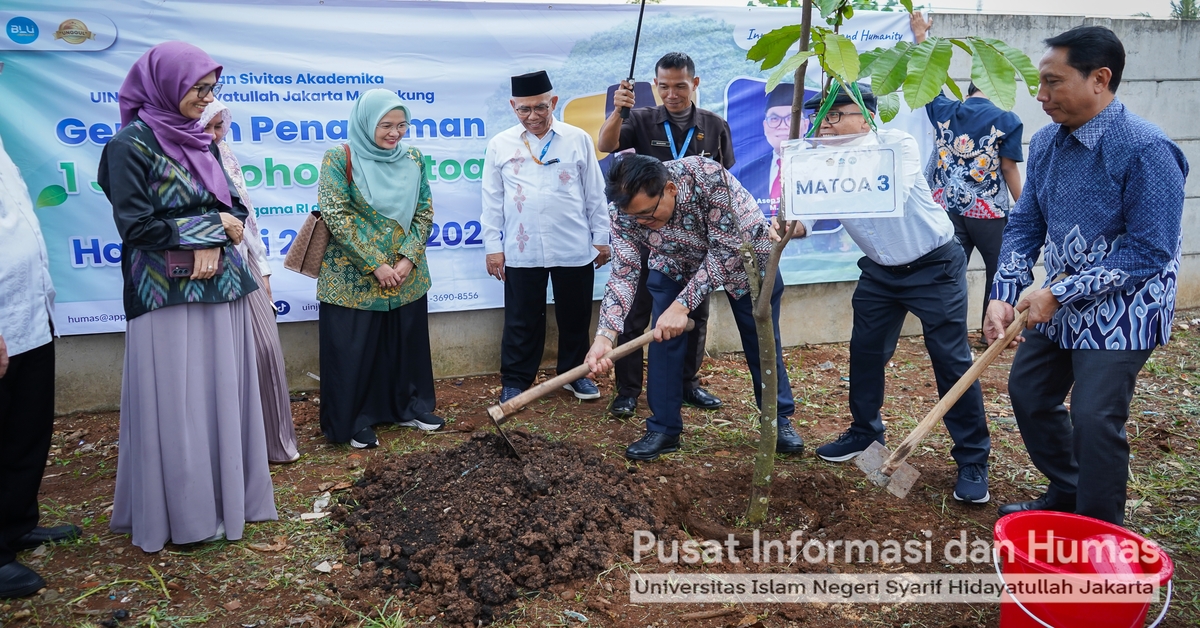
Strengthening Biodiversity Protection and the Policy Framework for Managing Invasive Alien Species at UIN Jakarta
Syarif Hidayatullah State Islamic University Jakarta is committed to promoting sustainable land management, environmental conservation, and the protection of biodiversity through its institutional Green Campus Policy. The University recognises that maintaining healthy terrestrial ecosystems requires responsible management of campus landscapes, vegetation, and natural habitats.
One potential threat to biodiversity is the introduction and spread of invasive alien species. These species may compete with native organisms, alter ecosystem processes, and reduce biodiversity when they become established outside their natural distribution. Addressing these risks requires appropriate environmental policies, species identification, preventive measures, and long-term ecological monitoring.
UIN Jakarta's existing Green Campus framework provides an institutional foundation for environmental protection and offers opportunities to strengthen more specific measures for invasive alien species management.
1. Establishing an Institutional Framework for Environmental Protection
On 21 October 2024, UIN Jakarta established Rector's Decree Number 1415 of 2024 concerning the Green Campus Policy. The policy provides an institutional framework for integrating sustainability into University operations, education, research, and community engagement.
It formally recognises the University's commitment to the United Nations Sustainable Development Goals, including SDG 15: Life on Land. The decree also incorporates environmental sustainability indicators into the University's institutional performance framework.
Through this policy, UIN Jakarta seeks to strengthen environmental management and encourage faculties and administrative units to contribute to sustainable campus development. These commitments provide a general institutional foundation for biodiversity conservation and responsible land management.
2. Recognising the Environmental Risks of Invasive Alien Species
Invasive alien species represent a potential threat to the stability and biodiversity of terrestrial ecosystems. Their introduction and uncontrolled spread can affect native vegetation, wildlife habitats, ecological relationships, and environmental quality.
Effective management therefore requires distinguishing between non-native species that do not cause significant ecological harm and invasive species that threaten local ecosystems. Preventive approaches may include identifying species before introduction, assessing potential ecological impacts, monitoring the spread of invasive organisms, and responding to identified risks.
These considerations are relevant to universities because campus landscapes, research activities, and ornamental planting may involve the introduction or movement of biological organisms. The management of such risks is consistent with the broader objective of maintaining environmentally sustainable campus ecosystems.
3. Applying Indonesia's National Regulatory Framework
Indonesia has established a national regulatory framework addressing invasive species through Minister of Environment and Forestry Regulation Number P.94 of 2016 concerning Invasive Species. The regulation provides definitions of invasive species and establishes principles for their prevention, risk assessment, control, and eradication.
Its objective is to reduce threats to ecosystems, biodiversity, environmental quality, and human welfare. This regulation provides an important national reference for universities and other institutions undertaking biodiversity-related activities.
For UIN Jakarta, the regulation offers a legal foundation that could guide the development of campus-specific procedures for identifying and managing invasive alien species. The national regulation should, however, be distinguished from evidence of an independently adopted University policy.
4. Integrating Biodiversity Considerations into Green Campus Governance
UIN Jakarta's Green Campus Policy supports the integration of environmental sustainability into institutional planning and performance evaluation. The policy recognises the importance of infrastructure, environmental management, resource conservation, education, and research in supporting sustainable development.
It also establishes responsibilities for faculties and University units to report their contributions to the Sustainable Development Goals. These institutional arrangements provide opportunities to incorporate biodiversity-related considerations into campus landscape planning and environmental management.
Potential future measures could include ecological assessments of campus vegetation, consideration of native species in planting programmes, and screening of potentially invasive species before their introduction. Such measures would support the policy's wider environmental objectives while providing more specific safeguards for terrestrial ecosystems.
5. Strengthening Institutional Coordination through the Green Campus Development Centre
On 24 April 2025, UIN Jakarta announced the establishment of the Green Campus Development Centre through Rector's Decree Number 196 of 2025. The Centre was established under the Institute for Research and Community Service to strengthen the implementation of the University's sustainability agenda.
Its organisational structure includes divisions addressing water, energy, waste, infrastructure, transportation, and education. The establishment of this Centre strengthens the University's institutional capacity to coordinate environmental programmes.
It also provides an organisational foundation through which biodiversity-related concerns could be integrated into future campus environmental planning. However, the available documentation does not yet establish a specific invasive alien species management mandate for the Centre.
6. Opportunities for Campus-Based Invasive Species Prevention
The University's environmental management framework creates opportunities for developing a dedicated approach to invasive alien species prevention. Such an approach could include the identification of native and non-native organisms occurring within campus boundaries.
Potentially invasive species could then be assessed using applicable national regulations and scientific references. Landscape development and planting activities could incorporate procedures to assess ecological risks before introducing unfamiliar plant species. Monitoring could focus on identifying the spread of organisms that threaten native biodiversity or disrupt campus ecosystems.
Where invasive species are confirmed, suitable control measures could be developed in consultation with relevant scientific and environmental authorities. These measures represent possible future directions and should not be interpreted as programmes already verified as operating at UIN Jakarta.
7. Strengthening Research and Environmental Education
As a higher-education institution, UIN Jakarta has opportunities to support biodiversity protection through academic research and environmental education. Research activities can contribute to identifying species, understanding ecological interactions, and assessing potential threats to terrestrial ecosystems.
Educational programmes may also help students and staff recognise the differences between native species, introduced species, and invasive alien species. The University's Green Campus Policy provides an institutional basis for connecting sustainability priorities with research and community engagement.
Further integration of invasive species awareness into campus environmental programmes could strengthen both institutional capacity and public understanding of biodiversity protection.
8. Improving Policy Documentation and Environmental Accountability
A comprehensive approach to invasive alien species management requires clear institutional procedures and verifiable evidence of implementation. The University's current Green Campus Policy establishes a general environmental sustainability framework.
However, publicly available documentation reviewed for this indicator has not confirmed the existence of a campus-specific policy governing invasive alien species. Further development could include a formal policy or standard operating procedure covering species identification, prevention of introduction, ecological risk assessment, monitoring, and appropriate control measures.
A supporting inventory of campus flora and fauna, together with documented monitoring activities, would strengthen accountability and provide a foundation for measurable biodiversity protection. These steps would also enable the University to demonstrate more direct alignment with SDG 15 Indicator 15.3.4.
9. Contribution to SDG 15: Life on Land
Syarif Hidayatullah State Islamic University Jakarta has established a policy framework supporting environmental sustainability and the protection of terrestrial ecosystems. Rector's Decree Number 1415 of 2024 formally incorporates the Sustainable Development Goals into University governance and institutional activities.
The establishment of the Green Campus Development Centre in 2025 further strengthens the University's organisational capacity to coordinate environmental initiatives. Indonesia's Minister of Environment and Forestry Regulation Number P.94 of 2016 provides an additional national reference for managing ecological risks associated with invasive species. Together, these institutional and regulatory frameworks provide a foundation for developing more specific preventive and management measures to reduce the potential impact of invasive alien species on campus ecosystems.
To demonstrate full compliance with SDG 15 Indicator 15.3.4, further verification or formal adoption of a University-specific invasive alien species management policy is required.
Source :
https://ksdae.kehutanan.go.id/regulasi/?page=15&search&year&
https://uinjkt.ac.id/id/keputusan-rektor-uin-syarif-hidayatullah-jakarta-no-1415-tahun-2024-tentang-kebijakan-kampus-hijau-green-campus-policy
https://www.uinjkt.ac.id/id/perkuat-komitmen-menuju-kampus-hijau-berkelanjutan-uin-jakarta-bentuk-pusat-pengembangan-green-campus
https://asset.uinjkt.ac.id/uploads/fmXyXwZY/2024/10/sk-rektor-1415---green-campus-policy.pdf