
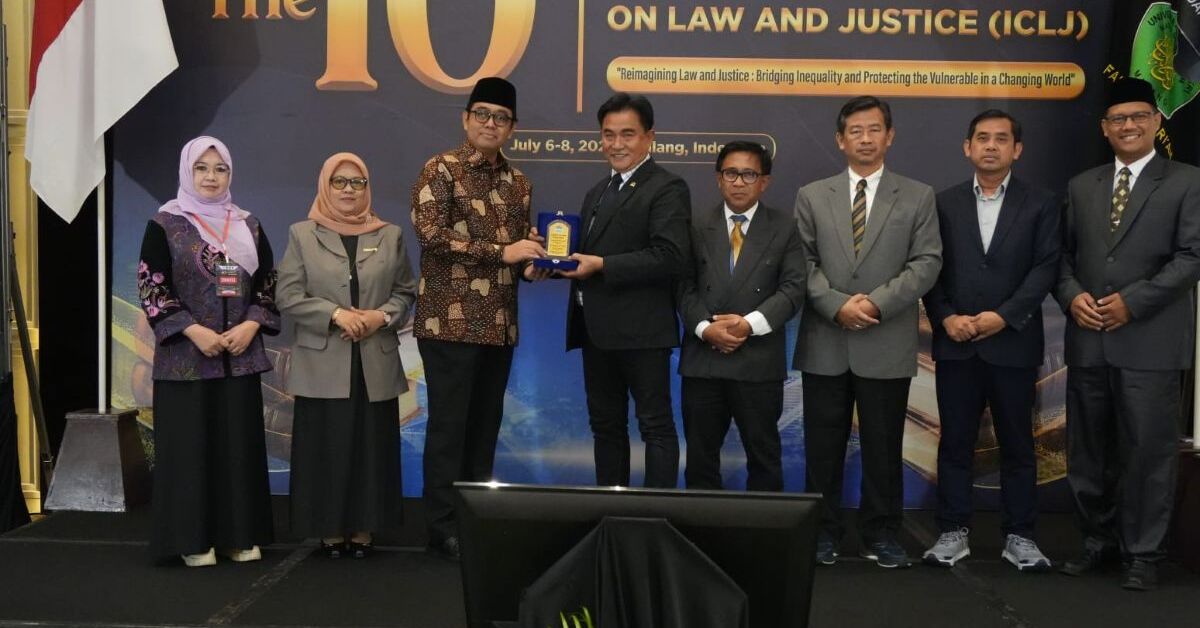
State-Level Judicial Reform: Minister Yusril Opens ICLJ 2026 to Align AI Regulation and Indonesia’s New 2026 Penal Code
MALANG, UIN Online News – Elevating the academic summit into a high-level state policy arena, the Coordinating Minister for Law, Human Rights, Immigration, and Correctional Affairs of the Republic of Indonesia, Professor Yusril Ihza Mahendra, officially inaugurated The 10th International Conference on Law and Justice (ICLJ) 2026 on July 6, 2026. The prestigious multilateral forum which is jointly hosted by UIN Jakarta, Universiti Malaya, and UIN Malang serves as a critical platform to synchronize global legal architectures under the mandate of protecting marginalized demographics in a highly disrupted world.
The high-profile assembly drew global legal heavyweights, including Vice Rector of UIN Jakarta, Professor Ahmad Tholabi, and Vice Rector of UIN Malang, Dr. Basri, alongside prominent international speakers from La Trobe University (Australia), Bielefeld University (Germany), and the University of Miskolc (Hungary).
Delivering a powerful keynote address, Coordinating Minister Yusril Ihza Mahendra mandated that the ultimate metric of a state's legal success is not its procedural bureaucracy, but its structural capacity to shield the most vulnerable. including victims of domestic violence, children, disabled citizens, migrant workers, and indigenous populations.
"If the law only functions efficiently for those who possess institutional power, higher education, and financial access, then it is not justice," Minister Mahendra fiercely asserted. "The law must be systematically felt by those at the bottom of the socioeconomic ladder."
Addressing modern technological disruptions, the Coordinating Minister explicitly targeted the rise of Artificial Intelligence (AI) and digital migration. While acknowledging that AI can vastly accelerate judicial data processing, Mahendra issued a strict ethical warning to the international delegates.
"Artificial Intelligence can technically assist the legal process, but it must never replace human conscience and judicial wisdom," the Minister directed, emphasizing that tech advancements must remain tightly bound to constitutional accountability and citizen rights.
A major highlight of the Minister's speech was his analytical review of Indonesia's landmark national legal overhaul the New National Penal Code (KUHP) and Criminal Procedure Code (KUHAP) which officially entered into force in January 2026.
Mahendra explained that this historic 2026 legal reform completely reconstructs Indonesia's criminal justice system away from colonial punitive models. The new framework prioritizes restorative justice, focusing on victim rehabilitation, social relationship restoration, and humane alternative sentencing, such as the strategic restructuring of the death penalty.
The conference split into eight high-intensity parallel research tracks to dissect contemporary legal anomalies. Among the most competitive papers presented were:
-
Digital Governance & AI Ethics: Deconstructing the original doctrine of authorship regarding AI-generated works within Indonesian copyright law, alongside Sharia compliance in cryptocurrency and digital banking.
-
Socio-Legal and Gender Vulnerabilities: Analyzing economic rights for divorced women in Islamic family law, and tracing the intersections between unregistered marriages (nikah siri) and transnational human trafficking networks.
-
Environmental & Resource Justice: Enforcing the principle of Free, Prior and Informed Consent (FPIC) to protect indigenous lands, and weaponizing Islamic corporate philanthropy (Zakat) as a legal aid instrument for the impoverished.
Through one a decade of continuous scholarly execution, the 10th ICLJ has successfully bridged the gap between academic theory and real-world state policy. The trilateral academic compact ensures that the research papers defended in Malang will directly feed into state-level policy formulations, ensuring that the evolution of modern law remains deeply anchored in human dignity.
(Zaenal/Arifin)