
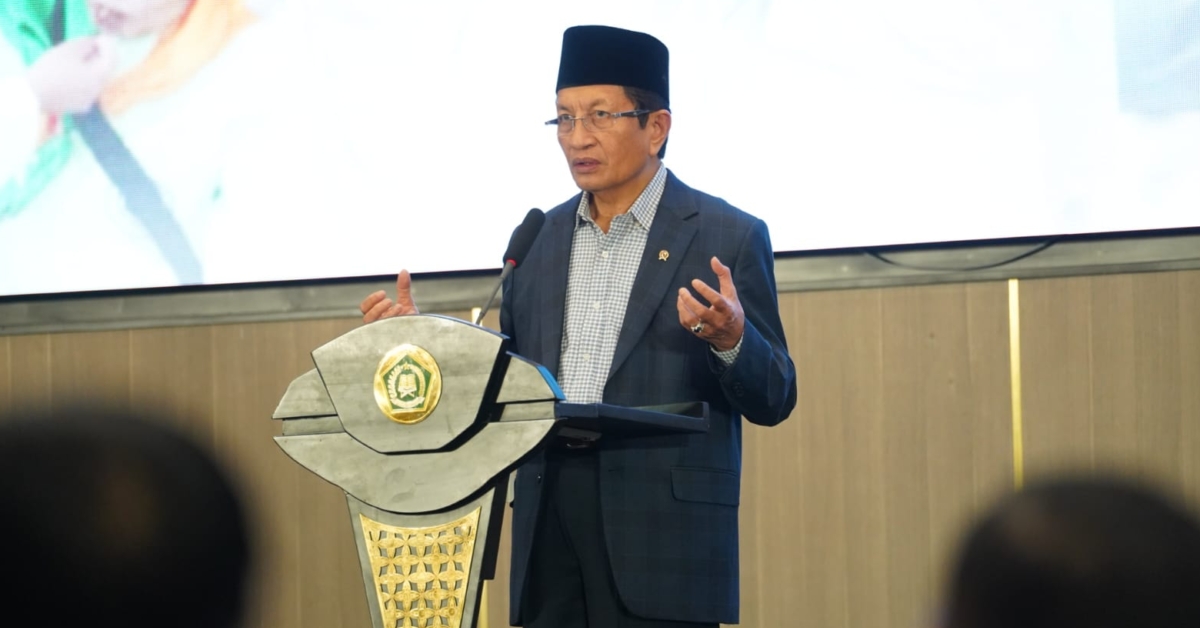
Respecting Minorities: An Islamic Perspective on Justice and Humanity
Nasaruddin Umar
(Professor of Qur’anic Exegesis, Faculty of Ushuluddin, UIN Syarif Hidayatullah Jakarta,
Minister of Religious Affairs of the Republic of Indonesia)
The presence of minority groups in a region carries its own wisdom in building social maturity. Respecting minority groups is a fundamental teaching in Islam.
Its foundation is widely found in the Qur’an and hadith, and it was practiced during the time of Prophet Muhammad (peace be upon him) and his companions. One example is a hadith narrated by Safwan ibn Sulaiman, in which the Prophet once said, "Whoever ظلمs (wrongfully treats) a mu’ahad (a person under a peace agreement), belittles them, burdens them beyond their capacity, or takes their property without consent, I will be his opponent on the Day of Judgment” (Narrated by Abu Dawud).
This hadith is remarkable. The Prophet clearly stood in defense of those who are oppressed, wronged, and humiliated, without distinction of gender, ethnicity, religion, or belief. It aligns with the spirit of the verse “And indeed We have honored the children of Adam” (Qur’an 17:70).
This tradition of the Prophet was continued by his companions. One day, Umar ibn Khattab visited various regions. He witnessed a group of non-Muslims being punished by being forced to stand under the scorching sun in one area of Sham (Syria). Umar asked why they were being punished this way. He was told it was because they refused to pay the jizyah (tax).
Umar did not agree with such punishment and ordered that they be released. He also instructed local authorities not to burden them beyond their capacity and to treat them as human beings, just as Muslims are treated.
On another occasion, Umar encountered an elderly blind beggar from among non-Muslims. Umar asked, “From which أهل الكتاب are you, old man?” The man replied, “I am a Jew.” Umar then asked, “What has brought you to this condition?” The man answered, “I need food and basic necessities.”
Umar brought the man to his home and wrote a note to the بيت المال (state treasury), saying: “Take care of this man and others like him. By Allah, we have taken from them in their youth and neglected them in their old age. Charity is for the poor. The poor among Muslims are one group, and the poor among the People of the Book are also entitled.”
What is striking from these accounts is that assistance and support in Islam cross religious and cultural boundaries. Help from Muslims is not only directed toward fellow Muslims but also toward non-Muslims, as demonstrated by the Prophet and the Rightly Guided Caliphs, especially Umar ibn Khattab.
Poverty and hardship are not limited to Muslims but are also experienced by followers of other religions. Whoever is in need has the right to receive help, even if it must come from the state treasury, as shown by Umar ibn Khattab.
In classical Islamic jurisprudence, there are extensive discussions on minority jurisprudence. One obligation of Muslims toward humanity, regardless of religion or ethnicity, is to rescue those in distress and suffering.
Even if a person has died, it becomes a communal obligation (fardhu kifayah) for Muslims to take care of the body. It is considered a collective sin if people in a community see a corpse floating in a river and do not retrieve and bury it. Because the deceased belongs to God (al-mayyit haq Allah), they must be cared for and buried properly.
Nasaruddin Umar, Minister of Religious Affairs of the Republic of Indonesia
This article was published in Kompas on Tuesday, March 17, 2026.