
Reflections on the 35th NU Muktamar: After the Election, Are We Still Brothers?
Dr. Lilik Ummi Kaltsum, M.Ag
(Professor at UIN Syarif Hidayatullah Jakarta)
Nahdlatul Ulama was not born out of an ambition to seize political power. It emerged from the deep concern, responsibility, and sincerity of the ulama (Islamic scholars) in safeguarding religion, the community (ummah), and the homeland. When K.H. Hasyim Asy’ari together with K.H. Abdul Wahab Chasbullah and the pesantren ulama founded NU on January 31, 1926, what they built was not a vehicle for seeking office. NU was prepared as a grand house that unified the steps of pesantren scholars in preserving the teachings of Ahlussunnah wal Jamaah while responding to social, economic, educational, national, and humanitarian challenges.
K.H. Hasyim Asy’ari laid the moral and spiritual foundations of the organization. To him, leadership was a sacred trust to protect religion and public interest, not an opportunity for self-aggrandizement. His utmost caution prior to approving NU's establishment demonstrated that a great organization must not be built merely on momentary enthusiasm. It must stand upon pure intentions, noble objectives, and mature deliberation regarding the future of the ummah and the nation.
Beside him, K.H. Abdul Wahab Chasbullah served as a driving force who labored sincerely without calculating personal gain. Long before NU's inception, he pioneered Nahdlatul Wathan in education, Tashwirul Afkar as a forum for intellectual exchange, and Nahdlatut Tujjar to foster economic independence among Muslims. From urban centers to rural hinterlands, Kiai Wahab mobilized networks of scholars and pesantren. His energy was poured out not to elevate his own name, but to build up the jam’iyyah (organization).
This spirit was carried forward by K.H. Abdurrahman Wahid, fondly known as Gus Dur. When leading the PBNU (Central Board of Nahdlatul Ulama), Gus Dur reaffirmed NU as a jam’iyyah diniyyah ijtima’iyyah (socio-religious organization) and a pivotal force in civil society. He brought NU to speak on democracy, humanity, pluralism, culture, and the defense of the marginalized. Through his expansive intellectual contributions and global network, Gus Dur introduced the moderate face of NU and Indonesian Islam to the international community.
Behind Gus Dur's greatness also stood a formidable mother, Nyai Hj. Sholihah Wahid. Following the passing of K.H. Wahid Hasyim, Nyai Sholihah did not merely raise and educate her children. She actively nurtured NU networks, mobilizing through Muslimat NU, founding social initiatives, study circles (majelis taklim), orphanages, maternity homes, and welfare services for the underprivileged. Her legacy shows that NU's grand house was constructed not only by the kiais who stood on organizational stages, but also by the nyais and women fighters who worked with quiet sincerity, fortitude, and lifelong devotion.
The legacy of these founding figures reveals a single common thread: NU grew grand because of khidmah (devoted service), not power struggles. They may have faced differences, competition, and even political pressure, but the interests of the jam’iyyah and the public good were consistently elevated above personal and factional interests.
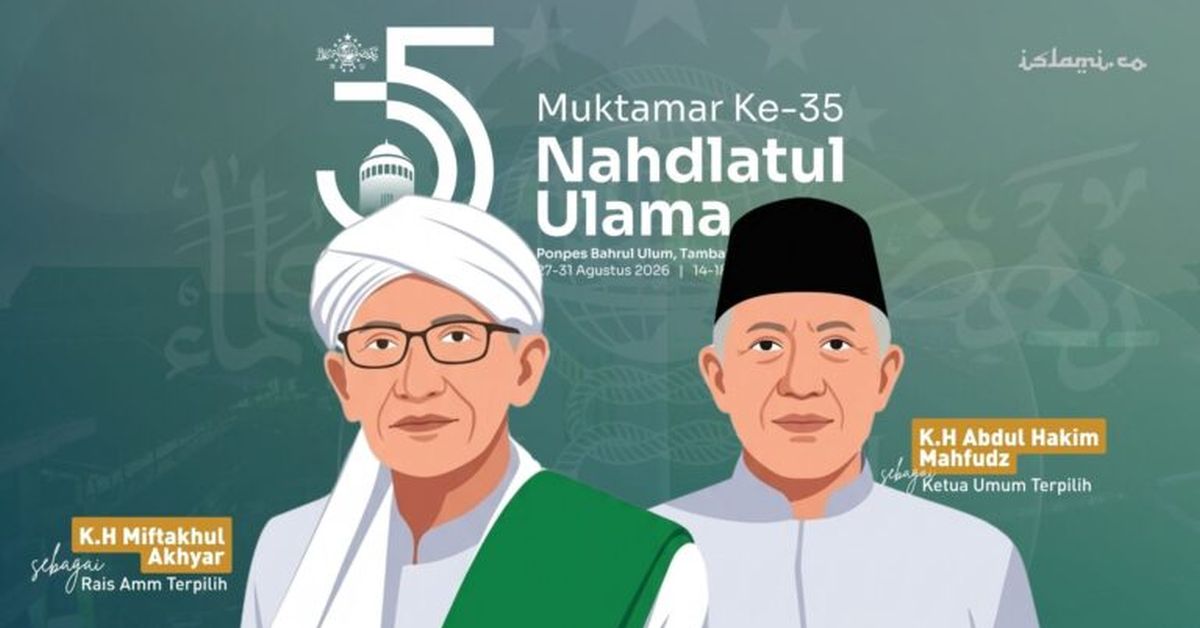
It is within this context that the 35th Congress (Muktamar) of Nahdlatul Ulama must be understood. The Muktamar is not merely a forum to elect the Rais Aam (Supreme Leader) and Chairman of PBNU, but the highest consultative space to define NU's future course. Therefore, NU members should focus not only on who is elected, but on how the election process is conducted and how brotherhood is preserved thereafter.
Nearly every leadership election yields a mapping of power. Some support a specific candidate, others choose a different candidate, and some remain undecided. Gatherings occur, support is gathered, strength is calculated, and potential coalitions are weighed. Within reasonable limits, all of this forms a natural part of organizational dynamics.
Problems arise when differing choices are no longer understood as part of consultation, but turn into a division between "friends" and "foes." Supporters of the same candidate are viewed as friends, while those with differing choices are suspected, distanced, or even framed as enemies. At this point, leadership contests risk leaving wounds longer-lasting than the election period itself.
Muktamar and the Friend-Enemy Politics
The 35th Congress of Nahdlatul Ulama, held on August 27–31, 2026, is not merely a forum to elect the Rais Aam and Chairman of PBNU. The Muktamar represents the highest consultative body determining NU's future direction. Therefore, the attention of NU members should extend beyond who gets elected to encompass how the election process is conducted and how brotherhood is maintained in its aftermath.
Every leadership selection almost always creates power dynamics. Some individuals back a specific candidate, others favor an alternative, and some remain neutral. Connections are nurtured, endorsements gathered, numbers tallied, and coalition possibilities evaluated. Up to a certain threshold, these activities constitute an expected element of organizational life.
Trouble starts when differences in preference cease to be viewed as healthy consultation and instead transform into a hard divide between "friend" and "foe."
Adherents of the same candidate are treated as allies, whereas those supporting another are met with suspicion, sidelined, or positioned as adversaries. Precisely at this juncture, competitive leadership struggles threaten to inflict enduring scars that outlast the election cycle itself.
The Friend-Enemy Logic
Carl Schmitt, a German political theorist, explained that one of the fundamental patterns of political life is the distinction between friend and enemy. According to him, a political group forms its identity by defining who belongs to "us" and who is categorized as "them."
This theory helps analyze the dynamics of organizational leadership elections. As competition intensifies, individuals are mapped out: who are our supporters, who are theirs, who can still be persuaded, and who must be watched carefully. A mapping that initially serves a tactical purpose can evolve into an overarching judgment of a person's character.
However, Schmitt's theory should not be embraced as a justification that politics must inevitably end in hostility. Instead, it serves as a tool to recognize its dangers. Not everyone with a different preference is an enemy, nor is every supporter a true friend. Friends and foes in a contest are often merely temporary categories shaped by circumstances and self-interest.
Henri Tajfel and John Turner, through Social Identity Theory, demonstrated that humans tend to divide their social environment into the in-group and the out-group: "our group" and "their group." Once this division takes root, individuals incline toward viewing their own group as superior while perceiving other groups negatively.
During an election, a candidate's name can become a surrogate group identity. Criticism of a candidate is perceived as an assault on all their supporters. Conversely, the shortcomings of one's own candidate are routinely forgiven, while the flaws of rivals are magnified. Consequently, objective evaluations regarding capacity, integrity, and leadership vision can be overshadowed by group fanaticism.
This phenomenon is not unique to the election of PBNU's Chairman. Similar patterns emerge in leadership elections across political parties, civic organizations, universities, professional associations, and religious institutions. Every contest carries the potential to create camps. What must be guarded against is the transformation of temporary camps into permanent enmity.
A Difference in Choice is Not a Difference in Jam’iyyah
For NU, friend-foe logic must never be allowed to override the logic of brotherhood and devoted service. People may differ in identifying the best candidate, yet they remain under the same grand roof of the jam’iyyah. Differences in preference do not dissolve a shared purpose to preserve the teachings of Ahlussunnah wal Jamaah, safeguard public welfare, and serve the nation.
The Qur'an provides explicit guidance:
وَلَا يَجْرِمَنَّكُمْ شَنَاٰنُ قَوْمٍ عَلٰٓى اَلَّا تَعْدِلُوْا ۗاِعْدِلُوْاۗ هُوَ اَقْرَبُ لِلتَّقْوٰىۖ وَاتَّقُوا اللّٰهَ ۗ
"And do not let the hatred of a people prevent you from being just. Be just; that is nearer to righteousness. And fear Allah." (QS al-Mā’idah [5]: 8)
This verse illustrates that moral standards must not shift based on relationships of friend and foe. Justice must be accorded equally to those we support and to those who hold differing choices. The merit of one's own candidate must not be constructed by spreading slander, malicious rumors, or unverified information about others.
The Qur'an also reminds us, "The believers are but brothers, so make settlement between your brothers" (QS al-Hujurāt [49]: 10). Brotherhood in this verse does not imply the absence of disagreement. Rather, brotherhood is tested precisely when differences arise. It is easy to call someone a brother when interests align; it is far more challenging to treat them as a brother when choices diverge.
Therefore, an NU leadership election should not conclude with the question, "Who will win?" The far more crucial question is, "After the election, can all parties sit together and continue their khidmah?"
Electing with Ethics
Regarding Khidmah at the 35th NU Muktamar, the election mechanism for Chairman was among the key topics discussed: whether conducted directly by delegates (muktamirin) or through a system involving Ahlul Halli wal Aqdi (a council of senior scholars). Whichever mechanism is adopted, the quality of the election is determined not solely by procedure, but by the ethics of the candidates, supporters, participants, and all NU members.
Electing a leader is not a mere struggle for position, but the conferral of a sacred trust. Therefore, considerations must return to the needs of the jam’iyyah: who is most capable of preserving the dignity of the scholars, strengthening the organization, embracing differences, and addressing the challenges facing the ummah in NU's second century.
Voters must also guard against three tendencies: First, personality fanaticism that compromises objectivity; second, the dissemination of unverified information to undermine rivals; and third, external interference that threatens the independent decision-making of the delegates.
Political dialogue need not be prohibited, but it must not devolve into transactional bargaining. Support may be gathered, but never through coercion, material inducements, or campaigns of animosity. Constructive criticism is welcome, provided it addresses vision, programming, track records, and capability, rather than attacking personal honor.
Candidates and their supporters should also build a moral consensus that whoever is elected must be assisted in fulfilling the trust. The winning side must not purge those with differing views, nor should those not elected cultivate destructive opposition. Following the election, categories of "my group" and "their group" must dissolve back into a single shared identity: NU members.
Winning Without Humiliating: Safeguarding NU's Honor
The success of a congress is not marked solely by the election of a new leader. A Muktamar is truly successful when the election proceeds with dignity, its results are accepted graciously, and all organizational forces unite once more in service.
Elected leaders must possess the nobility to win without humiliating others. Those not elected must accept the outcome without losing honor. Supporters must halt rivalry once the forum renders its verdict. After the congress, no group should feel they exclusively own NU, nor should any group be treated as outsiders in their own home.
In practical politics, dividing friends and foes might be considered inevitable. However, within a religious organization, such logic must be bounded by morality, justice, brotherhood, and an orientation toward the public good. An ally in an election is not always right, just as an opponent in an election is not always wrong.
K.H. Hasyim Asy’ari taught that an organization must be anchored in noble intent and responsibility toward religion and the nation. K.H. Abdul Wahab Chasbullah demonstrated that NU's greatness arose from tireless effort, courage, creativity, and selfless dedication. Nyai Hj. Sholihah Wahid proved that nurturing NU is equally achieved through family education, women's movements, and service to the underprivileged. Meanwhile, Gus Dur elevated NU as a cornerstone of civil society and presented a welcoming, democratic, and humane vision of Indonesian Islam to the world.
May the 35th NU Muktamar not only yield a new leadership team, but also rekindle the spirit of devotion modeled by its predecessors. NU requires leaders who are not merely capable of winning an election, but skilled at embracing all sides, preserving organizational independence, strengthening service to the ummah, and safeguarding public trust.
Amidst multifaceted national and global challenges, NU's dignity must continuously be upheld. NU is expected to remain a pillar of religious moderation, democracy, peace, social justice, and humanity, as exemplified by its founders and leading figures. The leadership emerging from the 35th Muktamar should enable NU to grow firmer domestically and gain deeper respect internationally.
Ultimately, the congress will pass and leadership terms will transition. What must remain preserved is the jam’iyyah, brotherhood, and the vision of dedicated service. The victory of a single candidate must never be purchased at the cost of organizational division. Elections last only a few days, whereas ukhuwah (brotherhood) and khidmah must be guarded for a lifetime.
Therefore, the greatest challenge of the NU Muktamar is not identifying who is a friend or foe, but transforming all differences into a collective force once decisions are finalized. For within the grand house of NU, a difference in choice should temporarily divide support, never permanently sever brotherhood.
NU with Honor, the State with Dignity.
(This article was originally published on Islami.co on Monday, August 31, 2026)