
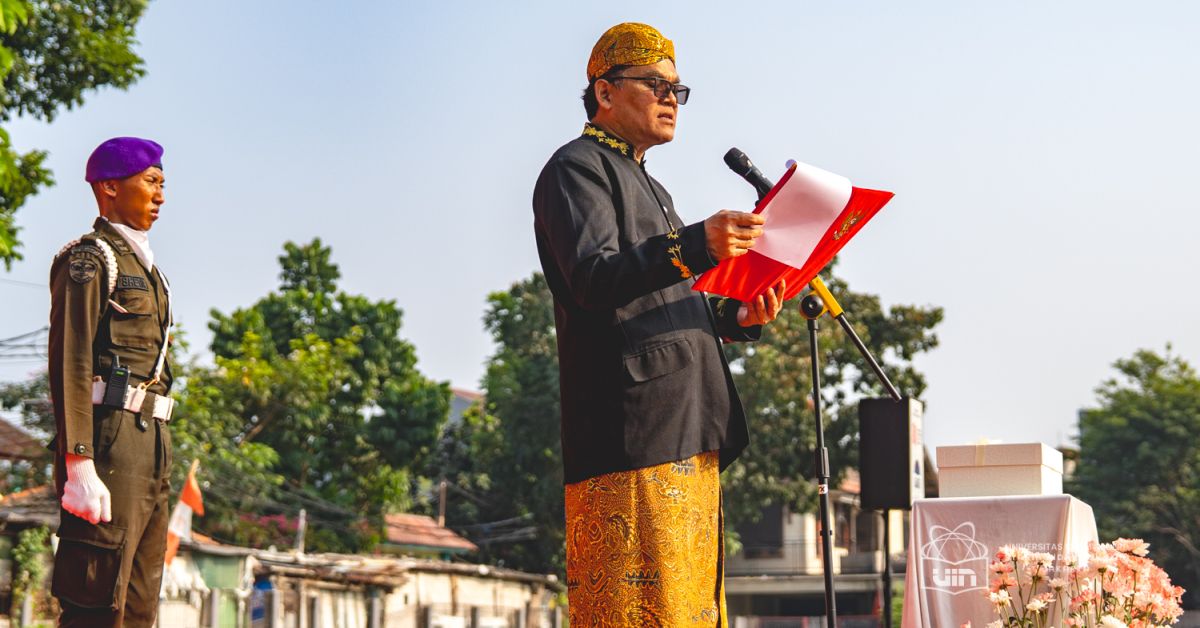
Reflecting on the Meaning of Independence Day
Prof. Dr. Asep Saepudin Jahar, MA Ph.D.
Rector of UIN Syarif Hidayatullah Jakarta
Indonesia's independence officially marks its 81st anniversary on this 17th of August, 2026. The birthday celebrations held by communities across various regions of the country serve as a moment for us to continually express gratitude while engaging in reflection to uncover the meaning of independence in the present era.
Eighty-one years represents more than just the passage of time. This span of time demonstrates how this nation was built through the spirit of struggle, sacrifice, unity, and fortitude of our predecessors. Thus, the independence we enjoy today is the fruit of a long struggle by our forebears that deserves both our gratitude and our accountability.
For this reason, giving meaning to independence today cannot be accomplished merely by remembering the service of heroes or carrying out various ceremonial activities. Independence must truly be positioned as a sacred trust that each generation must fulfill in accordance with the challenges of its time.
If past generations fought to seize and defend independence, the duty of today's generation is to ensure that this independence yields a national life that is increasingly advanced, educated, just, prosperous, and dignified.
An Increasingly Complex Global Environment
Various media reports and research studies note that as a global entity, the Indonesian nation currently faces increasingly complex global challenges. The world moves through rapid changes where today we still witness geopolitical tensions, global economic uncertainty, climate change, technological developments, and digital transformation creating an increasingly complex strategic environment.
At the national level, Indonesia also faces major tasks ahead. Economic growth must continuously be driven to become more inclusive, the quality of education and healthcare needs reinforcement, employment opportunities must be expanded, inequality reduced, and food and energy security as well as human resource competitiveness further fortified.
These various challenges require not only appropriate and consistent policies, but also the support and active participation of all elements of society. The government cannot work alone; it must consistently be supported by all components of the nation.
Ultimately, the success of a nation's development heavily depends on the capacity of all its national components to take part according to their respective roles and responsibilities.
Unity and Social Solidarity
In confronting diverse challenges, one of the greatest strengths we possess—and must therefore safeguard—is national unity.
Indonesia is a great nation whose greatness is anchored upon diversity. We are a nation born out of a tapestry of ethnicities, languages, cultures, traditions, and religions.
This diversity is not something to be forced into uniformity, but rather a wealth that must be managed in the spirit of nationalism. Indonesia's history demonstrates that independence was achieved when various groups from different backgrounds were able to find shared ideals as a single nation.
Therefore, unity arising from diversity must not be understood merely as a slogan. Unity must become a consciousness that is ever-present in daily life. We need to continuously foster mutual respect, appreciate differences, and prioritize dialogue whenever diverging views arise.
Safeguarding unity also means building social solidarity. A strong Indonesia is not only one with high economic growth or technological advancement, but an Indonesia whose society possesses solidarity and empathy toward fellow citizens.
When a segment of society experiences hardship, others must step forward to offer support. The spirit of mutual cooperation (gotong royong) that defines the nation's character must be preserved in forms relevant to contemporary life.
Caring for those affected by disasters, community groups requiring attention, or those facing hardships is a tangible manifestation of national identity.
Thus, nationalism is present not only in symbols and ceremonies, but also in simple actions to ensure that no fellow child of the nation feels they are walking alone in facing life's hardships.
Government Policy and the Critical Posture of the Academic Community
In the context of national development, the public also needs to support government efforts in executing the development agenda. Supporting the government forms part of our national responsibility, particularly when policies are directed toward enhancing public welfare and strengthening Indonesia's competitiveness.
However, such support does not imply eliminating a critical stance. Democracy constantly requires space for criticism and corrections presented responsibly.
To that end, as an academic community, we bear an obligation to convey perspectives objectively, grounded in data, scientific knowledge, and the public interest. Everything is conducted for the well-being of national life.
Higher education institutions can provide constructive support through research, policy studies, innovation, human resource development, and community service. Meanwhile, knowledge-based criticism is fundamentally a form of contribution to ensure that development proceeds ever better.
As a national asset, universities hold a highly strategic position. Higher education institutions must not serve merely as venues for educational instruction and degree conferral.
Universities must become part of the solution to various national problems. The knowledge cultivated on campus must connect directly with societal needs.
Research must be capable of generating knowledge and innovation that can be applied to address real-world challenges in society. Likewise, community service must provide a space for universities to be present and deliver direct benefits.
Meanwhile, education must prepare human resources who possess not only technical competencies, but also strong character and social responsibility.
Responsibility of PTKIN
In the context of fulfilling independence, State Islamic Higher Education Institutions (PTKIN) under the auspices of the Ministry of Religious Affairs of the Republic of Indonesia, such as UIN Syarif Hidayatullah Jakarta, carry a broad responsibility. Among these responsibilities is bringing together scholarship, Islamic values, humanity, and Indonesian national identity.
PTKIN must continuously produce graduates who possess academic and professional competencies alongside integrity, social empathy, the ability to respect differences, and a robust consciousness as part of the Indonesian nation. PTKIN must shape individuals capable of competing globally without losing their national roots and human values.
This role must also be realized through research and innovation across PTKIN that are relevant to national challenges, as well as community service that provides tangible benefits to society. With its academic strength, PTKIN is optimistic about continuing to increase its contribution by offering ideas and solutions for national development.
In this regard, every individual within the PTKIN environment can fulfill independence according to their respective roles. Lecturers and researchers can contribute through high-quality research relevant to national needs.
Educators bear the responsibility of preparing a young generation that is both excellent and principled. Meanwhile, administrative staff can strengthen professionalism and service quality as a manifestation of good university governance.
Meanwhile, PTKIN students, as part of the nation's succeeding generation, must continually prepare themselves with knowledge, competence, creativity, and character so that they may become human resources who contribute to Indonesia's advancement. PTKIN campuses must serve as spaces for students to learn, think critically, develop ideas, build social awareness, and prepare to meet future challenges.
Ultimately, independence is an ongoing process. Every generation receives a legacy from the previous one while carrying the responsibility to pass it on to the next. We received a free Indonesia from our predecessors, and our duty today is to ensure that the Indonesia we pass on will be a stronger, more advanced, just, prosperous, and dignified nation.
Long live the 81st Anniversary of the Republic of Indonesia.
This article was originally published on disway on Monday, August 17, 2026.