
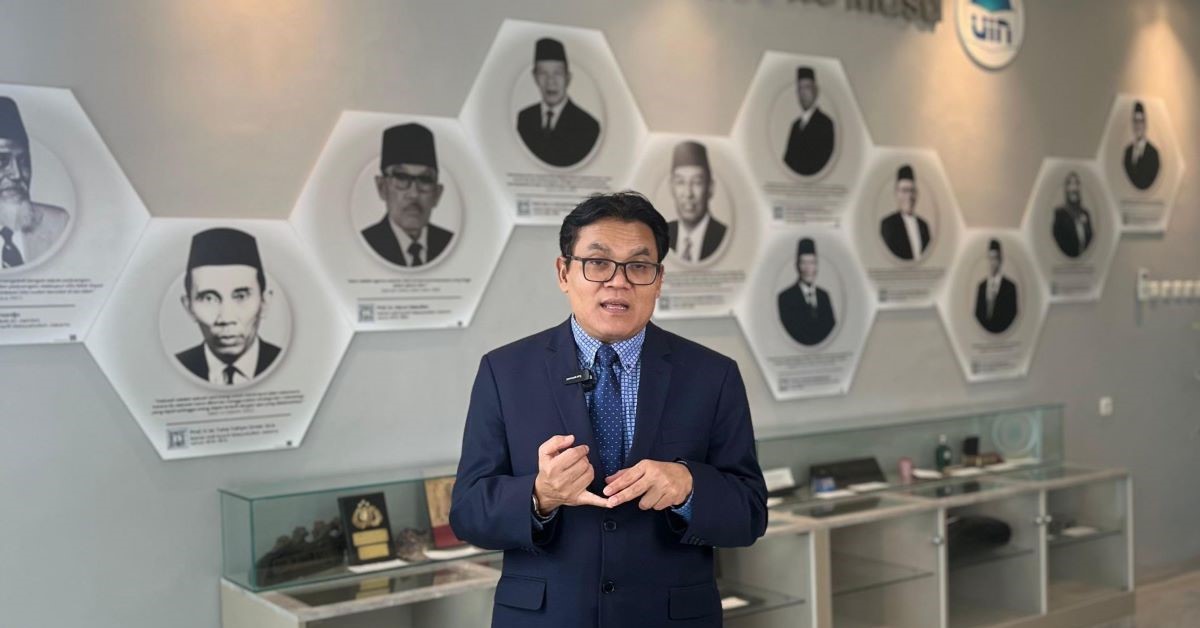
Rector of UIN Jakarta Calls for Stronger Islamic Philanthropy to Advance Social Justice
Jakarta, UIN Online News — Rector of UIN Syarif Hidayatullah Jakarta, Prof. Asep Saepudin Jahar, M.A., Ph.D., underscored the vital role of Islamic philanthropy—including zakat, infaq, sadaqah, and waqf (ZISWAF)—in addressing social inequality and fostering a more just society. Speaking at a public dialogue held in Jakarta on Monday (2 March 2026), he emphasized that a proper understanding of these philanthropic instruments, particularly the distinction between zakat and sadaqah, is essential to strengthening social justice and reducing socioeconomic disparities.
According to Prof. Asep, zakat is an individual religious obligation (fard 'ayn) governed by clear Islamic legal provisions, including nisab (minimum wealth threshold), haul (one lunar year of ownership), and prescribed rates—commonly 2.5 percent for applicable assets such as savings, trade, and gold. Beyond its religious dimension, zakat serves as a mechanism for wealth redistribution, ensuring that economic resources do not remain concentrated among the affluent.
To reinforce this principle, he cited Surah Al-Hashr (59:7), which emphasizes that wealth should not circulate exclusively among the wealthy.
"Surah Al-Hashr, verse 7 reminds us that zakat is an instrument of social justice. Without zakat, wealth would continue to accumulate among those who are already economically privileged, further widening social inequality," he stated.
The Rector further stressed that paying zakat represents only the minimum standard of social responsibility expected of Muslims. While obligatory, zakat should be viewed as the foundation of ethical conduct rather than the highest expression of generosity.
"Paying zakat does not automatically make someone generous. It is the moral baseline for every Muslim, not the pinnacle of charitable giving," he remarked.
In contrast, sadaqah possesses a broader philanthropic dimension because it is entirely voluntary and unrestricted by specific legal requirements. It reflects compassion, generosity, and solidarity, enabling individuals to contribute beyond mandatory obligations in addressing poverty and social challenges.
Because sadaqah is not subject to nisab or haul, Prof. Asep described it as an opportunity to maximize philanthropic impact beyond obligatory zakat. He noted that this practice is reflected in several Middle Eastern countries, where voluntary charitable giving—including sadaqah and infaq—often surpasses zakat in supporting education, social welfare, and community development.
"Since sadaqah is not limited by nisab or haul, it offers an opportunity to optimize philanthropy beyond compulsory zakat. This is also evident in several Middle Eastern countries, where voluntary donations such as sadaqah and infaq often exceed the amount collected through zakat," he explained.
In line with this vision, UIN Jakarta operates the Social Trust Fund (STF), the University's philanthropic institution dedicated to supporting underprivileged students through scholarships, training programs, and community empowerment initiatives. The fund is sustained through voluntary contributions from faculty members, university staff, students, alumni, and the wider public.
"At UIN Jakarta, we have the Social Trust Fund (STF), which serves as our philanthropic institution. STF provides scholarships and capacity-building programs for financially disadvantaged students, funded through infaq and sadaqah contributed by our academic community and the public," he said.
Concluding the dialogue, Prof. Asep expressed his hope that Islamic philanthropy in Indonesia would continue to evolve beyond a mere religious obligation into a transformative instrument for tackling socioeconomic challenges and promoting sustainable social welfare.