
Protecting Employee Rights through Administrative Appeals and Institutional Grievance Procedures
Syarif Hidayatullah State Islamic University Jakarta recognises that protecting employee rights requires accessible mechanisms through which academic and administrative personnel can raise concerns, challenge employment-related decisions, and seek appropriate administrative review. Fair employment practices depend not only on the provision of salaries, allowances, and professional development opportunities, but also on the ability of employees to question decisions that may affect their employment rights or professional standing.
As a state Islamic university, UIN Jakarta operates within Indonesia's public-sector administrative review framework and maintains institutional employee ethics, personnel administration, and complaint-handling procedures. During 2024–2025, the University documented institutional procedures allowing employees to raise objections concerning personnel performance assessments and maintained reporting arrangements for alleged misconduct or abuse of authority. These institutional mechanisms are supported by national regulations establishing formal administrative appeals for eligible public-sector employees. Together, they provide a foundation for employment accountability and the protection of employee rights under Sustainable Development Goal 8: Decent Work and Economic Growth.
1. Recognising Employees' Rights through University Regulations
A fundamental component of UIN Jakarta's employment governance is Rector's Decree Number 737 of 2021 concerning the Employee Code of Ethics. The decree establishes rights and responsibilities for University personnel, including civil servant and non-civil servant employees within its defined scope.
Article 4 recognises several employee rights relevant to fair employment practices. These include the right to receive salaries or remuneration in accordance with applicable regulations, obtain personnel administrative services, access professional development opportunities, receive legal assistance and protection, and benefit from applicable welfare facilities. The regulation also recognises employees' right to express opinions responsibly and participate in professional organisations.
These provisions establish an institutional recognition that employees are entitled to lawful treatment, professional support, and appropriate employment-related benefits. The University's employee ethics framework also establishes procedures for examining alleged breaches of professional conduct and addressing disciplinary decisions. These arrangements contribute to institutional accountability by identifying employee rights and establishing administrative procedures for employment-related conduct. However, the employee ethics framework should be distinguished from a dedicated salary-dispute procedure. The reviewed provisions do not independently establish a comprehensive process for appealing every type of remuneration disagreement.
2. Providing Formal Administrative Appeal Rights for Civil Servants
An important foundation for the protection of public-sector employees is Government Regulation Number 79 of 2021 concerning Administrative Remedies and the State Civil Apparatus Advisory Board. This regulation establishes a formal mechanism through which eligible State Civil Apparatus employees may challenge certain decisions made by personnel authorities.
Article 2 recognises the right of employees to seek administrative remedies when dissatisfied with decisions made by authorised personnel officials. These remedies include administrative objections and administrative appeals, with the applicable route determined by the type of decision. Under Article 3, employees may submit objections concerning decisions issued by authorised personnel officials within the regulatory scope.
The regulation therefore provides a structured mechanism for challenging employment-related decisions rather than requiring employees to accept every administrative decision without review. For eligible UIN Jakarta civil servants and Government Employees with Employment Agreements, the regulation provides an applicable national framework for protecting their employment-related administrative rights.
3. Establishing Written Objection and Decision-Making Procedures
Government Regulation Number 79 of 2021 also establishes specific procedures for submitting and examining employee objections. Under Articles 4 and 7, eligible employees must submit objections in writing, explaining the reasons for their disagreement and providing supporting evidence.
The objection must generally be submitted within 14 working days after the relevant decision has been received. The competent personnel authority or superior official is responsible for examining the objection according to the relevant procedure. Articles 5 and 8 require the appropriate authority to issue a decision within 21 working days after receiving the objection. The regulation also establishes options for further legal review where the applicable procedures and legal requirements are met.
These provisions demonstrate that employment-related objections are subject to defined procedural requirements, competent decision-making authorities, and specified timeframes. Such arrangements are important for procedural fairness because they provide employees with a formal opportunity to challenge administrative decisions affecting their professional interests. They also encourage evidence-based examination of disagreements between employees and personnel authorities.
4. Documenting Employee Objections through Faculty-Level Performance Assessment Procedures
At the institutional level, the Faculty of Science and Technology (FST) published an employee performance assessment procedure on 4 April 2024. The documented procedure concerns the assessment and confirmation of employee performance records, referred to in the document as Daftar Penilaian Pelaksanaan Pekerjaan (DP3). Importantly, the procedure provides an opportunity for employees to raise objections when they disagree with their performance assessment results.
The faculty's administrative unit is instructed to communicate assessment results to employees. Where an employee disagrees with an assessment, the procedure requires the employee to explain the grounds for the objection and provide supporting documentation. The employee may then submit the objection to the relevant assessing official rather than simply accepting the disputed evaluation.
The process involves the appropriate supervisors and personnel administrative units. This published procedure provides direct institutional evidence that UIN Jakarta has documented a mechanism allowing personnel to challenge an employment-related assessment. Such assessments are relevant to employees' professional interests, including performance recognition, career administration, and related personnel decisions.
The procedure is therefore an important example of institutional acknowledgement of employees' ability to contest administrative evaluations. The document uses the older DP3 terminology and cites earlier civil service provisions. Consequently, it provides evidence of a published faculty-level procedure in 2024, while confirmation of its operational applicability under the current performance assessment framework would strengthen the University's documentation.
5. Providing Institutional Channels for Reporting Abuse of Authority
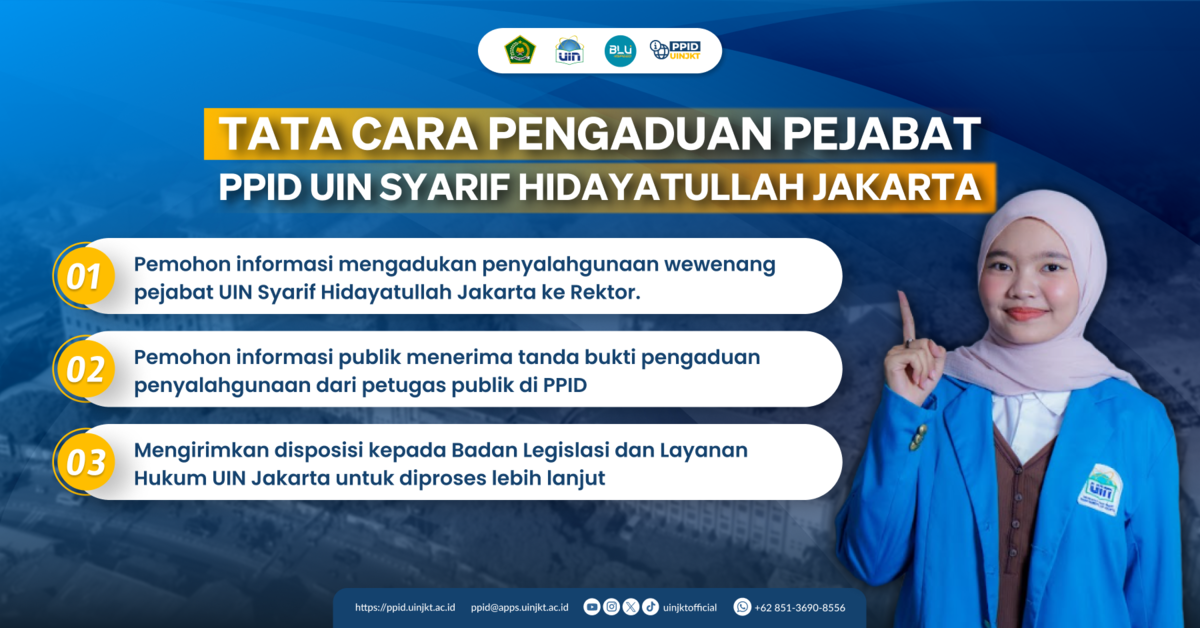
UIN Jakarta also maintains a publicised complaint-handling procedure for alleged abuse of authority by University officials. Through the University's Public Information and Documentation Officer (PPID), individuals can submit complaints involving suspected misuse of authority.
The published procedure provides for complaints to be addressed to the Rector, the issuance of evidence acknowledging receipt, and the referral of matters to the University's legislation and legal services unit for further processing. The University also publicises Indonesia's national public complaint platform, SP4N-LAPOR!, as an additional reporting channel.
The University's PPID documentation identifies procedures for complaints involving University officials and external parties holding institutional permissions or working agreements. These measures demonstrate that UIN Jakarta has established administrative reporting arrangements intended to support transparency and institutional accountability.
For employment-related concerns involving suspected abuse of authority, such arrangements may provide a relevant reporting route, subject to the applicable competence and admissibility requirements. However, general public complaint procedures should not be treated as equivalent to a dedicated employee salary appeal mechanism.
6. Supporting Employment Rights through National Labour Dispute Resolution
In addition to the administrative review framework for State Civil Apparatus employees, Indonesia provides a separate legal framework for workers whose employment relationships are governed by the relevant labour legislation. Law Number 2 of 2004 concerning the Settlement of Industrial Relations Disputes establishes procedures concerning disputes over employment rights, employment interests, termination, and certain trade union disputes.
The legislation requires relevant employment disputes to be addressed initially through bipartite discussions between the parties. Where such efforts do not resolve a rights dispute, the law provides mechanisms involving the competent labour authorities, mediation, and ultimately the Industrial Relations Court where appropriate.
This framework is relevant to remuneration disagreements when they fall within the scope of an employment rights dispute governed by the legislation. Because UIN Jakarta employs personnel under different legal employment arrangements, the applicability of these procedures must be determined according to the employee's contractual and legal status. The framework demonstrates the existence of a national process for resolving employment rights disputes, including relevant remuneration-related disputes. Nevertheless, the available University documentation does not establish a single internal procedure applying uniformly to salary disputes across all non-civil servant employment categories.
7. Strengthening Institutional Accountability through Complaint and Corrective Action Procedures
UIN Jakarta's institutional quality assurance arrangements also support the principle that administrative concerns should be identified, assessed, and addressed through documented procedures. The Faculty of Science and Technology published documentation concerning corrective action procedures in April 2024. The procedure describes the identification and analysis of complaints or nonconformities, examination of their causes, preparation of corrective action plans, and monitoring of follow-up activities. It also recognises the involvement of faculty leadership, administrative managers, and relevant organisational units.
These arrangements demonstrate the University's use of documented methods for processing organisational problems and monitoring corrective actions. They complement formal employee appeal procedures by reinforcing the importance of institutional responsiveness and administrative review.
However, the corrective action procedure is a general quality management mechanism and should not be presented as a substitute for the specific legal protections governing employment rights and salary disputes.
8. Strengthening Access to Fair Employment Review
The documented regulations and procedures provide several mechanisms relevant to employee rights protection. For eligible State Civil Apparatus personnel, administrative decisions may be challenged through procedures established by Government Regulation Number 79 of 2021. At faculty level, the University's published performance assessment procedure recognises an employee's ability to object to disputed assessment results.
The Employee Code of Ethics establishes rights and responsibilities, while institutional complaint-handling arrangements support reporting and accountability. Together, these mechanisms demonstrate that employees are not necessarily without procedural options when they believe relevant personnel decisions have adversely affected them. Nevertheless, the administrative appeal framework, performance assessment procedure, ethics process, and general complaint channel have different legal purposes.
A comprehensive University-level employment grievance policy would benefit from clearly distinguishing these procedures and identifying the appropriate routes for salary discrepancies, allowance calculations, employment contract issues, career decisions, and other personnel rights. Further evidence of their application during 2024–2025 would also strengthen institutional verification.
9. Contribution to SDG 8: Decent Work and Economic Growth
Syarif Hidayatullah State Islamic University Jakarta maintains written institutional arrangements and operates within national legal frameworks recognising employees' rights to challenge relevant employment-related decisions. The University's Employee Code of Ethics recognises rights concerning remuneration, professional development, welfare, and legal protection. Government Regulation Number 79 of 2021 provides formal administrative remedies for eligible civil servants and other covered public-sector employees.
The Faculty of Science and Technology's April 2024 performance assessment procedure documents an institutional opportunity for employees to object to disputed assessment results and provide supporting evidence. The University's complaint-handling and corrective action arrangements further support institutional accountability. Together, these measures demonstrate an established legal and administrative foundation for employee objections, personnel decision review, and the protection of employment-related rights.
The available evidence is particularly relevant to the employee rights component of THE Sustainability Impact Ratings Indicator 8.2.8. Further documentation is required to verify a dedicated salary appeal mechanism and clarify the procedures applicable to all employment categories at the University. Strengthening and clearly communicating these arrangements would reinforce the University's contribution to decent work, procedural fairness, employee protection, and accountable employment governance under Sustainable Development Goal 8.
Source :
https://jdih.kemnaker.go.id/peraturan/detail/1237/undang-undang-nomor-2-tahun-2004
https://www.ppid.uinjkt.ac.id/id/pedoman-dan-sop-ppid-uin-syarif-hidayatullah-jakarta
https://ppid.uinjkt.ac.id/id/tata-cara-pengaduan-pejabat
https://asset.uinjkt.ac.id/uploads/TkyZgnBj/2025/10/737-pedoman-kode-etik-pegawai.pdf
https://sop.uinjakarta.id/kb/penilaian-dp3/
https://peraturan.go.id/files/pp79-2021bt.pdf