Proposing Religious Ethics in AIUA 2026, National Resilience Strategist Directs Islamic Campuses towards Engineering a Human Centric Global Transformation
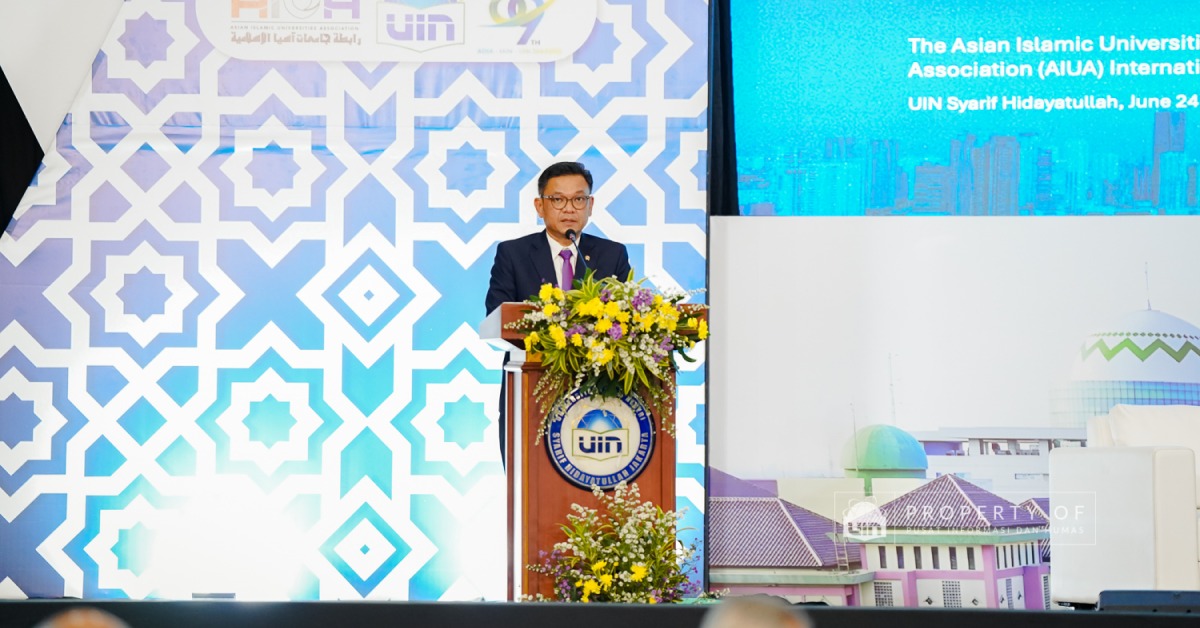
JAKARTA, UIN Online News – Serving as a central strategic architect for state stability, Indonesia’s National Resilience Strategist, Dr. Ace Hasan Syadzily, mandated that Islamic universities must evolve beyond standard degree-printing institutions to become the primary defense line for global civilization. Delivering a high-impact keynote address at the 15th Asian Islamic Universities Association (AIUA) International Summit, Syadzily outlined how academic institutions hold the ultimate competitive advantage in anchoring human-centric public policy amid aggressive digital transformations.
The three-day international forum, running from June 23 to June 25, 2026, at UIN Syarif Hidayatullah Jakarta, operates under the strategic directive: “Transforming Islamic Higher Education for Advancing Global Peace, Resilience, and Inclusive Development.”
In his policy briefing titled “Islamic Higher Education, Democracy, and Global Transformation,” the National Resilience Strategist strategically elevated the institutional value of Islamic education. He argued that while Western-centric models focus heavily on market efficiency, Asian Islamic universities possess the rare structural capability to embed deep-seated moral and spiritual governance directly into state development.
"Islamic higher education commands a vital national security mandate, which is to engineer a generation that matches academic supremacy with radical moral integrity and humanitarian accountability," Syadzily asseted.
The National Resilience Strategist explicitly countered the regressive stereotype that theological principles clash with modern technological advancements. Instead, he framed religious ethics as an indispensable moral compass required to keep corporate artificial intelligence and tech engineering from devaluing human dignity. He called for an immediate, aggressive integration of hard STEM sciences with Islamic ethical frameworks within all university research laboratories.
Syadzily further detailed how Islamic higher education must actively protect democratic frameworks, gender equality, human rights defense, and regional peace architectures. Faced with highly volatile contemporary geopolitics and chaotic digital shifts, he expects these universities to act as the primary incubators for next-generation leaders capable of drafting ethical public policies.
"The ultimate civilizational goal is simple: technology must never control humanity, and humanity must maintain absolute, ethical control over technology to construct an advanced, just, and dignified global society," the strategist emphasized.
Reinforcing this strategic vision, the Rector of UIN Jakarta and sitting President of the AIUA, Professor Asep Saepudin Jahar, Ph.D., stated that the summit is a critical launching pad for transnational academic diplomacy. Jahar reiterated that member universities bear a profound institutional accountability to generate sustainable regional growth and fortify cross-border social resilience.
The high-level consortium, which also featured a major geopolitical address on conflict resolution by Indonesia’s 10th and 12th Vice President Jusuf Kalla, successfully materialized its discussions by executing a massive multilateral signing of Memorandums of Understanding (MoUs).
Witnessed by an elite delegation of 200 international diplomats, university rectors, and global policymakers, this legal compact locks in cross-border student mobility pipelines, multi-author international research grants, and joint-degree frameworks across Asia, permanently elevating the global security posture of Islamic higher education.
(Zaenal/Arifin/Photo: Azka Raysa)