
Professor Masykuri Abdillah Encourages Contextual Political Fiqh Without Standardizing the Form of the State


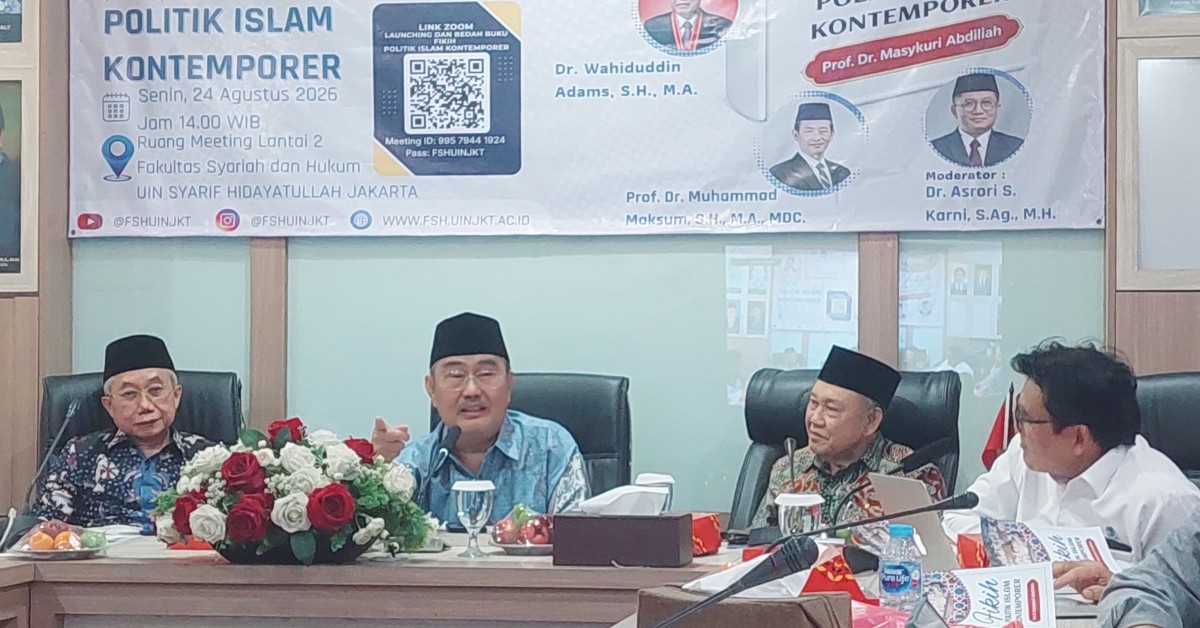
UIN News Online - Professor of UIN Syarif Hidayatullah Jakarta Prof. Dr. Masykuri Abdillah emphasized that political jurisprudence must continue to be developed according to the changing times and the needs of society without standardizing one form of state as a doctrine that applies uniformly. This view was conveyed when presenting the book Contemporary Islamic Political Fiqh in the launch and book review activity at the Faculty of Sharia and Law (FSH) UIN Jakarta, Monday (24/8/2026).
He explained that Islam provides basic principles and values in political life, but does not establish a form of state that must be applied by all Muslim communities. Therefore, the problems of the state, democracy, citizens' rights, political parties, opposition, and change of power need to be placed as ijtihad areas that can be adjusted to the history, culture, and agreement of the community.
The book review took place offline and online, and was also attended by Vice Chancellor I Prof. Dr. Ahmad Tholabi S.Ag., S.H., M.H., M.A. and the Head of the Center for Fatwa and Islamic Law Studies (Pusfahim) UIN Jakarta Prof. Asrorun Ni'am online. Also present were the Dean of FSH Prof. Dr. Muhammad Maksum S.H., M.A., Vice Dean Prof. Dr. Kamarusdiana M.H. and Dr. Afwan Faizin M.A., the Head of the S3 Sharia Science Study Program FSH Prof. Dr. Yayan Sopyan S.H., M.Ag., and around 30 academics of UIN Jakarta. The activity presented Prof. Jimly Asshiddiqie and Dr. Wahiduddin Adams S.H., M.A. as the discussants, with Dr. Asrori S. Karni as the moderator.
Professor Masykuri said that the preparation of political jurisprudence cannot be done by simply transferring classical political concepts into modern life. According to him, religious texts need to be read together with the context in which the opinion was born, the development of society, and the problems faced today.
"We have to look at the text, context, and interpretation. What was the context at that time, how is it now, and how should we behave," he said.
One of the main discussions in the book is the distinction between Islamic countries and Muslim countries. Professor Masykuri explained that Islamic countries refer to countries that formally place sharia as positive law or the main source of law, while Muslim countries are countries with a majority Muslim population without having to use the form or label of Islamic countries. This distinction is necessary so that Muslim countries are not considered to have the same institutional form.
"Islamic countries and Muslim countries must be distinguished. The task of academics is to distinguish something that is indeed different," he said.
In discussing the caliphate and democracy, he considered that both need to be placed in the context of political development. The caliphate should not be understood as the only form of state that must be implemented, while democracy can be studied based on principles that are in line with Islamic values, such as deliberation, participation, power supervision, and accountability of officials.
He also discussed the opposition as part of contemporary political jurisprudence. According to him, opposition can be a means of control over power as long as it is carried out properly and aims to encourage benefits. He related it to the principle of amar makruf nahi munkar in political life.
"Opposition is allowed if it is part of the amar makruf nahi mungkar and is carried out properly," he said.
Prof. Jimly Asshiddiqie considers this approach important to bring together fiqh and law. According to him, modern political and legal theory do not need to be directly positioned in opposition to Islam. A more important measure is the ability of a system to ensure justice, limit power, protect citizens, and open up space for deliberation.
Dr. Wahiduddin Adams added that Indonesia's experience needs to be an important part of the development of political jurisprudence. The formulation of the constitution, the establishment of religious courts, and the inclusion of sharia principles in a number of laws and regulations show that Islamic values can be developed through the constitutional process.
The Rector of UIN Jakarta, Prof. Asep Saepudin Jahar, also appreciated Professor Masykuri's work which brought together sharia studies with actual legal and political issues. Meanwhile, Professor Masykuri said that the study is still open to be developed through further discussions about Islam and the Indonesian state, the constitution, legislation, and the experience of institutionalizing Islamic values.
Through this study, Professor Masykuri emphasized that political jurisprudence does not have to be tied to one particular form of state. The principles of justice, equality, benefits, freedom, and power responsibility need to continue to be interpreted according to the context of society and the development of the times, so that the form of the state can develop without losing its basic Islamic values.