
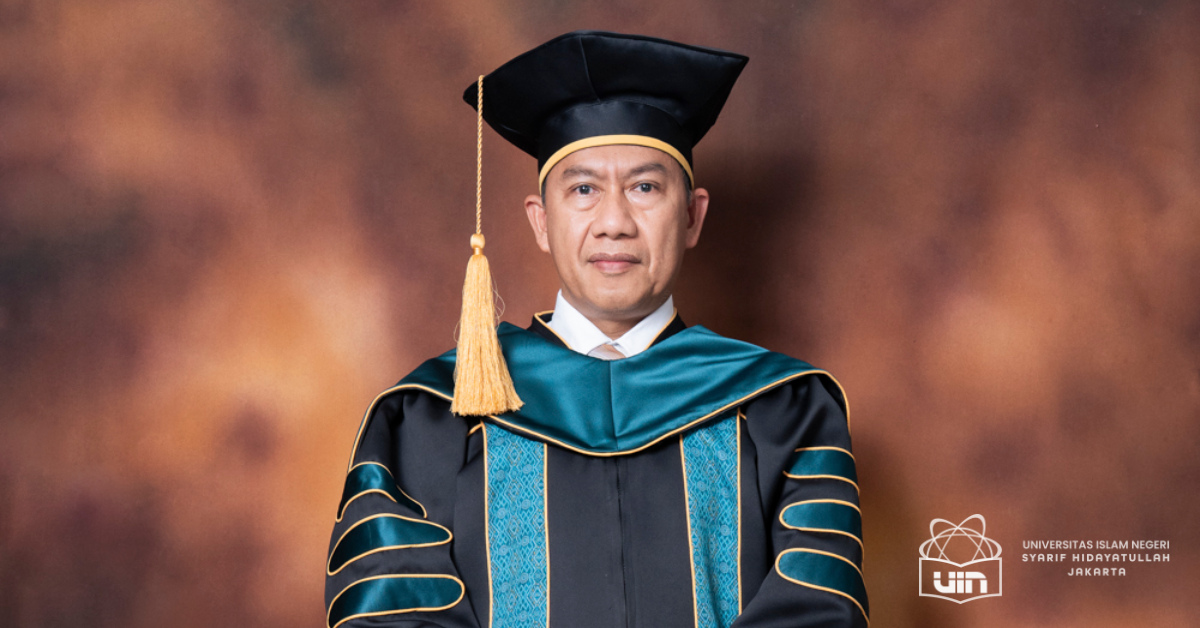
Prof. Zubair’s Insight at Professorial Inauguration: How Divine Revelation Answers Humanity's Evolving Challenges



Harun Nasution Auditorium UIN Jakarta, UIN News Online – A revealed text remains fixed in its written words, while human life continuously evolves with time, inevitably generating unprecedented challenges unknown during the era of revelation. As transaction models transform through technology and medical science alters how humanity understands life and death, a fundamental question emerges: How can Islamic law interpret ever-evolving human realities when the revealed text used as its foundational reference is finite?
This fundamental problem is precisely what Prof. Dr. Zubair, M.Ag., sought to address through his framework of Axio-Linguistic Hermeneutics of Islamic Law. In his inaugural professorial address as Full Professor of Islamic Jurisprudential Linguistics at UIN Syarif Hidayatullah Jakarta, he demonstrated that the adaptability of Islamic law need not be achieved by abandoning the text, but by developing methodologies to read it so as to resolve increasingly complex human dilemmas. This vision was presented during the Open Senate Session for the Professorial Inauguration at the Harun Nasution Auditorium, UIN Jakarta, on Wednesday (30/09/2026).
This problem arises because human life experiences grow increasingly complex, whereas divine revelation possesses quantitative boundaries. Prof. Zubair described this condition as the gap between al-nuṣūṣ mutanāhiyah (the finite revealed texts) and al-waqā’i‘ ghairu mutanāhiyah (the infinite realities of human life). Consequently, the central issue lies not in whether a text exists, but in how that text is interpreted when confronting continuously shifting realities. Hence, an axio-linguistic hermeneutic approach becomes essential in reading revealed texts.
“The tradition of Ushul Fiqh (jurisprudential methodology) possesses precise linguistic tools for textual comprehension; however, traditional readings have mostly relied on literal certainty, causing jurisprudence to become trapped in normative rigidity. On the other hand, interpretations relying excessively on unanchored rationality risk distancing legal rulings from textual authority. Here lies the value of axio-linguistic hermeneutics as an integrative methodological offer,” Prof. Zubair stated.
This approach converges three core elements simultaneously: linguistic analysis is employed to examine textual structure and semantic flexibility; axiology grounded in Maqashid al-Shariah connects textual meaning to public benefit (maslahah); and contextual hermeneutics brings the text into active dialogue with evolving realities.
Through this framework, Prof. Zubair observed that the language of divine revelation does not remain static within closed meanings. Normative terms within the text possess expanding semantic possibilities when interacting with varying human needs and life contexts.
“Normative terms such as al-'adl (justice) or al-ma'ruf (goodness) are not closed concepts. They are open-ended concepts whose axiological value continuously expands. Through axiology, we understand that revelatory language possesses semantic flexibility,” he explained.
This flexibility becomes evident when Islamic law engages with digital economic developments. The rise of crypto assets introduces forms of property and transaction distinct from conventional economic practices. Therefore, concepts such as mal (property) and the prohibition of gharar (excessive ambiguity) cannot be interpreted solely through static physical parameters.
“The concept of mal and the prohibition of gharar are no longer interpreted in static, physical terms, but are evaluated through utility function, social consensus ('urf), and the protection of wealth (hifzh al-mal),” Prof. Zubair noted.
A similar challenge appears in medical science. Advances in medical technology present new questions regarding the boundaries between life and death, including organ transplantation. For Prof. Zubair, these developments demonstrate that Islamic jurisprudence must engage in active dialogue with modern knowledge—in this instance, medical science—so that the objective of protecting life (hifzh an-nafs) remains fully realized in contemporary society.
“Determining the threshold of death or organ donation is transposed to fulfill hifzh an-nafs—the protection of human life,” he explained.
These two examples demonstrate that Prof. Zubair's proposal extends far beyond theoretical debates on textual linguistics. Axio-Linguistic Hermeneutics functions as a practical methodology connecting textual rigor with changing realities, ensuring Islamic law retains its normative grounding while remaining capable of responding to evolving challenges.
This framework emerged organically from a long academic journey before reaching full conceptual maturity. Prior to specializing in Islamic Jurisprudential Linguistics, Prof. Zubair completed his Bachelor's degree in Arabic Language and Literature at IAIN Alauddin Makassar in 1996. Four years later, he earned his Master's degree in Islamic Studies at UIN Jakarta, subsequently pursuing doctoral studies in the same field until achieving his Doctorate in 2008.
His intellectual trajectory naturally led him to examine the intersections among language, the Quran, and Islamic jurisprudence. His undergraduate thesis analyzed the influence of the Abbasid civilization on the development of Arabic language and literature. At the Master's level, his focus shifted toward Al-Zamakhshari's thought in Islamic jurisprudence through an examination of legal verses in Tafsir al-Kashshaf. Meanwhile, his doctoral dissertation analyzed the linguistic styles of legal verses in the Quran.
Through this trajectory, Prof. Zubair's foundation in linguistics converged with Islamic legal studies. This interdisciplinary synthesis formed the bedrock of his expertise in Islamic Jurisprudential Linguistics, culminating in the Axio-Linguistic Hermeneutics framework presented in his professorial address.
For Prof. Zubair, this journey does not conclude with a single methodological proposal. Rather, he sees wide opportunities for further expansion, particularly to enable Ushul Fiqh to engage in broader dialogue with diverse academic disciplines.
“There is a clear imperative to reorient the development of Ushul Fiqh from rigid positivism toward an interdisciplinary approach,” he stressed.
This reorientation is directed toward integrating modern linguistic theory, semiotics, and value philosophy. In his address manuscript, this framework is also oriented toward addressing public law, environmental law, and the ethics of artificial intelligence. Thus, the flexibility envisioned by Prof. Zubair represents not a dilution of textual meaning, but a rigorous methodology ensuring that Quranic textual readings remain the solid legal foundation for resolving the complex issues of modern life.