
Portfolios Over Papers: UIN Jakarta Journalism Students Graduate via Documentary Photo-Books
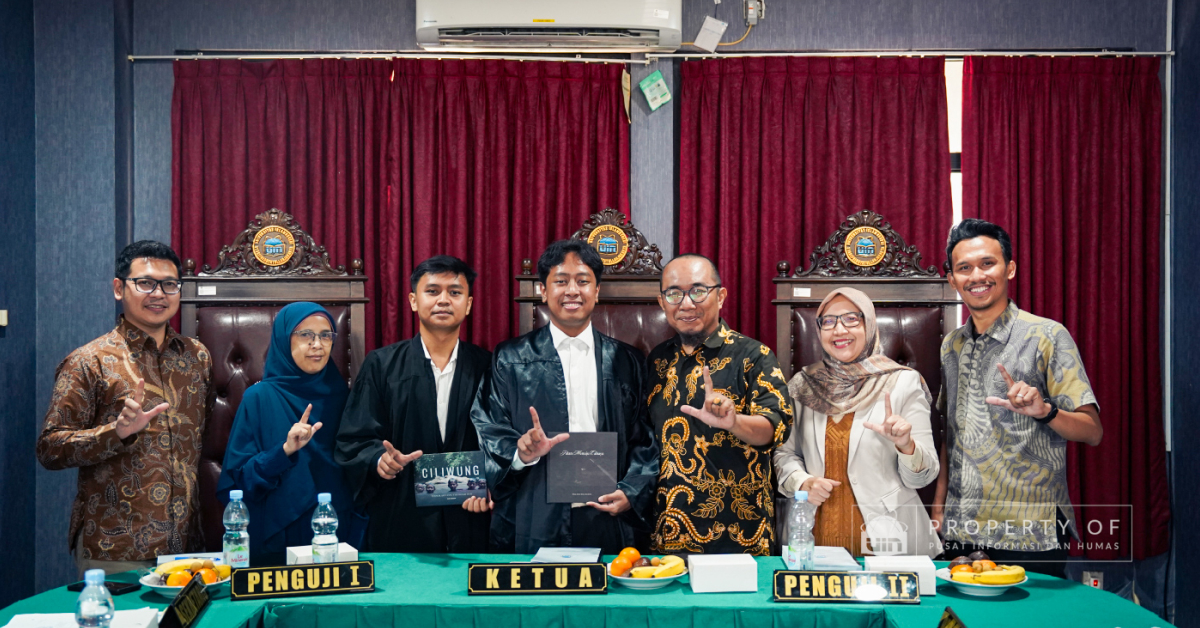
FDIKOM Building, UIN Online News – The Journalism Study Program at the Faculty of Da'wah and Communication Sciences (FDIKOM), UIN Syarif Hidayatullah Jakarta, has officially operationalized an alternative non-thesis graduation track in the form of a Professional Photojournalism Book. Regulated under the Dean’s Decree Number 204 of 2026, two undergraduate students made institutional history as the inaugural graduates to successfully exit the program via this creative project framework on Friday, June 26, 2026.
This milestone policy marks a strategic pivot by the Journalism Department to provide diversified graduation tracks that accommodate multi-dimensional student talents without compromising rigid academic benchmarks. While producing high-grade professional media assets, students are strictly required to execute structured field research and apply scientific methodologies equivalent to traditional thesis writing.
The Chair of the Journalism Study Program, Dr. Bintan Humeira, emphasized that academic departments must carve out clear spaces for student skill differentiation rather than trapping candidates into a single, rigid thesis model. Through this revised curriculum, students are not merely armed with abstract theories, but are directed to scale up functional, market-ready portfolios required by the global media industry.
“We evaluated that the department needed to recognize diverse student competencies, meaning academic output should not be limited to a standard written thesis. Our current curriculum structure ensures that students acquire deep theoretical knowledge while simultaneously gaining immersive opportunities to master technical, professional media skills,” she explained.
Dr. Humeira added that the academic weight and quality control of the non-thesis project strictly mirror traditional dissertation standards, demanding a high-level research blueprint from the applicants.
A senior journalism lecturer and project supervisor, Rasdian A. Vadin, clarified that the mentorship structure for this track is designed to be highly dynamic and digitalized. Consultations are executed through a blend of in-person workshops and real-time online channels to immediately respond to student challenges during active field reporting.
“The process runs fluidly via face-to-face meetings or digital networks. Frequently, when students are deploying in the field, they drop raw assets into our network for immediate group evaluation. The dynamic mimics a real-world corporate newsroom,” he remarked.
Vadin asserted that this non-thesis track yields massive leverage for UIN Jakarta graduates. Upon clearing the program, they do not merely carry an abstract degree and academic transcript, but step into the competitive market holding a fully published, professional portfolio.
“The supreme advantage is that students must actively integrate every single lecture module they absorbed over four years and deploy it directly into the field. They write, shoot, layout, print, and defend their work. When they graduate, they carry a physical, industry-ready photo-book asset to show employers,” he added.
From the student perspective, the project framework operates as a liberation tool allowing them to audit their personal career specializations. Graduate Nur Ikhwan stated that his deep passion for visual storytelling was the driving force behind choosing the photojournalism book track.
“When the faculty rolled out this project option, I applied immediately. The track demands intensive field immersion. My book examines the socio-economic realities of marginalized communities along the banks of the Ciliwung River, capturing the daily survival of residents in the Manggarai and Kebon Pala sectors. The ultimate hurdle was not technical photography, but building deep ethical trust with a community facing sensitive issues like state evictions to ensure a completely humanized, ethnographically sound documentation process,” Ikhwan revealed.
Concurrently, fellow graduate Reza Alwi Ibnu Ibrohim launched his comprehensive visual volume titled Jalan Indah Kecahayaan (The Beautiful Path of Radiance). Working as a freelance photographer, he noted that the non-thesis track heavily accelerated his motivation to graduate.
“As a freelance photojournalist who frequently operates in crisis zones, this project tract made the graduation process incredibly engaging. My volume investigates disability inclusion across four distinct geographic sectors in Jakarta and Bandung over multiple weeks. My core objective was to break the media stereotype that frequently exploits disabled individuals through a lens of pity. Through structured visual sociology, I worked to project a narrative framework that is humanistic, equitable, and entirely inclusive,” he concluded.