
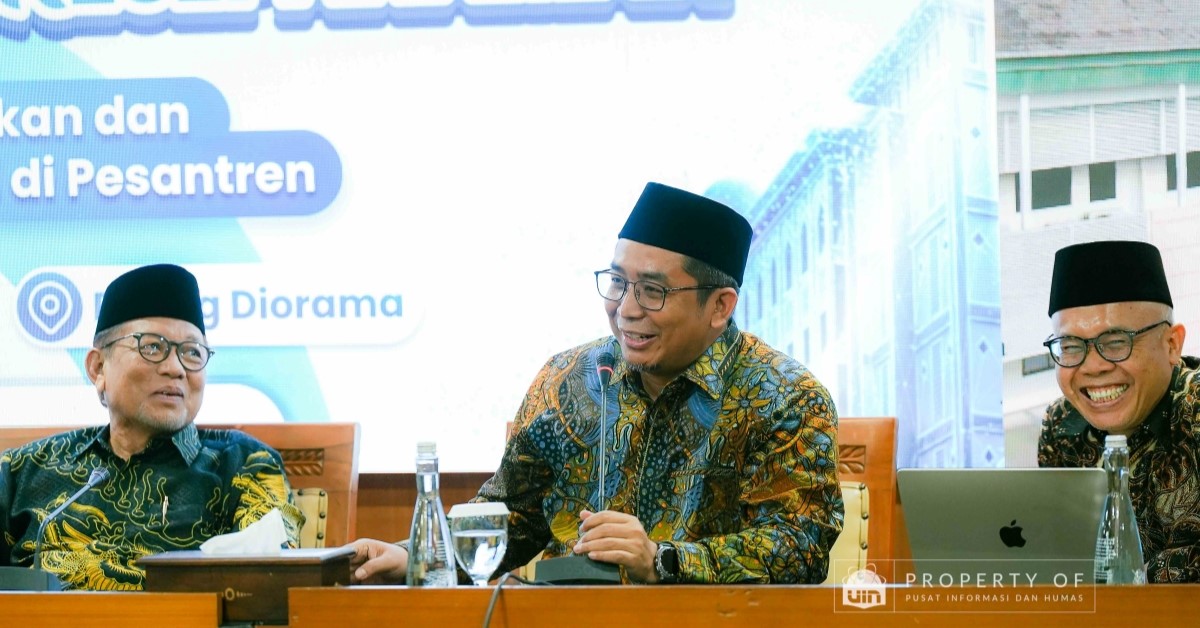
Pesantren: New Directorate General Expected to Expand Santri Access to Diverse Academic Disciplines
Diorama Room, UIN Online News — UIN Syarif Hidayatullah Jakarta has taken another significant step toward strengthening Indonesia's national education ecosystem through a Sarasehan (Academic Forum) and the signing of a Memorandum of Understanding (MoU) held at the Diorama Hall, Ground Floor of the Harun Nasution Auditorium, on Tuesday (April 21, 2026). The forum highlighted the establishment of the Directorate General of Islamic Boarding Schools (Direktorat Jenderal Pesantren) as a key instrument for implementing the multi-entry and multi-exit education system envisioned under Indonesia's Islamic Boarding School Law.
Under the theme "Strategies and Challenges in Education and Human Resource Development in Islamic Boarding Schools," participants discussed legal certainty regarding diploma recognition and broader access for pesantren graduates to academic programs across various disciplines. The issue was emphasized by the Chairman of the Indonesian Association of Islamic Boarding School Caretakers (P2I), Dr. KH. Tata Taufiq, M.Ag., who expressed hope that the new Directorate General would ensure greater inclusivity for pesantren graduates in higher education.
"The Islamic Boarding School Law positions pesantren as providers of prospective students for all academic disciplines through its multi-entry and multi-exit system. This legal framework guarantees that pesantren graduates can continue their studies at any higher education institution without being restricted to specific academic pathways," he explained.
Responding to this aspiration, Rector of UIN Syarif Hidayatullah Jakarta, Prof. Asep Saepudin Jahar, M.A., Ph.D., reaffirmed the university's commitment to supporting pesantren graduates in pursuing higher education through advanced academic levels. He stressed that sustainable collaboration between universities and pesantren is essential to enhancing the global competitiveness of future graduates.
"This partnership must be developed as a continuous academic pathway. We hope to encourage pesantren graduates not only to pursue undergraduate studies but also to continue through master's and doctoral programs. This reflects UIN Jakarta's commitment to providing the widest possible opportunities for pesantren alumni to excel in both religious and scientific disciplines," the Rector stated following the event.
Beyond expanding access to higher education, participants also expressed high expectations that the new Directorate General would accelerate human resource development within Islamic boarding schools. Through closer collaboration with universities, pesantren across Indonesia are expected to adopt modern institutional management practices while strengthening education in Science, Technology, Engineering, and Mathematics (STEM) to meet the evolving qualification standards for educators.
This concern was echoed by the Chairman of the Forum of Gontor Alumni Islamic Boarding Schools (FPAG), Dr. KH. Luqman Hakim Arifin, M.Pd., who emphasized the important role universities can play in supporting technological transformation across approximately 1,300 pesantren affiliated with FPAG throughout Indonesia, from Aceh to Papua.
"Partnerships with Islamic boarding schools offer tremendous mutual benefits. Universities can support us in areas such as technology and institutional management. We oversee thousands of pesantren that continue to improve their educational quality, and collaboration with UIN Jakarta will help strengthen teacher qualifications through master's and doctoral education in response to contemporary challenges," he said.
For UIN Jakarta, the collaboration supported by the Directorate General of Islamic Boarding Schools represents a strategic opportunity to welcome prospective students who already possess strong moral character, intellectual curiosity (hubbul 'ilmi), and a deep commitment to learning. With stronger institutional support from the Ministry of Religious Affairs, this partnership is expected to move beyond symbolic cooperation and become a practical model for integrating the rich traditions of pesantren education with a modern, competitive university system.