
PBAK Second Day of UIN Jakarta: Realizing the Ulul Albab Generation in the Midst of National Challenges

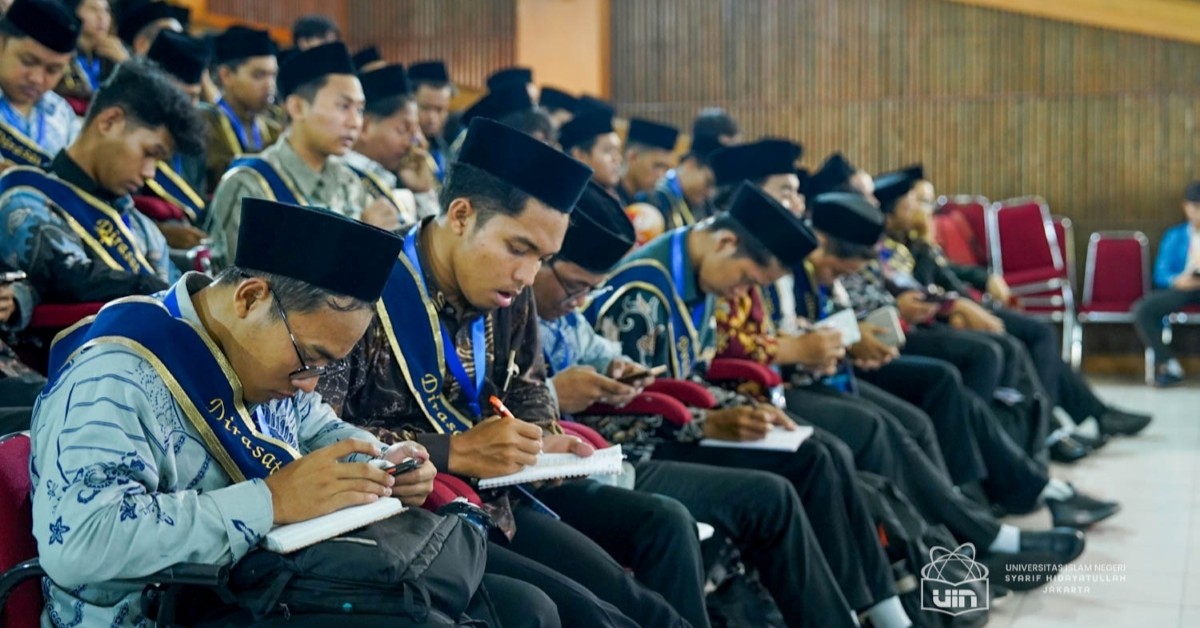
Harun Nasution Auditorium, UIN News Online – The second day of the Introduction to Academic and Student Culture (PBAK) of UIN Syarif Hidayatullah Jakarta 2026 invites new students to understand technological changes while strengthening the value of Pancasila and national character as a provision to face academic life and the world of work. A total of 3,249 new students from the Faculty of Economics and Business (FEB), Faculty of Dirasat Islamiyah (FDI), Faculty of Social and Political Sciences (FISIP), and Faculty of Sharia and Law (FSH) participated in PBAK UIN Jakarta which was held, at the Harun Nasution Auditorium, Thursday (27/8/2026).
The series of activities presented a number of figures, academics, and practitioners including the Deputy Minister of Home Affairs of Indonesia Dr. H. Bima Arya Sugiarto, S.I.P., M.A., Deputy Chairman III of the South Tangerang City DPRD for the 2024-2029 period Maria Teresa Suhardja, B. Sc., Scholar, Expert in Islamic Thought & Nationality Yudi Latif, M.A., Ph.D., and Political Communication Analysis & Media Practitioner Salsabila Syaira, S.I.P., M.I.P.
Starting the series of events, Talk Show 3 entitled "Building a Future Indonesia: Transformation, Innovation, and Leadership of the Young Generation in the Digital Era" moderated by the Ambassador of UIN Jakarta, Mohammad Arifandi, Deputy Minister of Home Affairs, Dr. H. Bima Arya Sugiarto, S.I.P., M.A., in his presentation said that Indonesia is currently in the momentum of the demographic bonus, when the number of productive age population is larger than the non-productive age group. However, this momentum does not last forever.
Therefore, students as part of the productive generation need to be able to take advantage of this momentum to push Indonesia towards a developed country. Bima reminded that this success does not come by itself, but requires the readiness of the younger generation to read changes and determine their role in the future.
He then invited students to read the signs of the times, both based on scientific developments and by learning from history. According to Bima, the development of artificial intelligence (AI) is one of the signs of change that students need to understand. These technological advances still need to be balanced with wisdom so that humans do not lose their own strengths.
Bima emphasized that AI can facilitate human work, but not all human abilities can be replaced by technology. Therefore, students need to strengthen three main competencies, namely digital skills, thinking skills, and human skills.
"As sophisticated as AI is, of course we use it. But humans still have value," said Bima.
According to him, thinking skills are related to the ability to think analytically, while human skills include the ability to build relationships with the social environment. Both abilities are important because a person's success is not only determined by intelligence and technical ability.
Bima also reminded students that competence and achievements can lead a person to a certain position, but character is a factor that determines a person's ability to survive.
"Competence will take you to the top. But making you stay at the top is character," he said.
After the session, PBAK continued with Talk Show 4 entitled "Internalization of Pancasila Values and National Character". This session presented Scholars of Islamic and National Thought Dr. Yudi Latif, M.A., Ph.D., and Salsabila Syaira, S.I.P., M.I.P., with Salamah Agung, M.A., Ph.D. as moderator.
In his presentation, Yudi Latif emphasized the importance of creative and character education by internalizing the values of Pancasila as capital to face the challenges of the times. Pancasila is considered the foundation of national integrity as well as a meeting point for various diversity in Indonesia.
Yudi related the values of Pancasila to various sources of people's lives, ranging from religious teachings in the first precept, social values in the second precept, local wisdom of the archipelago in the third precept, geopolitics in the fourth precept, to social justice in the fifth precept. Then Yudi added, in building the character of individuals and citizens, there are nine core values of personal character that are references, namely courage, justice, kindness, gratitude, honesty, humility, wisdom, self-reflection, and respect.
He emphasized that the strength of a nation is not only determined by insight, but also by morals and character. In the context of UIN Jakarta, the depth of religious insight is considered necessary to go hand in hand with general insight so that science can be a force that encourages progress.
"In addition to having general insights, we must also have a depth of religious insight. Religious teachings must actually be a driving force for us to move forward," said Yudi.
Meanwhile, Salsabila Syaira linked the value of Pancasila to people's lives in the midst of technological developments. In the session, she invited students to understand their position as citizens as well as users of digital space who have moral responsibility.
According to Salsabila, Pancasila should not only be understood as a value that is socialized from state institutions to the community. These values need to be reflected in common life and shown through the example of state institutions and officials.
He also invited students to understand nationalism more substantively. Nationalism, according to him, is not only a matter of symbols, but an awareness of identity as a citizen, culture, region, as well as the basis and philosophy of Indonesia.
The discussion on the readiness of the young generation then continued in Talk Show 5 entitled "Global Education, Digital Intelligence, and Ethical Leadership: Building an Outstanding and Impactful Generation in the Digital Era". The session presented Deputy Chairperson III of the South Tangerang City DPRD Maria Teressa, B.Sc., with Farabi Fardiansyah as the moderator.
Maria highlighted the changes that digital transformation has brought to education and the world of work. According to her, the development of AI makes it not enough for students to rely only on educational degrees, but also need to have various skills that are relevant to the changing times.
He introduced a number of competencies that students need to develop, including critical thinking, digital and AI literacy, creativity and innovation, collaboration, communication, adaptability, lifelong learning, and leadership.
"Title is important. But is it enough?," said Maria.
On the other hand, Maria reminded that technological progress needs to go hand in hand with concern for the environment. The principles of sustainability, environmental stewardship, and conservation are important parts in dealing with technological and climate change.
Entering the afternoon session, the second day of the University PBAK series will continue with an agenda intended for new students of FISIP and FSH.
New students are scheduled to take part in Talk Show 6 entitled "Introduction to UIN Jakarta Services". This session presents a Public Relations Information Center with a number of introductions to university service managers to introduce various facilities and services that can be used by students while living their academic life at UIN Jakarta.
The series is then scheduled to continue with Talk Show 7 entitled "Smart Media, Wise in Building Self-Image: Personal Branding of the Ulul Albab Generation". This session will present resource persons, Musfiah Saidah, S.Sos., M.Si. and Dzakwan Afif as moderators.
Of the entire series of event activities above, PBAK University has officially ended. PBAK 2026 activities are continued with a series of PBAK Faculties and Study Programs and UKM Villages which is scheduled to take place on August 28-30, 2026.
Documentation of the 2026 Introduction to Academic and Student Culture (PBAK) series on Thursday (27/08/2026), can be watched through the official YouTube channel of UIN Syarif Hidayatullah Jakarta