
PBAK 2026: Salsabila Syaira Emphasizes the Meaning of Pancasila in Building National Character



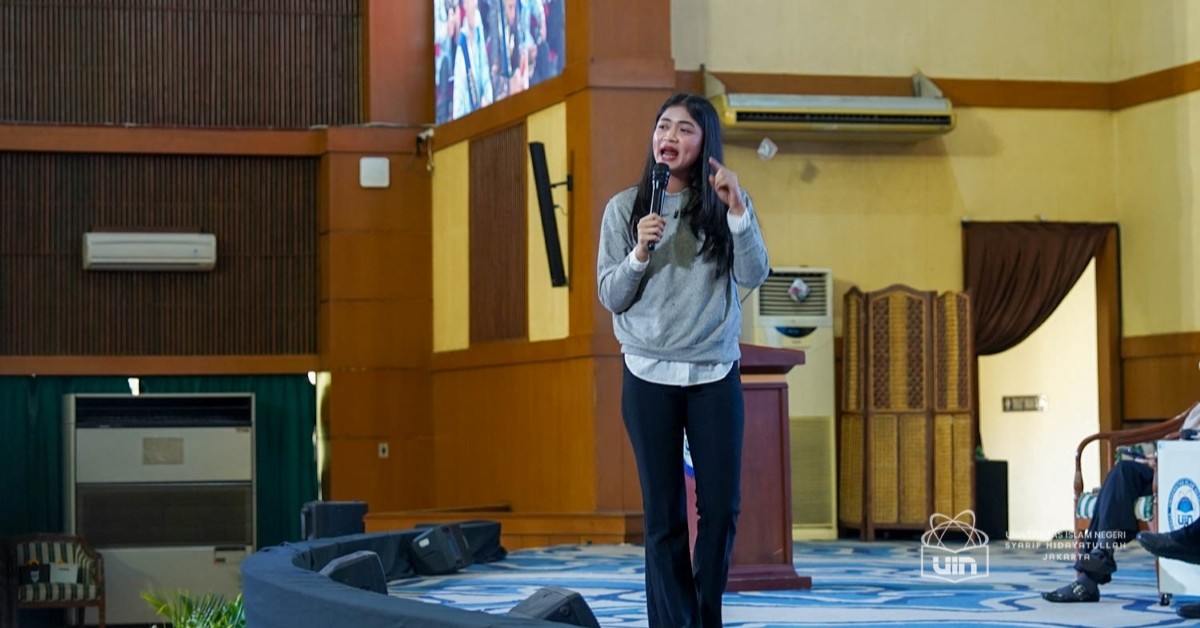
Harun Nasution Auditorium, UIN News Online– Assistant to the President's Special Staff for Domestic Religious Affairs for the 2018–2019 period, Salsabila Syaira, S.I.P., M.I.P., encouraged incoming students at UIN Syarif Hidayatullah Jakarta to understand Pancasila as a foundation for building national character while preserving Indonesia's identity and sovereignty. This message was delivered during the second session of the 2026 Academic and Student Culture Orientation (PBAK) UIN Jakarta talk show, titled “Internalizing Pancasila Values and National Character,” held at the Harun Nasution Auditorium on Thursday (27/8/2026).
The second day of PBAK featured a panel of figures, academics, and practitioners. Among them were the Deputy Minister of Home Affairs of the Republic of Indonesia, Dr. H. Bima Arya Sugiarto, S.I.P., M.A.; Vice Chairperson III of the South Tangerang City Regional House of Representatives (DPRD) for the 2024–2029 period, Maria Teresa Suhardja, B.Sc.; Scholar and Expert in Islamic and National Thought, Yudi Latif, M.A., Ph.D.; and Political Communication Analyst and Media Practitioner, Salsabila Syaira, S.I.P., M.I.P.
This talk show formed part of the second day's PBAK agenda. The second session was attended by 1,817 incoming students, comprising 1,239 students from the Faculty of Sharia and Law (FSH) and 578 students from the Faculty of Social and Political Sciences (FISIP). Meanwhile, the preceding first session was attended by 1,432 students, including 229 from the Faculty of Islamic Studies (FDI) and 1,203 from the Faculty of Economics and Business (FEB).
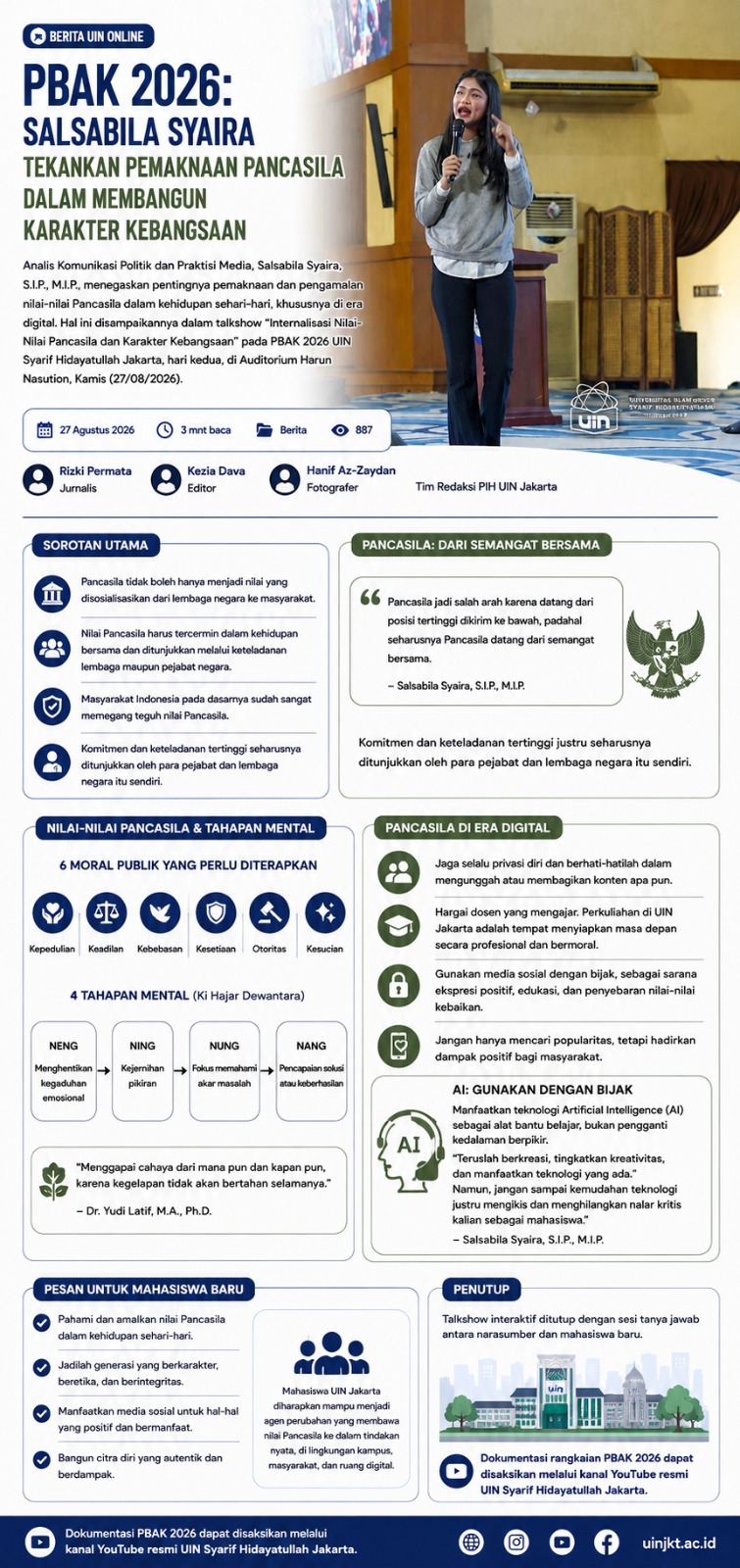
In her presentation, Salsabila explained that Pancasila must be comprehended more deeply as the nation's state foundation and philosophy. The values embedded in each principle extend beyond normative statements, serving as a framework that connects values, morality, and governance. This aligns with her point that Pancasila functions both as the state foundation and a philosophy bridging morality and power.
Salsabila noted that the interpretation of Pancasila should not merely position it as a set of values handed down from the highest authorities to the public. According to her, Pancasila should instead be understood as values emerging from shared spirit and the daily life of Indonesian society.
“Pancasila becomes misdirected when it is sent down from the highest authority to the bottom, whereas Pancasila should originate from a shared spirit,” Salsabila stated.
According to her, this understanding demands commitment and role modeling from those serving in state governance. She emphasized that Pancasila values cannot simply be taught to the public, but must first be exemplified by public officials and state institutions.
“Therefore, the highest commitment and leadership by example should be demonstrated by state officials and institutions themselves,” she asserted.
Furthermore, Salsabila explained that Pancasila has deep roots in the life of Indonesian society. These values were not merely political concepts born in isolation, but were discovered by the founding fathers through community life and the spirit of togetherness that had evolved culturally over generations.
“Pancasila is a philosophical foundation discovered by the nation's founders, inspired by the civic life, community practices, and mutual cooperation (gotong royong) inherent in Indonesian society itself,” Salsabila explained.
In response to the discussion, Yudi Latif highlighted that Pancasila values are interconnected with various facets of societal life. According to him, the internalization of Pancasila can be nurtured through religious teachings, social values, Nusantara local wisdom, geopolitical awareness, and a dedication to social justice.
“First, through religious teachings in the first principle of Pancasila, social values in the second principle, Nusantara local wisdom in the third principle, geopolitics in the fourth principle, to social justice in the fifth principle. The public is urged not to focus on finding differences, but rather on nurturing commonalities for the collective good,” Yudi added.
Yudi also remarked that the understanding of Pancasila should guide society to recognize commonalities as the bedrock of national life. Consequently, internalizing Pancasila involves not just knowledge of the five principles, but how these values are put into daily social practice.
Through this talk show, students were encouraged to recognize that Pancasila is the foundation for building national character while preserving Indonesia's identity and sovereignty. This understanding is crucial for the younger generation to navigate civic life with value awareness, identity, and a sense of responsibility as citizens.
Documentation of the Academic and Student Culture Orientation (PBAK) 2026 series on Thursday (27/08/2026) can be viewed on the official YouTube channel of UIN Syarif Hidayatullah Jakarta.