
PBAK 2026: Prof. Amany Lubis Emphasizes the Integration of Islamic Values and Science at UIN Jakarta



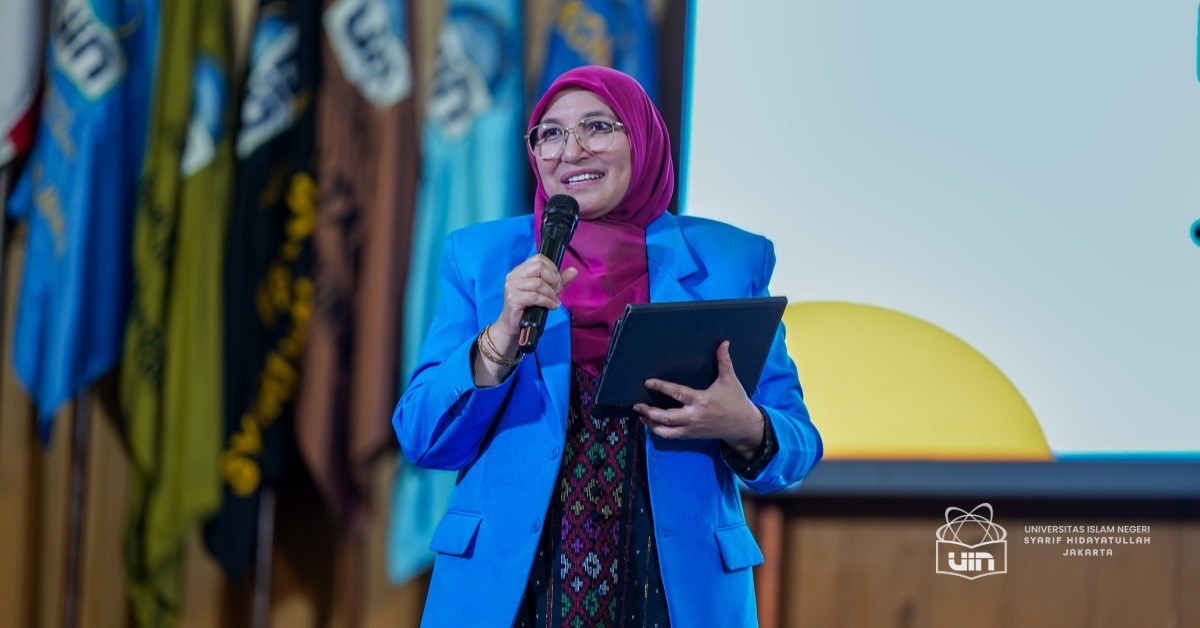
Harun Nasution Auditorium, UIN News Online – Professor of UIN Syarif Hidayatullah Jakarta, Prof. Dr. Hj. Amany Lubis, M.A., delivered a presentation as a speaker at the 2026 Academic and Student Culture Orientation (PBAK) of UIN Jakarta. The session, titled “The Historical Thought Profile of UIN Jakarta (Forming the Character of Ulul Albab: The Integration of Islamic Values, Indonesian Identity, and the Characteristics of Islamic Thought at UIN Jakarta),” took place on Wednesday (26/08/2026) at the Harun Nasution Auditorium, UIN Jakarta.
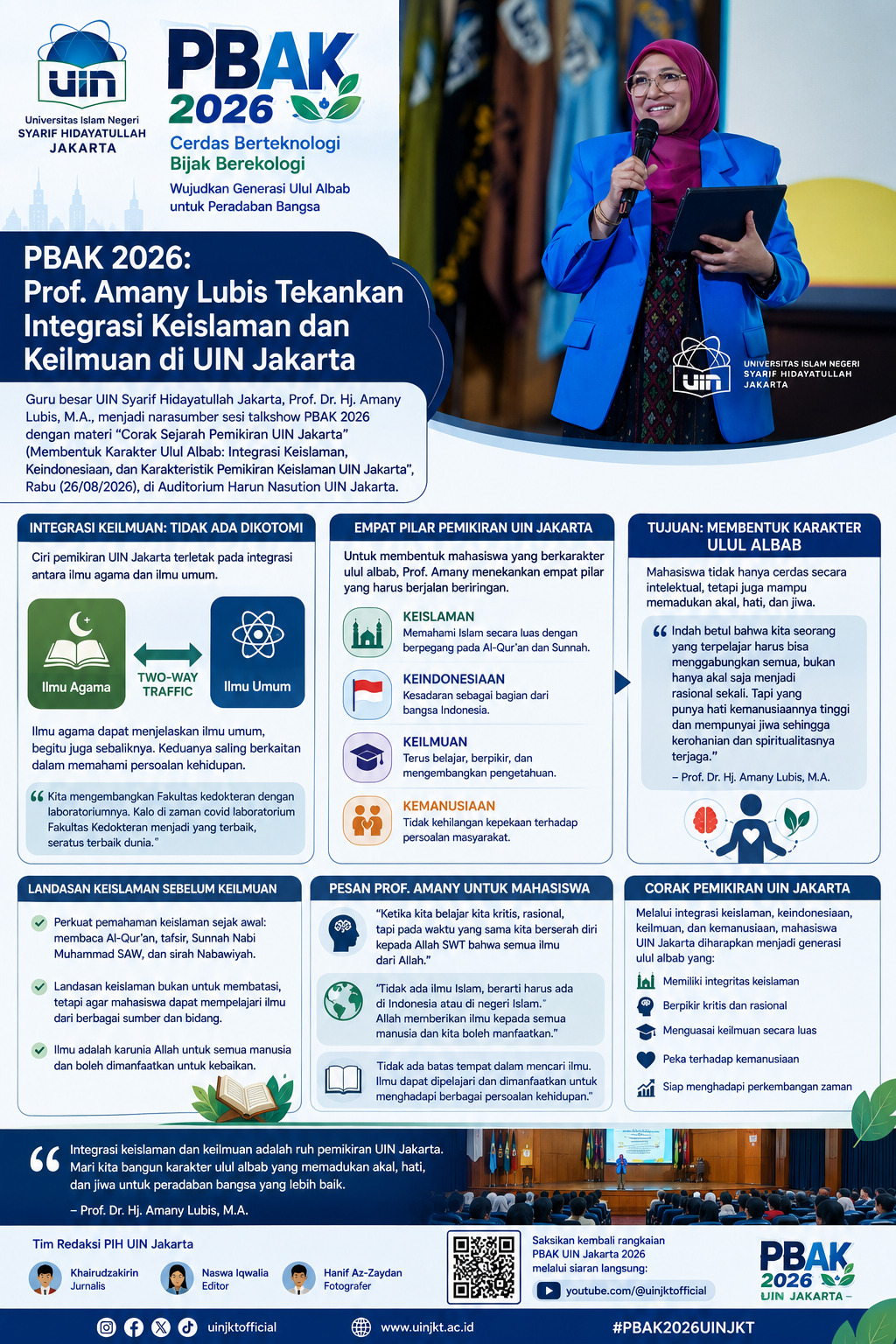
During the PBAK UIN Jakarta talkshow session, Prof. Amany explained that a defining characteristic of thought at UIN Jakarta lies in the integration of religious sciences and general sciences. According to her, these two branches of knowledge are not treated separately, but are interconnected in understanding various life issues.
This integration of knowledge serves as the foundation for various academic fields developed at UIN Jakarta. Fields such as medicine, law, politics, social sciences, literature, and philosophy continue to flourish without detaching themselves from Islamic values as their core foundation.
"We developed the Faculty of Medicine complete with its laboratories. During the COVID-19 pandemic, the Faculty of Medicine's laboratory was recognized among the best, ranked in the top one hundred globally."
Throughout this process, Prof. Amany encouraged students to foster a tradition of rational and critical thinking. Students, she noted, should have the courage to ask questions, seek reasons, and deepen their understanding of various issues, while remaining grounded in faith and morality.
She illustrated this concept through a two-way traffic approach, where religious science can be utilized to explain general science, while general science can help elucidate and expand the understanding of religious science. Through this approach, Islam can continually be understood in ways that remain relevant alongside scientific advancements and changing times.
“There is no dichotomy among branches of knowledge,” Prof. Amany asserted.
She also outlined four pillars that should form an integral part of intellectual development for UIN Jakarta students: Islamic values, Indonesian identity, knowledge, and humanity. These four pillars must advance together to shape students who possess not only academic competence, but also national consciousness and social empathy for human issues.
In terms of Islamic values, students are encouraged to understand Islam broadly by adhering to the Qur'an and Sunnah. Meanwhile, Indonesian identity relates to students' awareness of their role as citizens of Indonesia, while the aspect of knowledge requires students to continuously learn, think, and advance their understanding. Lastly, the pillar of humanity demands that students maintain sensitivity toward societal challenges.
These four pillars are directed toward cultivating the character of ulul albab. Prof. Amany explained that this character involves not only intellectual capability, but also the ability to synthesize the mind, heart, and soul.
“It is truly wonderful that as educated individuals, we must be able to combine everything—not relying solely on the mind to become purely rational, but also possessing a deep heart for humanity and a nurtured soul so that our spirituality remains intact,” she stated.
In navigating contemporary developments, Prof. Amany believes students need a firm Islamic foundation before advancing their knowledge across various disciplines. She encouraged students to broaden their understanding of the Qur'an, its exegesis (tafsir), the Sunnah of Prophet Muhammad SAW, and the prophetic biography (sirah Nabawiyah).
“The more one studies Islamic foundations—from the verses of the Qur'an, their tafsir, to the Sunnah of Prophet Muhammad SAW and the sirah Nabawiyah read during the first semester—the stronger our Islamic foundation becomes,” she remarked.
Prof. Amany clarified that this Islamic foundation is not intended to restrict students in their pursuit of knowledge. Rather, it enables students to acquire knowledge from diverse sources and fields as part of broader intellectual development.
Prof. Amany reiterated this concept following the talkshow session. She emphasized that students should remain critical and rational in their studies, while simultaneously maintaining spiritual awareness that all knowledge ultimately originates from Allah SWT.
“When we learn, we are critical and rational, but at the same time we surrender to Allah SWT, acknowledging that all knowledge comes from Allah,” she expressed.
According to Prof. Amany, students also do not need to restrict their pursuit of knowledge to specific places or environments. Knowledge, she noted, is a divine gift from Allah to all humanity, which can be learned and applied to address life's various challenges.
“Knowledge in Islam is not confined to Indonesia or Islamic nations alone. Allah bestows knowledge upon all humanity, and we are encouraged to utilize it. That is the beauty of Islam,” she added.
This message was part of Prof. Amany's efforts to introduce the intellectual profile of UIN Jakarta to incoming students. Strengthening Islamic values alongside an openness to diverse academic disciplines must proceed hand in hand, enabling students to navigate modern developments with critical, rational thinking without losing their foundation of faith and human values.
Through the integration of Islamic values, Indonesian identity, knowledge, and humanity, Prof. Amany urged UIN Jakarta students to cultivate the character of ulul albab—one capable of harmonizing intellectual intelligence, strong faith, and humanitarian concern in facing the demands of changing times.
Watch the opening ceremony of PBAK UIN Jakarta 2026 via the following live stream: