Partnering with NGOs to Advance Climate Education and Sustainable Development
Syarif Hidayatullah State Islamic University Jakarta actively collaborates with non-governmental organisations to address Sustainable Development Goal challenges through research programmes, educational-resource development, capacity building, and knowledge dissemination. One of the University's strongest examples is the collaboration between the Center for the Study of Islam and Society (PPIM), Greenpeace Middle East and North Africa (MENA), and Ummah for Earth Greenpeace Indonesia. The partnership, implemented through the programme “Ulama (Imam) and Climate Change and Environmental Issues in Islamic Higher Education,” operated from 2023 to 2025 and focused on strengthening the capacity of Muslim scholars, lecturers, universities, and communities to respond to the climate crisis.
The collaboration directly contributes to SDG 4: Quality Education, SDG 13: Climate Action, and SDG 17: Partnerships for the Goals.
1. NGO–University Collaboration through Climate Research
A core element of the partnership was a collaborative research programme examining how climate-change and environmental issues were integrated into Islamic higher education. PPIM and Greenpeace investigated institutional conditions, environmental literacy, curriculum development, and the capacity of lecturers to integrate Climate Change and Environmental Education into teaching.
The initial research identified several recurring challenges. These included limited environmental literacy among lecturers, insufficient institutional support, the absence of specialised climate-related courses, and the limited integration of environmental issues into existing curricula. The partnership subsequently expanded its research to Islamic higher education institutions affiliated with major Muslim organisations.
PPIM's 2025 research portfolio records “Dari Iman ke Aksi: Ulama dan Kurikulum Hijau di PTKAI untuk Pendidikan Islam yang Responsif terhadap Krisis Iklim” as research covering 12 campuses affiliated with Nahdlatul Ulama and Muhammadiyah, with Greenpeace as the partner organisation. This demonstrates a sustained research partnership between Syarif Hidayatullah State Islamic University Jakarta and an environmental NGO to identify sustainability challenges within higher education and develop practical responses.
2. Turning Research Findings into Educational Resources
The partnership did not stop at collecting and publishing research data. Based on its findings, PPIM developed two educational models to strengthen climate and environmental education within Islamic higher education. The first was “Religion and Environment,” designed for integration into Introduction to Islamic Studies. The second was “Environmental Citizenship,” designed for integration into Citizenship Education. These resources translated research findings into practical teaching frameworks that lecturers could adapt to existing courses.
The programme therefore demonstrates a direct pathway from NGO–university research collaboration to the development of educational resources for sustainable development. The models were subsequently implemented and tested through capacity-building programmes at Syarif Hidayatullah State Islamic University Jakarta and UIN Maulana Malik Ibrahim Malang.
3. Implementing Green Curriculum Capacity Building with Greenpeace

On 3 November 2025, PPIM collaborated with Ummah for Earth–Greenpeace Indonesia and the Institute for Research and Community Service of UIN Maulana Malik Ibrahim Malang to implement a lecturer capacity-building programme entitled:
“From Faith to Action: Ulama and Green Curriculum in Islamic Higher Education for Climate-Responsive Islamic Education.”
The programme involved lecturers in religious studies and Pancasila and Citizenship Education. Participants were not positioned merely as recipients of information. They worked with PPIM and Greenpeace to explore how climate and environmental issues could be translated into lesson plans, syllabi, teaching methods, and research projects. The activity was explicitly developed from previous research conducted collaboratively by PPIM and Greenpeace. The findings had identified gaps in lecturers' environmental literacy and teaching methodologies. Capacity building therefore became a research-informed response to a documented sustainability challenge.
4. Testing and Strengthening the Educational Model at UIN Jakarta
Syarif Hidayatullah State Islamic University Jakarta also became one of the pilot locations for implementing the green-curriculum model. In November 2025, 22 lecturers teaching Islamic Studies and Citizenship Education participated in capacity building at the University. The programme equipped participants with contextual teaching methodologies, including the use of immersive technology to simulate the impacts of climate change. Monitoring and evaluation conducted in December 2025 showed high acceptance of Climate Change and Environmental Education among lecturers.
The programme also observed implementation in classes involving 132 students, demonstrating that the resources developed through the NGO–university collaboration progressed from research and curriculum design into actual teaching practice. This pilot process enabled the partners to test, evaluate, and refine the educational approach before wider dissemination.
5. Research Collaboration Supporting Wider Environmental Action
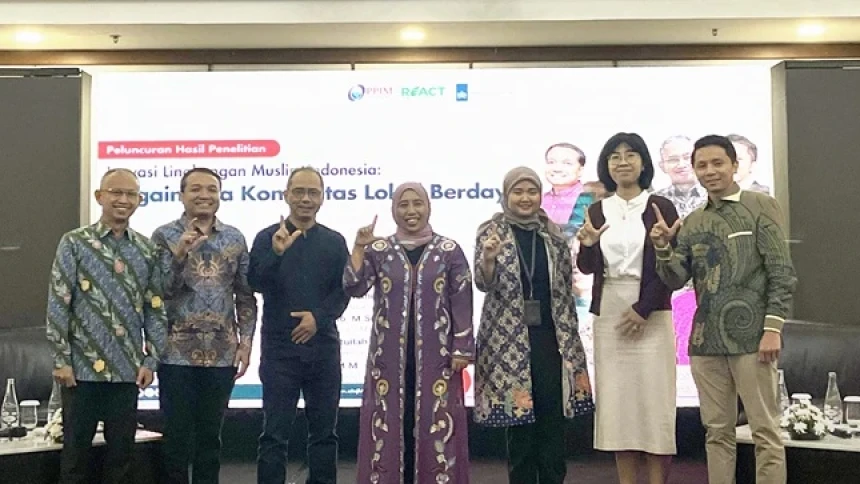
The University's NGO collaboration exists within a broader ecosystem of environmental research and civil-society engagement. Through the REACT Project, PPIM has conducted research on environmental activism, Muslim environmental innovation, environmentally friendly pesantren, and public environmental attitudes. This research has generated knowledge products, policy recommendations, training programmes, and public educational materials.
In 2025, PPIM also disseminated research on environmental innovation in Muslim communities. The research examined local environmental initiatives and identified factors that enable community-based sustainability practices to succeed. The study helped transform local experiences into evidence and recommendations that could be shared with community organisations and other stakeholders.
6. Extending Collaboration through Civil-Society Networks
The University's engagement with civil society extends beyond a single NGO partnership. The REACT programme has brought together environmental organisations, religious institutions, research institutes, community initiatives, and other civil-society organisations. Capacity-building activities have helped partner institutions develop environmental programmes and strengthen their networks with government, private-sector actors, and other civil-society organisations.
The PPIM unit report records substantial civil-society participation in these activities, demonstrating that the University's environmental partnerships operate through a wider network rather than isolated institutional relationships. This network approach allows research findings and educational resources to reach organisations capable of implementing sustainability initiatives within communities.
7. Contribution to SDG 17: Partnerships for the Goals
The collaboration between Syarif Hidayatullah State Islamic University Jakarta and Greenpeace demonstrates how university–NGO partnerships can translate research into practical sustainable-development interventions.
Through this partnership, the University and its NGO partners have:
-
conducted collaborative research on climate-change and environmental education;
-
mapped environmental literacy and institutional challenges across Islamic higher education institutions;
-
developed the “Religion and Environment” and “Environmental Citizenship” teaching models;
-
implemented lecturer capacity-building programmes;
-
tested educational resources at university level;
-
monitored implementation and learning outcomes; and
-
strengthened networks for wider environmental education and action.
The evidence demonstrates collaboration through both research programmes and the development of educational resources, directly addressing the requirements of SDG Indicator 17.2.5.
Through partnerships with Greenpeace and wider civil-society networks, Syarif Hidayatullah State Islamic University Jakarta demonstrates an evidence-based model of university–NGO collaboration in which research findings are transformed into educational resources, institutional capacity, and practical action for the Sustainable Development Goals.
These activities provide substantive evidence for SDG Indicator 17.2.5: Collaboration with NGOs for the Sustainable Development Goals.
Source :
https://ppimcensis.or.id/program/ummah-for-earth-u4e-greenpeace-mena-indonesia/
https://ppimcensis.or.id/profil/research/
https://ppimcensis.or.id/2025/11/05/ppim-uin-jakarta-dorong-transformasi-kurikulum-hijau-di-ptki-melalui-capacity-building-bersama-greenpeace/
https://ppimcensis.or.id/2025/12/10/uin-jakarta-kembangkan-kurikulum-hijau-dan-perkuat-dosen-sebagai-garda-depan-respon-krisis-iklim/
https://www.greenpeace.org/indonesia/siaran-pers/58629/ulama-dan-perubahan-iklim-di-indonesia/