
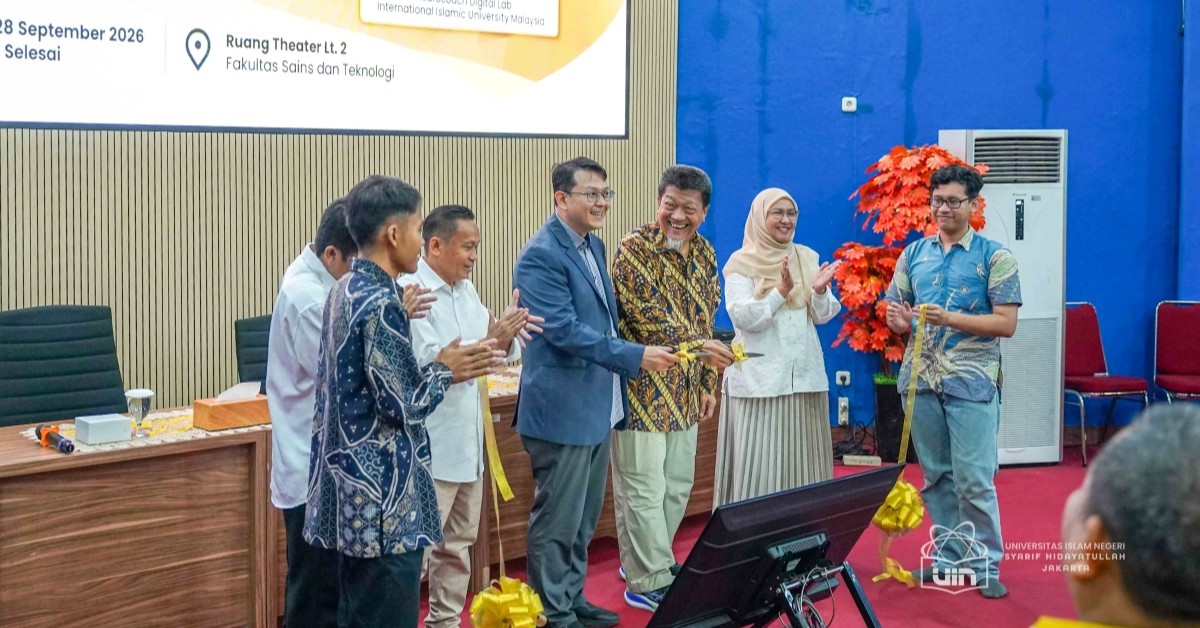
Partnering with IIUM Neuroscience Expert, FST UIN Jakarta Inaugurates Senzeband QEEG Device
FST Theater Room, UIN News Online – The Faculty of Science and Technology (FST) at UIN Syarif Hidayatullah Jakarta officially launched the Senzeband Quantitative Electroencephalography (QEEG) device technology. This launch marks a strategic milestone for FST UIN Jakarta in integrating neuroscience technology to strengthen research, teaching, and objective individual profiling based on cognitive data. The event took place in the 2nd Floor Theater Room of FST UIN Jakarta, Monday (28/09/2026).
The event was attended by Neurocoach Digital Lab expert from International Islamic University Malaysia (IIUM), Prof. Abdul Wahab Abdul Rahman; Dean of FST UIN Jakarta, Prof. Husni Teja Sukmana, S.T., M.Sc., Ph.D.; Vice Dean I for Academic Affairs at FST, Dr. La Ode Sumarlin, M.Si.; Vice Dean III for Student Affairs and Cooperation at FST, Khodijah Hulliyah, M.Si., Ph.D.; Head of PLT, Dr. Iwan Aminudin, S.Hut., M.Si.; as well as FST faculty members and the academic community of UIN Jakarta.
Dean of FST UIN Jakarta, Prof. Husni Teja Sukmana, S.T., M.Sc., Ph.D., warmly welcomed the introduction of this brainwave scanning technology. He expressed that the launch of the Senzeband QEEG reflects FST UIN Jakarta's ongoing commitment.
“The launch of the Senzeband QEEG represents FST UIN Jakarta's commitment to providing cutting-edge research facilities for our academic community. The presence of this technology enhances teaching activities and, beyond that, can ignite innovative research, particularly in neuroscience and artificial intelligence,” he stated.
Neurocoach Digital Lab expert from International Islamic University Malaysia (IIUM), Prof. Abdul Wahab Abdul Rahman, elaborated in depth on the immense potential of this technology. He explained that the Senzeband QEEG is a technological breakthrough for real-time monitoring of electrical brain signals, featuring a headband equipped with four primary electrodes.
“We have the SenseBand which observes four channels: Fp3, Fp4, T7, and T8. With this device, we can conduct much more extensive analyses for emotions such as happiness and fear, as well as detect whether an individual is experiencing mental fatigue,” he explained.
In his presentation, Prof. Wahab shared research findings demonstrating that the Senzeband QEEG is capable of reading personality indicators as well as neural traces of social media addiction in the brain. One example was drawn from laboratory experiments conducted on teenagers aged 13–15.
“In teenagers aged 13–15, brain mapping indicated that those with signs of gadget addiction suffered a drastic decline in Alpha wave power. This occurred in the frontal region of the brain responsible for clear thinking, self-control, and decision-making, causing it to function suboptimally,” he elaborated.
Prof. Wahab also added that brainwave mapping opens vast opportunities to study various aspects of human emotion and behavior—ranging from behavior and mood, memory effectiveness, developmental brain disorders, and physical health deterioration, to conditions of depression and anxiety. He underscored the importance of integrating QEEG technology with Deep Learning-based AI processing methods to detect neurodevelopmental disorders such as autism, dyslexia, and ADHD, as well as memory analysis among Quran memorizers.
“Through brainwave studies, we can assist children with developmental disorders such as autism, dyslexia, and ADHD to achieve a better quality of life. With the integration of AI today, the potential for intervention becomes vastly broader,” he added.
Furthermore, Prof. Abdul Wahab asserted that the utilization of brain signal technology holds strong potential for development within Information Systems and Informatics Engineering programs through behavioral analysis approaches.
“For Information Systems (IS) and Informatics Engineering (IE) study programs, behavioral studies and analysis present highly compelling opportunities. We can leverage this Senzeband QEEG to conduct extensive research,” he expressed.
In closing, he invited FST UIN Jakarta students to actively utilize the Senzeband QEEG laboratory facilities, particularly for exploring Undergraduate Thesis topics.
“I hope you will be interested in conducting research in this field. Through such research, we can gather invaluable datasets,” he concluded.