
Pancasila as a Global Model for Peace: UIN Jakarta Rector Outlines University’s Role in Fostering Interfaith Unity
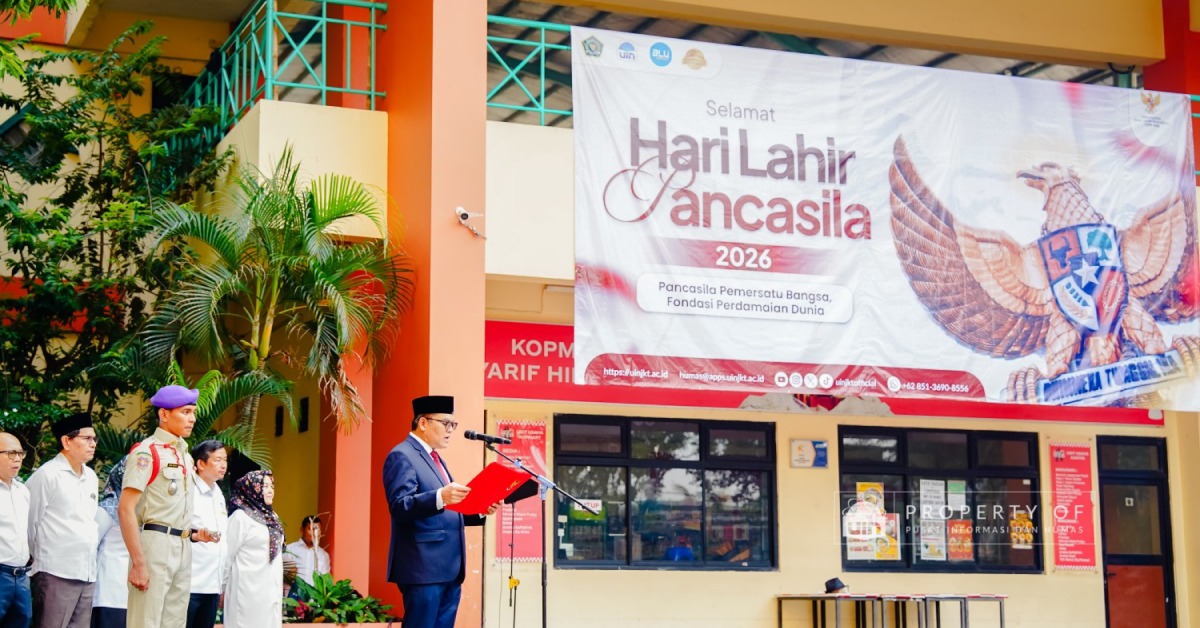
JAKARTA, UIN Online News – The Rector of UIN Syarif Hidayatullah Jakarta, Prof. Asep Saepudin Jahar, Ph.D., reaffirmed the strategic responsibility of higher education institutions to serve as spaces for actualizing Pancasila values through education, research, and community outreach. This statement was delivered during his keynote address at the Pancasila Day commemoration ceremony before the university's academic community on Monday, June 1, 2026.
In his speech, Rector Asep Jahar invited the academic community to utilize the momentum of Pancasila Day to strengthen national commitment and practice the state ideology's values in both academic environments and broader social interactions.
According to him, this year's theme, "Pancasila as the Nation's Unifier, the Foundation for Global Peace," cements Pancasila's position as the social glue for Indonesia's pluralistic society while offering universal values relevant to creating peace, justice, and humanity on a global scale.
"As a higher education institution, UIN Syarif Hidayatullah Jakarta bears a strategic responsibility in instilling, developing, and actualizing the values of Pancasila. The campus is not merely a space for knowledge transfer, it is a vehicle for character building, reinforcing moral integrity, and fostering national awareness," he stated.
At UIN Jakarta, the Rector explained, this commitment is realized through the execution of the Higher Education Tri Dharma, which is oriented toward producing a generation that excels academically, possesses noble character, and maintains a robust national consciousness.
The Rector noted that Pancasila values have long been an integral part of UIN Jakarta's development as a campus that harmoniously integrates Islamic values, scientific knowledge, and Indonesian identity. The first principle, "Belief in the One and Only God," is manifested through strengthening an academic culture that is deeply religious, tolerant, moderate, and respectful of religious diversity.
The second principle, "A Just and Civilized Humanity," serves as the baseline for scientific advancements that advocate for public welfare and the resolution of various humanitarian crises. Meanwhile, the third principle, "The Unity of Indonesia," is reflected in a campus environment that serves as a welcoming home for students from highly diverse regional, cultural, and social backgrounds.
"UIN Jakarta must function as a miniature model of Indonesia, proving that diversity is a core strength that can be woven into brotherhood and solidarity," he noted.
Furthermore, Rector Asep Jahar emphasized the importance of a culture of dialogue, consensus-building, and respect for differing viewpoints within the university environment, in accordance with the fourth principle of democratic deliberation. In his view, the campus must remain a healthy space for the exchange of ideas and the development of an open academic tradition rooted in scientific argumentation.
Additionally, higher education institutions are required to generate education, research, and innovations that directly impact society, serving as the implementation of the fifth principle, "Social Justice for All the People of Indonesia."
Concluding his address, the Rector invited the entire academic community to make this Pancasila Day commemoration a momentum to strengthen their resolve in establishing an excellent, inclusive campus that contributes actively to national progress.
"With the spirit of Pancasila, UIN Syarif Hidayatullah Jakarta must continue to play a leading role in producing future leaders who are knowledgeable, ethical, and deeply committed to national values," he asserted.
The 2026 Pancasila Day commemoration within UIN Jakarta proceeded solemnly. Led directly by the Rector as the Inspector of the Ceremony, the event was attended by executive board members and staff from the university senate, rectorate, bureaus, faculty deans, the graduate school directorate, as well as various university institutes and centers.
(Zaenal/Arifin)