National Education Day 2026: Vice Rector of UIN Jakarta Outlines Strategic Human Resource Roadmap Toward Golden Indonesia 2045
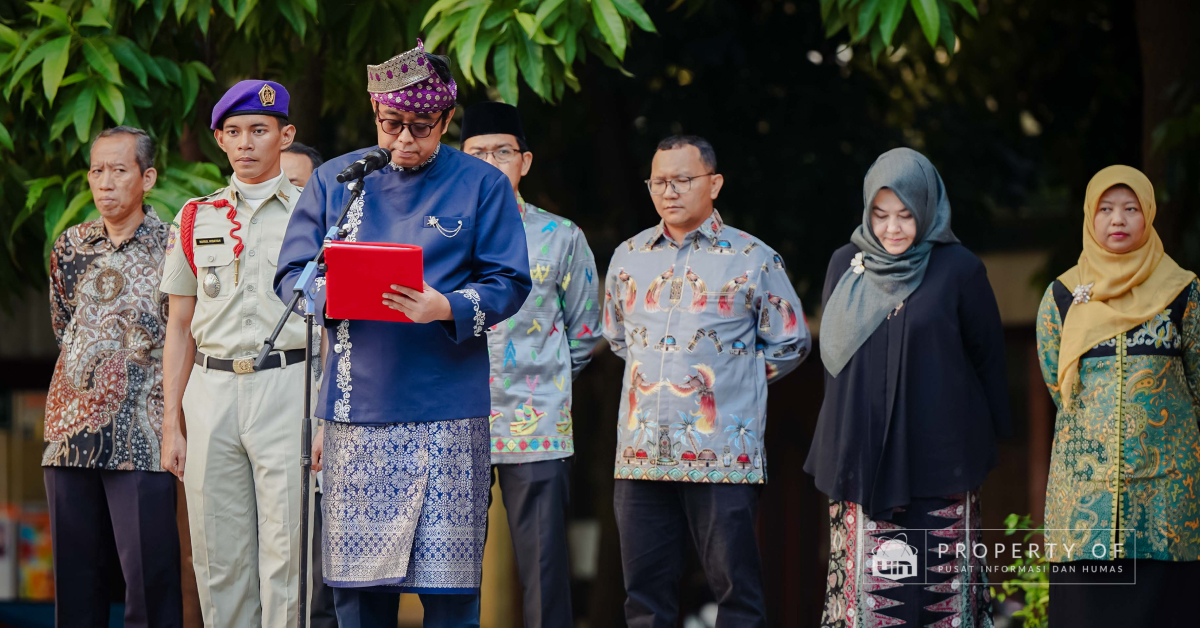
CIPUTAT, UIN Online News – National Education Day (Hardiknas) is commemorated every year in Indonesia on May 2. Ahmad Tholabi Kharlie, a professor and Vice Rector for Academic Affairs at UIN Syarif Hidayatullah Jakarta, views this annual milestone as a critical reflective moment for the nation to evaluate and strategize its human resource development.
The 2026 commemoration centers on the theme "Strengthening Global Participation to Realize Quality Education for All." This theme underscores that education can no longer be viewed as the sole responsibility of the state or formal institutions, rather, it is a collective duty shared by all sectors of society.
Prof. Tholabi noted that this year's theme reflects an urgent need for cross-sector collaboration to address the complex educational challenges of the global era. "Global participation is more than just a normative slogan. It must be translated into policy frameworks that enable active involvement from families, communities, the private sector, and religious organizations," he stated in Jakarta on Friday, May 1, 2026.
According to Tholabi, one of the most pressing issues facing Indonesian education today is shifting the focus from merely expanding access to improving equitable quality. Over the last two decades, access to education has progressed significantly. However, systemic improvements in educational quality remain an unfinished task.
He cautioned that educational quality should not be reduced to cognitive metrics alone. Instead, it must encompass character building, ethics, and adaptability. In this light, the educational philosophy pioneered by Ki Hajar Dewantara, the founding father of Indonesian education, remains profoundly relevant.
"An empowering education is not just about transferring knowledge, it is about shaping a whole human being who possesses critical thinking, empathy, and creativity," said Tholabi, who also serves as a member of the Higher Education Council.
Tholabi identified several major hurdles currently facing national education. First is the rapid pace of technological disruption. While digital learning expands access and fosters innovation, it also creates a new digital divide, particularly in rural areas that lack adequate infrastructure.
Second is the persistent quality gap between regions. Urban schools are generally more prepared to adopt modern changes, whereas schools in underdeveloped regions still struggle with basic issues, such as subpar infrastructure and a shortage of qualified teachers.
Third is maintaining curriculum relevance amid a fast-changing world. Tholabi argued that education should not trap itself in short-term orientations that solely cater to immediate market demands. Instead, institutions must maintain a healthy balance between applied sciences and foundational disciplines.
"If education is geared only toward producing a ready-made workforce, we risk losing our capacity as an innovative nation. True innovation is born from a strong academic foundation, including basic sciences and the humanities," he explained.
In a broader framework, universities hold a strategic position as hubs for knowledge production and intellectual leadership. Tholabi emphasized that campuses must not function merely as extensions of the job market, instead, they must safeguard their academic autonomy.
He encouraged higher education institutions to strengthen integrative research ecosystems that connect academic knowledge with societal needs without compromising independent scholarship.
"Universities must serve as dialectical spaces where tradition meets modernity, and where values intersect with technology. This is where the crucial role of the campus lies, preparing a workforce that is not only competent but also deeply principled," he said.
Looking ahead to the "Golden Indonesia 2045" vision, a national milestone aiming for developed country status by its centenary, human resource development stands as an non-negotiable priority. Tholabi noted that Indonesia’s current demographic bonus, a massive productive-age population, will only become a blessing if managed through a high-quality educational system.
He stressed that funding for education must be viewed as a long-term investment in global competitiveness.
"There are three things that must be prioritized. First, upgrading teacher quality as the primary actors in education. Second, implementing an adaptive curriculum that remains rooted in national values. Third, ensuring equitable and inclusive access to educational technology," he outlined.
Furthermore, he added that Indonesian education must produce a generation that balances intellectual capacity with social and spiritual awareness.
"A Golden Indonesia cannot be built on intelligence alone. It requires individuals with a strong moral compass. Without that, progress can easily lose its direction," he warned.
Ultimately, Tholabi noted that National Education Day should not be reduced to an annual ceremony. It must serve as a launchpad for evaluation and forward-thinking strategies.
In the spirit of collective participation, he urged all elements of society to play an active role in advancing education.
"Education is the work of civilization. It cannot be completed within a single generation, it must be passed down as a timeless commitment across eras," he said.
Despite the challenges ahead, Tholabi remains optimistic, provided that this optimism is backed by concrete actions and consistent policies.
"Our hope is simple yet foundational: that Indonesian education can cultivate free, globally competitive individuals who never lose their cultural identity," he concluded.
(Zaenal/Arifin)