
National Cinema Discussion Warms Up CBX UIN Jakarta: From 'Laut Bercerita' Director to KPI Commissioner Speaking Out



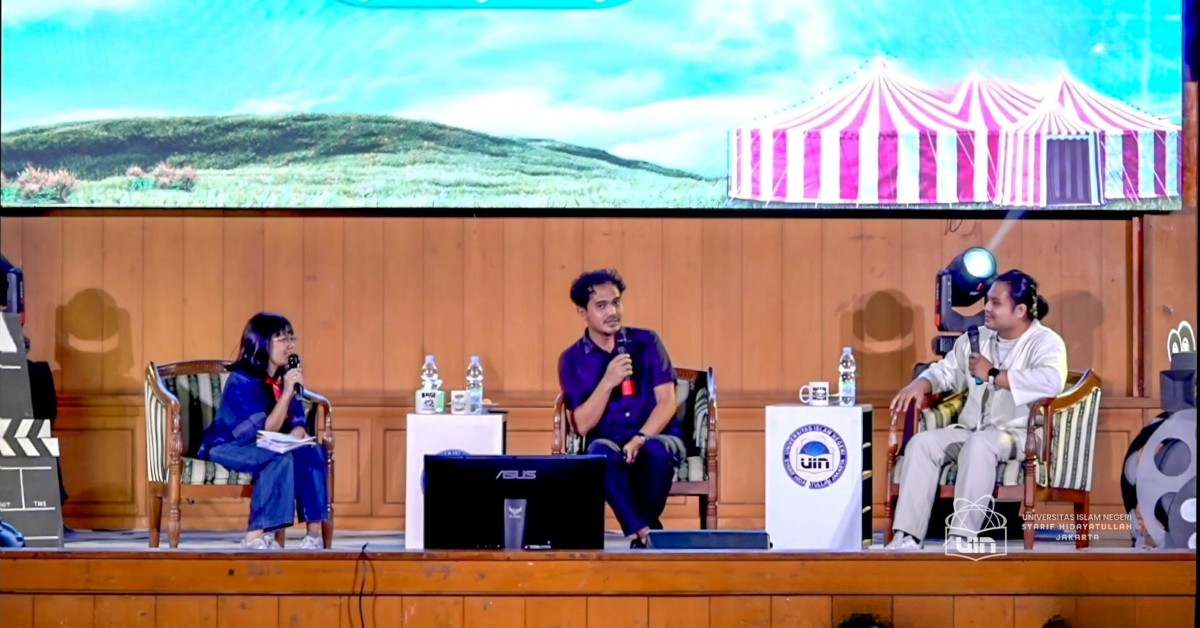
Harun Nasution Auditorium, UIN News Online – DNK TV of the Faculty of Da'wah and Communication Sciences (FDIKOM) at UIN Syarif Hidayatullah Jakarta once again successfully hosted the Campus Broadcasting Expo (CBX) featuring an array of engaging events. Carrying the theme “Endless Loop: Is Indonesian Cinema Still in Its Comfort Zone?” in the form of a creatalk, the session piqued curiosity among thousands of attendees at the Harun Nasution Auditorium, Tuesday (15/09/2026).
CBX 2026 served as a creative arena where student members of DNK TV FDIKOM presented a creatalk, short film scriptwriting competition, short film screenings, a director's talk, and booth explorations across the Expo area (Shootopia). The event was attended by Rector of UIN Jakarta Prof. Asep Saepudin Jahar, M.A., Ph.D.; Dean of FDIKOM Prof. Dr. Gun Gun Heryanto, M.Si.; Commissioner of the Central Indonesian Broadcasting Commission (KPI) Amin Shabana, Ph.D.; Director of The Sea Speaks His Name (Laut Bercerita) Yosep Anggi Noen; Cinematographer Reviewer Petra Hormati; Head of Organizing Committee CBX 2026 Muhammad Rafli Ramadan; along with the academic community of UIN Jakarta.
Rector of UIN Jakarta, Prof. Asep Saepudin Jahar, M.A., Ph.D., delivered opening remarks underscoring the vital role of communication and visual media in resolving various social issues.
“Visual works or films are not merely entertainment, but carry profound philosophical, moral, and spiritual impacts in shaping public perspective. The creation of visual products or films must firmly uphold Pancasila values, alongside Islamic values and spirituality, rather than simply following global trends. Students need to examine and filter issues or content in visual media through a philosophical lens and national values, rather than viewing them solely from a human rights perspective alone. The resulting works should foster a spirit of patriotism, nationalism, unity, and the Unitary State of the Republic of Indonesia (NKRI), especially for educating the younger generation,” he stated.
Dean of FDIKOM, Prof. Dr. Gun Gun Heryanto, M.Si., also offered remarks on the importance of consistency and creativity in advancing the national film industry, particularly within DNK TV UIN Jakarta.
“Film is certainly no ordinary industry. Many interconnected factors come into play—not merely the market, but more importantly, the filmmakers' creativity, overarching grand ideas, teamwork, and of course, audience appreciation as a response that generates momentum for filmmakers to continuously produce their ideas to be enjoyed, appreciated, and critiqued. Film is an integral part of mass communication, just like television,” he explained.
Former volunteer for the 1999 Jakarta International Film Festival (JIFFest) who now serves as Central KPI Commissioner, Amin Shabana, Ph.D., was also present at CBX 2026 to outline the history of the Indonesian film industry's resurgence following the Reform Era. He elaborated on how film festivals acted as catalysts for the birth of film communities across various university campuses.
“Film was once utilized as a government propaganda tool. For approximately 14 years, we experienced a production vacuum and a lack of public appreciation. When Reform broke out in 1998, demands for democratization emerged across media industries, including freedom of expression in the film industry. JIFFest was born in the Reform Era in 1999 to revitalize Indonesian cinema. The festival ran for over a decade and served as a catalyst for the emergence of film activism and campus film communities, including embryos at UIN Jakarta,” he revealed.
Citing Kompas.id, the national film industry recorded significant growth in 2025, capturing approximately 65 to 70 percent of the national cinema market share. Total viewership for domestic films reached 80.2 million across an accumulation of 201 released titles. The horror genre dominated with 90 titles, followed by 66 drama titles, alongside other genres such as comedy, action, and religious themes.
Director of The Sea Speaks His Name (Laut Bercerita), Solo, Solitude (Istirahatlah Kata-Kata, 2016), and The Science of Fictions (2019), as well as Locarno International Film Festival award winner, Yosep Anggi Noen, shared his perspective regarding the heavy dominance of the horror genre in domestic theaters. He noted that this trend reflects producers' strategies to minimize financial risks in film investments.
“Speaking of genres, the film industry is a high-risk industry, even though gains can also be substantial when successful. People minimize risk by producing films that align with current prevailing trends. If statistics indicate horror dominance, producers make horror films to mitigate risk because filmmaking is far from cheap,” he expressed.
Beyond commercial aspects, Yosep also noted that mystical narratives and belief in the supernatural within local thought history are not mere entertainment commodities, but serve distinct social and cultural functions.
“Ghosts are actually political statements that can be utilized to exert control over something, or even act as agents of change,” he added.
On the same occasion, he shared insights from the production process of The Sea Speaks His Name, adapted from Leila S. Chudori's novel. Scheduled to premiere in Indonesian theaters starting October 29, 2026, the film carries a profound message for the younger generation.
“This film is our collective story about youth passion in building consciousness toward a better nation. The key is liberating oneself and daring to spark ideas first. The challenge lies in restoring confidence and persuading others through persuasive ability and strong arguments derived from reading and discussing social issues,” he explained.
Echoing these thoughts, Cinematographer Reviewer Petra Hormati encouraged students to experiment freely without the burden of commercial targets or return on investment. According to him, this sets short filmmaking apart from feature films, which involve substantial business considerations. Furthermore, he advised students to increase social interaction beyond classroom walls as a means of enriching ideas and storytelling.
“The broadest medium for experimentation is in short films. In feature-length films, business considerations are immense, so experimentation is scaled back. Meanwhile in short films, especially for film school students, there are no commercial demands or pressure to break even. That is where filmmakers experiment,” he noted.
In his closing remarks, Petra Hormati reminded UIN Jakarta students of the vital role social interaction plays as a source of creative inspiration.
“My message is to socialize, step out of your homes, and talk with people. From socializing and telling stories, we learn how to narrate. If you wish to convey a story to a broader audience, deliver it through the big screen,” he concluded.