Ministry Secretary-General: Khairu Ummah Must Be Realised through Concrete Action and Collaboration among MABIMS Member States
Jakarta – The concept of Khairu Ummah (the best community) should not be understood merely as a normative discourse or theological slogan. Its noble values must be translated into concrete actions, programmes and policies that deliver positive and measurable benefits to society, particularly across Southeast Asia.
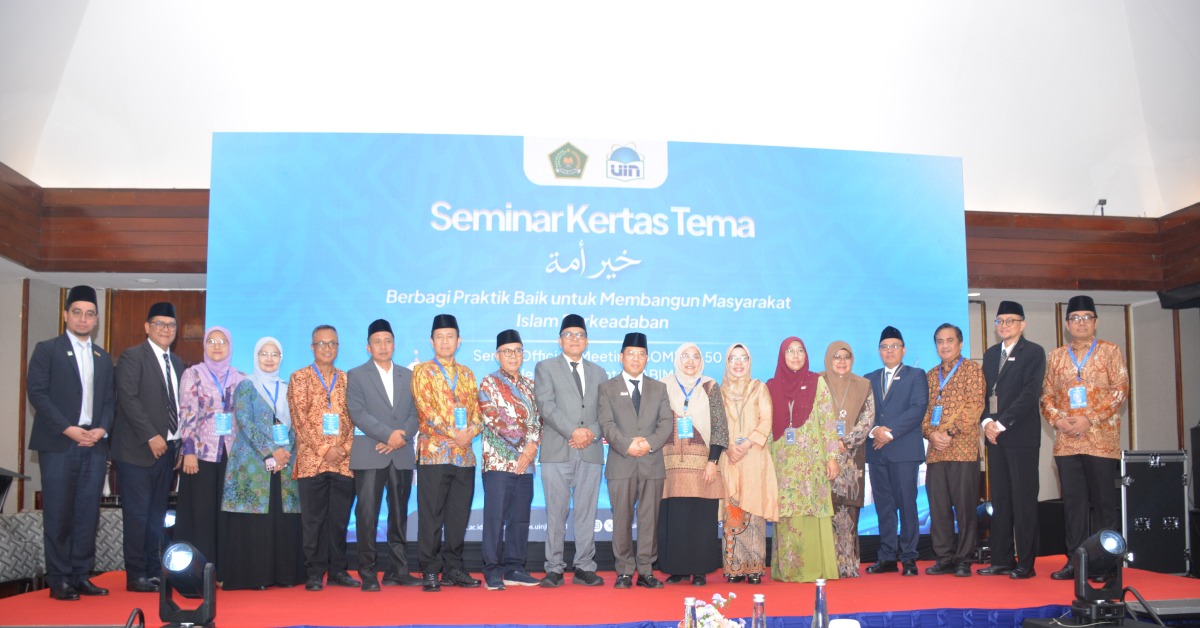
This was emphasised by the Secretary-General of the Indonesian Ministry of Religious Affairs, Prof. Dr. Phil. H. Kamaruddin Amin, M.A., in his address at the Thematic Paper Seminar held as part of the 50th Senior Officials Meeting (SOM) of MABIMS at the Sari Pacific Hotel, Jakarta, on Monday (2 November 2026). Entitled “Khayru Ummah: Berbagi Praktik Baik untuk Membangun Masyarakat Islam Berperadaban” (Khayru Ummah: Sharing Best Practices to Build a Civilised Muslim Society), the seminar formed part of UIN Jakarta’s support for the Ministry of Religious Affairs in advancing regional Islamic cooperation.
Secretary-General Kamaruddin explained that the spirit of Khairu Ummah, as set out in the Qur’an, Surah Ali ‘Imran, verse 110, must be reflected in everyday conduct, public policy and cooperation among MABIMS member states. Religious values such as honesty, integrity, compassion and discipline should be put into practice as solutions to various challenges facing religious life and humanity.
“The concept of Khoiru Ummah (the best community) is no longer relevant if it is merely promoted as normative discourse or a theological slogan. This noble concept must be translated into concrete actions, programmes and policies that deliver positive and measurable impacts at regional level,” he said.
He noted that the challenges facing modern Muslim communities were becoming increasingly complex amid technological disruption, a crisis of values and global socio-economic change. These issues were no longer confined to local contexts but had evolved into cross-border and multidimensional challenges.
According to him, digital disruption, the influence of social media on values, radicalism and socio-economic inequality were shared concerns that individual countries could not address effectively on their own. He therefore underlined the importance of strengthening the tradition of sharing best practices among MABIMS member states through the exchange of experience and knowledge.
“Sharing best practices is therefore a means of developing collective responses. By bringing together research, field data and policy experience, MABIMS member states can build resilient cultural and spiritual safeguards to protect future generations from the negative effects of global disruption,” he explained.
Through this forum, he continued, each country could learn from solutions developed in other local contexts, then adapt and replicate them according to its own characteristics and needs. This would enable MABIMS member states to avoid having to start from scratch when addressing challenges faced by their communities.
At the seminar, Secretary-General Kamaruddin Amin also expressed his appreciation to the delegations from MABIMS member states in attendance. The Brunei Darussalam delegation was led by Yang Mulia Awang Haji Shamshol bin Haji Omar, Permanent Secretary (Policy and Religious Affairs) at the Ministry of Religious Affairs. The Malaysian delegation was led by Yang Berusaha Tuan Muhyidin bin Aziz Saari, Deputy Director-General (Policy) of the Department of Islamic Development Malaysia (JAKIM), while the Singapore delegation was led by Yang Berbahagia Tuan Kadir Maideen, Chief Executive of the Islamic Religious Council of Singapore (MUIS).
The three delegation leaders attended alongside their respective delegation members. Indonesia, as the host country, was represented by officials from the Ministry of Religious Affairs and higher education institutions, including UIN Syarif Hidayatullah Jakarta, which served as the seminar’s academic partner.
Four Countries Present Their Best Practices
One of the seminar’s main sessions was a panel featuring four presenters from MABIMS member states: Brunei Darussalam, Indonesia, Malaysia and Singapore. Held on Monday (2 November 2026), from 9.00 to 11.30 am Western Indonesian Time (WIB), the session was followed by a discussion and question-and-answer session.
Brunei Darussalam was represented by Dr Hajah Siti Juriah @ Hajah Raneya Fatehah Binti Haji Japar of Kolej Universiti Perguruan Ugama Seri Begawan. She presented a paper entitled “Pembinaan Khaira Ummah Berasaskan Pendekatan Maqasid al-Syari‘ah: Peranan Keluarga dalam Membentuk Masyarakat Islam Berkeadaban di Negara Brunei Darussalam” (Building Khaira Ummah through the Maqasid al-Shari‘ah Approach: The Role of the Family in Shaping a Civilised Muslim Society in Brunei Darussalam).
In her presentation, Dr Hajah Siti Juriah emphasised the importance of the family as an institution for nurturing generations who are faithful, knowledgeable, dignified and responsible. The approach draws on the five principles of Maqasid al-Syari‘ah: the preservation of religion, life, intellect, lineage and wealth, as the foundation for building a civilised Muslim society.
Indonesia was represented by the Rector of UIN Syarif Hidayatullah Jakarta, Prof. Asep Saepudin Jahar, M.A., Ph.D., who presented a paper entitled “Pendidikan dan Beragama Maslahat: Praktik Baik Indonesia di Tengah Disrupsi Multidimensi” (Education and Beneficial Religious Practice: Indonesia’s Best Practices amid Multidimensional Disruption).
His presentation highlighted three key components: strengthening education and religious understanding through the Love-Based Curriculum (Kurikulum Berbasis Cinta) and the development of madrasah and pesantren ecosystems; enhancing the competencies of Islamic preachers (dai) and religious teachers (asatizah); and making use of emerging technologies, including artificial intelligence (AI), while remaining guided by ethical and religious values.
Meanwhile, Malaysia was represented by Zuraini binti Yahaya of the Department of Islamic Development Malaysia (JAKIM), who presented a paper entitled “Praktik Baik Harmonisasi Sosioekonomi: Pengalaman Malaysia” (Best Practices in Socio-Economic Harmonisation: The Malaysian Experience). The paper outlined four pillars of Malaysia’s approach to fostering socio-economic harmony within the Muslim community: halal certification as a foundation for economic integrity and trust; zakat as an instrument of distributive justice; waqf and Islamic social finance as sources of sustainable benefit; and the empowerment of asnaf groups and community welfare.
Singapore was represented by Ustaz Abdul Hafiz Latiff, Senior Manager of Religious Policy and Development (Fatwa) at the Islamic Religious Council of Singapore (MUIS). His presentation, entitled “Pendekatan Berpusatkan Manusia (Human-Centric Approach) dalam Mendepani Kecerdasan Buatan (AI): Pengalaman MUIS” (A Human-Centric Approach to Navigating Artificial Intelligence (AI): The MUIS Experience), explored MUIS’s experience in the digital transformation of religious institutions through the use of AI, particularly in supporting fatwa research through the IftaSG platform.
In his presentation, Ustaz Abdul Hafiz Latiff emphasised the importance of a human-centric approach to the use of technology. The adoption of AI, he explained, must be accompanied by efforts to enhance human resource capabilities, strengthen scholarly integrity, and establish sound governance and oversight, ensuring that religious authority remains grounded in human scholarly judgement.
Separately, Rector Asep Jahar observed that the presentations from the four delegations demonstrated how each country had developed distinct yet complementary priorities and experiences in building a civilised Muslim society.
“The potential of young people, education and beneficial religious practice, socio-economic harmonisation, and regional harmony are four strategic priorities that can be brought together through regional cooperation,” he added.
Through this event, Rector Asep Jahar expressed his hope that UIN Jakarta would play an active role in strengthening knowledge diplomacy and cooperation among Islamic higher education institutions across Southeast Asia. The exchange of ideas among presenters and delegates, he said, should extend beyond academic discussion and develop into institutional collaboration, knowledge exchange and joint programmes that deliver tangible benefits to society.
The Thematic Paper Seminar at the 50th SOM MABIMS, entitled “Khoiru Ummah: Berbagi Praktik Baik Membangun Masyarakat Islam Berkeadaban” (Khoiru Ummah: Sharing Best Practices to Build a Civilised Muslim Society), was organised by the Indonesian Ministry of Religious Affairs in collaboration with its Bureau of Legal Affairs and International Cooperation and UIN Syarif Hidayatullah Jakarta as its academic partner. The seminar also marked the beginning of the 50th SOM MABIMS meeting, which took place in Jakarta from 1 to 4 November 2026.
Centre for Information and Public Relations, Institute for Research and Community Service (LP2M), UIN Syarif Hidayatullah Jakarta