Minister of Religious Affairs Urges Integration of Islamic Values and Medicine to Produce Humanistic Doctors
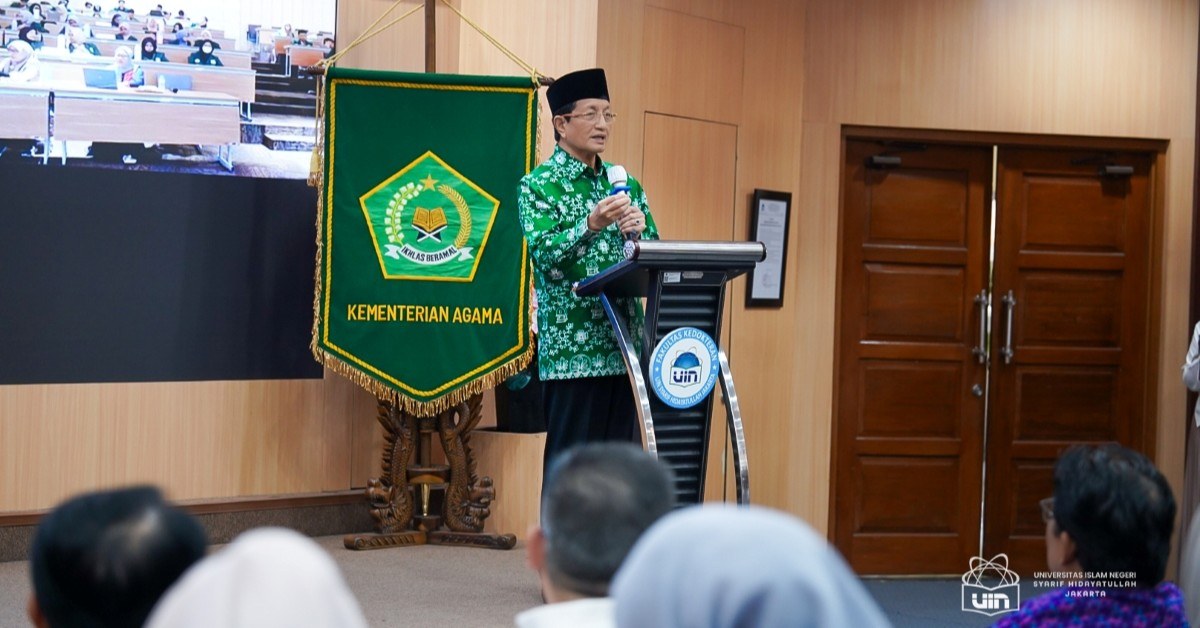
Prof. MK Tadjudin Auditorium, UIN News Online – Minister of Religious Affairs of the Republic of Indonesia, Prof. Dr. KH. Nasaruddin Umar, M.A., encouraged prospective doctors from State Islamic Higher Education Institutions (PTKIN) to focus not only on patient recovery, but also on how to address societal issues through the integration of medical science, Islamic values, and humanity.
This message was delivered by Prof. Nasaruddin during the Inaugural Lecture of the Consortium of Faculties of Medicine at State Islamic Higher Education Institutions (FK PTKIN) for incoming students of the 2026/2027 Academic Year, held hybridly at the Prof. MK Tadjudin Auditorium, Faculty of Medicine, UIN Syarif Hidayatullah Jakarta, Tuesday (1/9/2026).
The event was attended by several State Islamic Higher Education Institutions affiliated with the consortium, as well as Minister of Religious Affairs Prof. Dr. KH. Nasaruddin Umar, M.A., Rector of UIN Jakarta Prof. Asep Saepudin Jahar, M.A., Ph.D., Vice Rector for Academic Affairs Prof. Dr. Ahmad Tholabi, S.Ag., S.H., M.H., M.A., Vice Rector for Student Affairs Prof. Ali Munhanif, M.A., Ph.D., Dean of the Faculty of Medicine Dr. dr. Achmad Zaki, M.Epid., Sp.OT., FICS., along with members of the academic community of UIN Jakarta.
In his address, Prof. Nasaruddin stated that the medical profession carries a responsibility that extends beyond managing individual health conditions; furthermore, he emphasized that doctors must also understand the evolving issues within society and offer a comprehensive approach in executing their service.
“Healing an individual involves one theory. Curing society of its various social ills requires a completely different approach,” he remarked.
He argued that such an approach can be realized through a doctor's ability to integrate Islamic values into their profession. According to him, the Qur'an and Hadith should not be placed separately from medical science, as both can serve as a foundation in building a doctor's humanitarian orientation.
He also stressed the importance of morality and empathy in the relationship between doctors and patients. According to him, emotional closeness with patients can assist doctors in developing attitudes, delivering care, and taking vital actions humanely.
“Treat the patient as if they were your close family. Do not treat them as strangers. That way, good morals will naturally emerge,” he said.
Furthermore, he highlighted the importance for medical students to broaden their perspectives regarding the relationship between divine revelation and science. He explained that for UIN, the Qur'an should not function merely as a confirmation of scientific findings, but should also be positioned as a primary source of information. Science and human reason can uncover various truths, while divine revelation provides legitimacy to those findings. Therefore, students are encouraged not to limit the Qur'an strictly to a confirmatory role.
“So, my students, treat the Qur'an not merely as confirmation, but also as information,” he advised.
By integrating these values, medical education within PTKIN is expected to produce doctors who are not only medically competent, but also capable of building close connections with the community. He noted that a religious approach can serve as one of the key strengths for UIN alumni doctors when communicating with patients.
On that occasion, Prof. Nasaruddin also conveyed the Ministry of Religious Affairs' support for the development of medical fields within Islamic higher education institutions. He stated that funding for such development will be made a priority, provided all applicable requirements are met.
“And regarding funding, our Ministry of Religious Affairs will prioritize it. Provided it meets all required criteria, as long as the conditions are satisfied,” he expressed.
He expressed hope that the advancement of medical education within PTKIN will proceed comprehensively and produce medical personnel capable of harmonizing professional competence with Islamic values and social responsibility.