Maximizing Regional Development Impact: UIN Jakarta Briefs Faculty Supervisors for Multi-Sector Academic Civic Missions
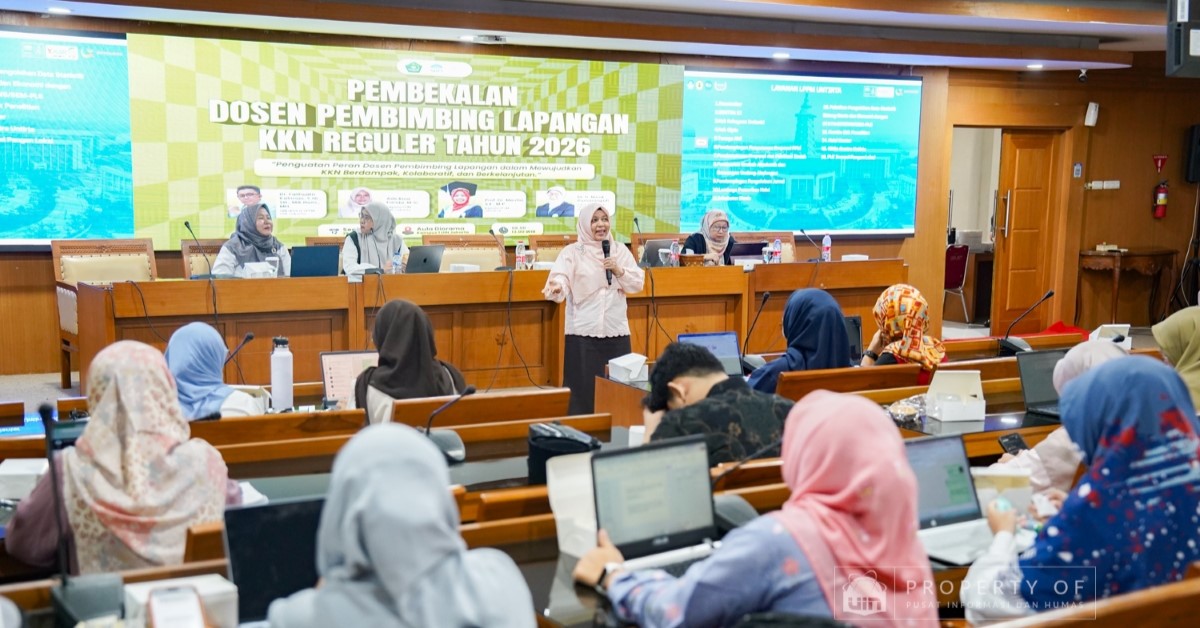
CIPUTAT, UIN Online News – The Center for Civic Engagement (PPM) at UIN Syarif Hidayatullah Jakarta organized an executive orientation camp for Faculty Mission Advisors (DPL) ahead of the 2026 Regular Academic Civic Mission. Carrying the theme "Strengthening the Role of Faculty Advisors in Realizing Impactful, Collaborative, and Sustainable Civic Missions," the high-level briefing was convened at the central Diorama Auditorium on Monday, June 29, 2026.
The program serves as a strategic milestone by PPM UIN Jakarta to scale up the field management capacities of its senior faculty advisors. This framework ensures that the student field deployments transcend standard academic compliance, operating instead as highly structured regional development interventions that deliver tangible, long-term public utility.
The intellectual orientation featured prominent development experts, including the Secretary of LPPM UIN Jakarta, Dr. Fathudin Kalimas; the Head of PPM UIN Jakarta, Ade Rina Farida; community empowerment specialist from FISEMA IPB University, Dr. Ir. Ninuk Purnaningsih; alongside the Head of LP2M at Sultan Ageng Tirtayasa University (UNTIRTA), Prof. Dr. Meutia.
The Head of PPM UIN Jakarta, Ade Rina Farida, asserted that the center maintains an absolute commitment to providing 360-degree administrative and operational backing for all faculty advisors, both through internal capacity building and the facilitation of macro-institutional networks.
"Our operational support goes far beyond basic orientations on student group logistics, program mapping, and undergraduate mentoring methodologies. We are arming our faculty advisors with advanced fieldwork insights so they can troubleshoot field challenges and optimize student innovations directly on the ground," she explained.
Furthermore, Farida revealed that PPM actively bridges the academic mission with strategic regional governments, central ministries, and corporate regulatory bodies to maximize cross-functional collaboration.
"Our office coordinates direct structural partnerships with municipal regencies, the Ministry of Religious Affairs, the Directorate of Zakat and Waqf Empowerment, the Center for Religious Harmony (PKUB), the Ministry of Cooperatives and SMEs, the Financial Services Authority (OJK), and numerous other premier bodies. This ensures that the student civic mission operates on a highly collaborative blueprint that matches the precise socioeconomic needs of the rural populations," she added enthusiastically.
During the technical lectures, IPB University development expert Dr. Ir. Ninuk Purnaningsih emphasized the necessity of applying progressive andragogic methodologies when guiding undergraduate units.
In her analysis, faculty supervisors must master the mission guidelines comprehensively to deliver fluid, data-backed directions. She asserted that the advisor's posture must shift away from rigid, top-down lecturing toward acting as an agile facilitator dedicated to protecting, advising, and serving the students' practical learning cycle.
"The defining metric of success is an institutional spirit of public service. While mastering administrative manuals can be easily learned, the authentic willingness to commit personal time and stand shoulder-to-shoulder with students in remote fields constitutes the primary capital of an excellent academic advisor," she clarified.
Concurrently, the Head of LP2M UNTIRTA, Prof. Dr. Meutia, reminded the forum of the absolute requirement to design civic mission programs that hold strict generational sustainability, ensuring that the developmental impacts do not cease when the student deployment cycle ends.
She explained that each student unit is required to formulate an extensive community needs assessment matrix, an empirical field execution dossier, and a comprehensive follow-up master plan to operate as the baseline data for the next cohort of students.
"By establishing a rigorous follow-up master plan, the incoming wave of civic mission students can seamlessly scale up the local development projects pioneered by their predecessors. This turns the university's public engagement into a continuous, multi-year developmental pipeline that yields permanent, long-term economic and infrastructural benefits for the rural society," Prof. Meutia stated.
Concluding her presentation, Prof. Meutia delivered an inspirational charge to the assembled faculty advisors, urging them to guard their dedication to public empowerment. She noted that high-impact community engagement operates as the ultimate arena for academic blessing, transforming modern university scholarship into an enduring legacy that elevates both the contemporary society and future generations.