
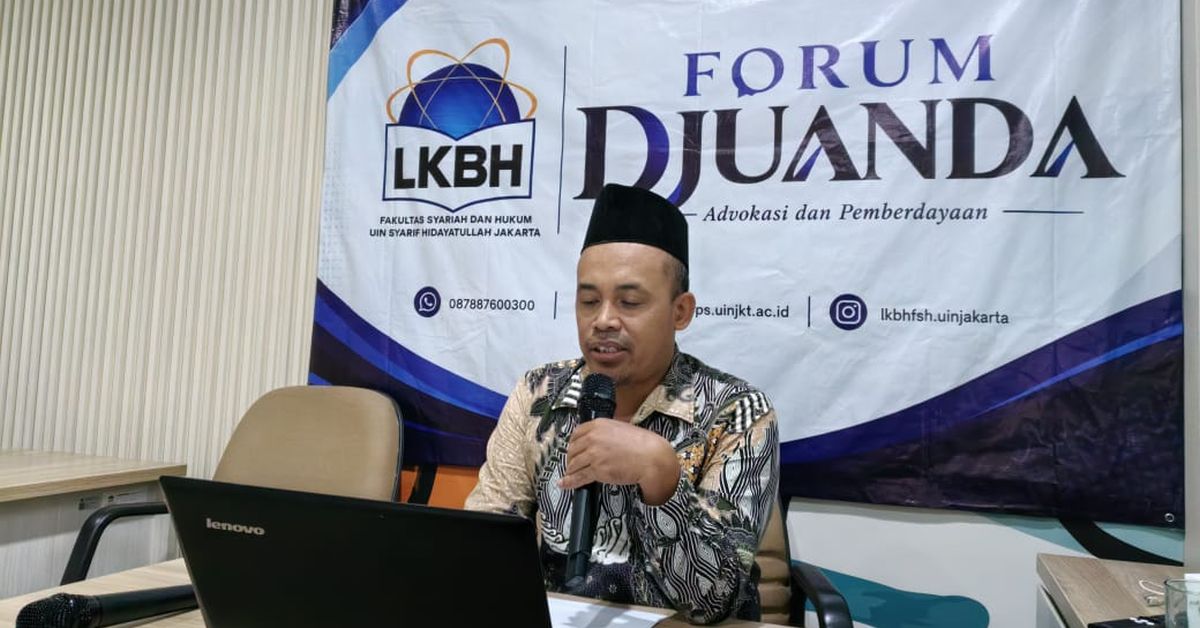
LKBH FSH UIN Jakarta Urges Overhaul of Correctional Facility Governance


Ciputat, UIN News Online – The Legal Consultation and Assistance Institute (LKBH) at the Faculty of Sharia and Law (FSH) UIN Syarif Hidayatullah Jakarta is pushing for systemic reforms in the governance of correctional facilities (lapas) across Indonesia. This recommendation was articulated during a discussion forum titled “Caste System in Correctional Facilities: Fact or Perception? Questioning the New Direction of Corrections Post-Ministerial Separation,” organized as part of the Djuanda Forum at the LKBH Office, 1st Floor of the FSH Building, on Monday (05/10/2026).
Legal practitioner and FSH UIN Jakarta lecturer Abdul Azis, S.HI., M.H., serving as the keynote speaker, noted that separating the Ministry of Immigration and Corrections (Kemenimipas) from the Ministry of Law was expected to overhaul correctional facility governance.
“Theoretically, by the end of 2026, correctional facilities across Indonesia were expected to be fully systemized and integrated, thereby eliminating irregularities across all prisons nationwide,” he explained.
However, two years into the restructuring, these expectations have yet to materialize fully. According to Abdul Azis, tangible improvements should have manifested in institutional bureaucracy and prison management, yet the progress recorded so far remains negligible.
“Two years after separating from the Ministry of Law, the Ministry of Immigration and Corrections has yet to demonstrate significant reform,” he noted.
Addressing these persistent conditions, Abdul Azis urged Kemenimipas to capitalize on the momentum of the ministerial split to comprehensively overhaul the correctional system. Key priority areas include reforming the management of inmates' basic provisions within facilities.
“The Ministry of Immigration and Corrections must reset correctional governance by stopping the circulation of physical money inside prisons, as well as reforming food supply systems and other facility amenities. This step is essential to dismantle flawed practices and enforce strict regulatory compliance,” he asserted.
Furthermore, Abdul Azis emphasized that reforming prison governance is crucial to ensuring that the core objective of corrections remains aligned with its true essence. The correctional framework, he argued, must extend beyond mere rehabilitation during incarceration to effectively prepare inmates for social reintegration and community acceptance.
“We must prevent the core purpose of corrections from becoming compromised due to the emergence of class hierarchies inside prisons,” Abdul Azis cautioned.
Through this forum, LKBH FSH UIN Jakarta continues to cultivate critical legal discourse while formulating constructive insights aimed at shaping national public policy reforms.