
Legal Politics: Research Explores Indonesia’s Unique Legal Recognition of Traditional Islamic Boarding Schools
JAKARTA, UIN Online News – The enactment of Law Number 18 of 2019 concerning Pesantren marks a defining structural milestone in the history of Islamic educational jurisprudence in Indonesia. The regulation is evaluated not merely as a tool providing legal certainty for traditional operations, but as an absolute state recognition toward the indigenous intellectual traditions, institutional autonomy, and centuries-old contributions of Islamic boarding schools in sculpting national character.
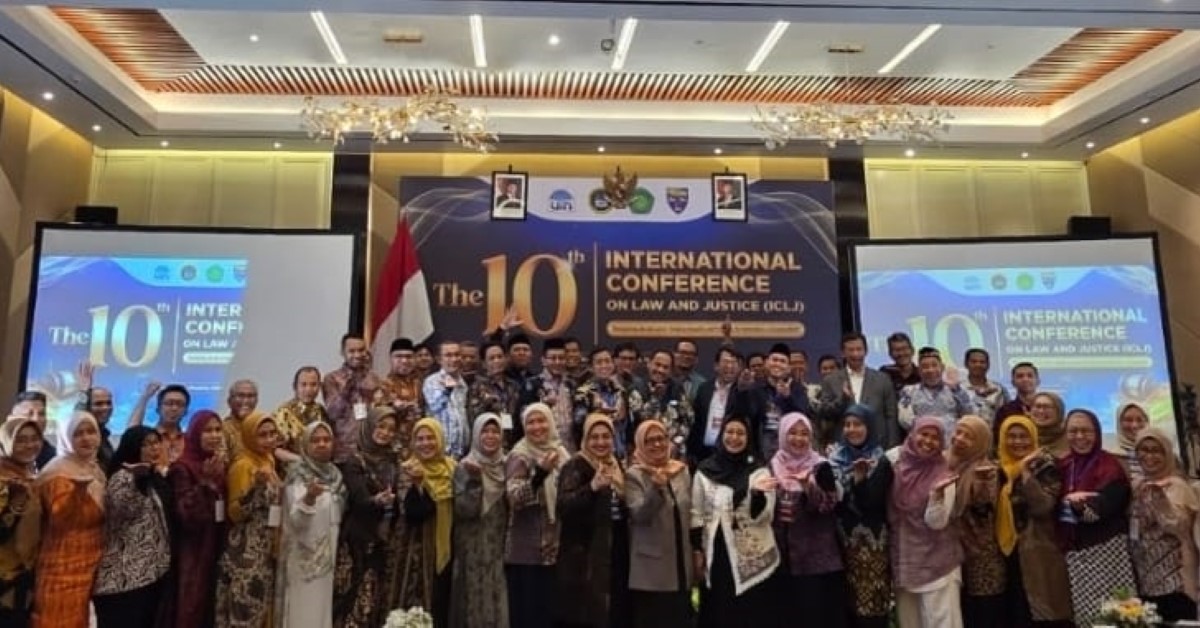
The analysis was presented by senior academic from the Graduate School and Chair of the Islamic Education Department at FITK UIN Jakarta, Dr. Suwendi, M.Ag. He delivered his empirical paper titled "Islamic Education as an Instrument of State Legal Politics in Indonesia: A Case Study of the Pesantren Law and Minister of Religious Affairs Decrees Number 183 and 184 of 2019" during the 10th International Conference on Law and Justice (ICLJ) 2026. Organized by the Faculty of Sharia and Law at UIN Jakarta in strategic collaboration with Universiti Malaya and UIN Maulana Malik Ibrahim Malang, the international summit was convened at the Ijen Suites Resort & Convention in Malang on July 6 to July 8, 2026.
The global conference was officially opened by the Coordinating Minister for Law, Human Rights, Immigration, and Correctional Affairs of the Republic of Indonesia, Prof. Dr. Yusril Ihza Mahendra, alongside top research delegations, university executives, and international legal scholars.
"The Pesantren Law effectively terminates a long historical phase where traditional faith-based boarding schools were only recognized socially by the community, but remained legally marginalized within the national statutory framework. Today, the state formally positions these traditional academies as strategic subjects of national educational development without dismantling their authentic pedagogical identities," Dr. Suwendi asserted during his presentation.
According to Dr. Suwendi's findings, the legislative framework marks a radical paradigm shift in the legal politics of Islamic education in Indonesia. The state has moved away from acting merely as an administrative regulator, transforming into a statutory guardian that provides formal recognition, legal protection, and structural empowerment to an indigenous educational system deeply rooted in civil society.
The state recognition is systematically actualized through concrete macro policies. These include the formal legalization of traditional boarding school degrees through equivalent curriculum tracking (mu'adalah and Formal Diniyah Education), direct state budgetary backing, and institutional capacity expansion funded by the state's multi-trillion rupiah Pesantren Endowment Fund (Dana Abadi Pesantren).
"This fiscal framework bypasses basic state charity. Government financial backing is a direct legal consequence of recognizing the schools' massive historical output in driving public literacy, anchoring public morality, guarding religious harmony, and securing national social cohesion," he clarified.
Crucially, Dr. Suwendi highlighted that the state does not homogenize or dilute the unique scholastic features of these institutions. Traditional pedagogical methods—such as the rigorous auditing of classical medieval texts (kitab kuning) and individualized mentoring structures (sorogan and bandongan) under the academic authority of traditional scholars (kiai)—are fully integrated into the national legal framework.
"Traditional boarding schools remain completely autonomous. The state explicitly avoids forcing a standardized, corporate model onto Islamic education. Instead, statutory law legitimizes this indigenous uniqueness as a rich asset within the national curriculum matrix," he explained.
The healthy equilibrium between state administrative regulation and institutional academic autonomy is clearly demonstrated by the formation of the Majelis Masyayikh (Council of Traditional Boarding School Scholars) acting as the independent quality assurance board. The establishment of this statutory organ proves that the federal government does not monopolize intellectual or religious authority.
The research concludes that the legal politics of Islamic education in Indonesia is moving toward a highly participatory partnership model. While the state manages administrative oversight, fiscal facilitation, and structural integration, the traditional institutions retain absolute academic command over their century-old intellectual lineages. This collaborative blueprint serves as Indonesia's core strength in maintaining robust, values-based education within a highly pluralistic democratic society.